About Acacia hastulata Sm.
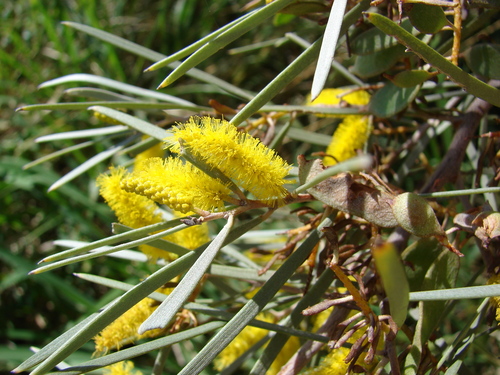
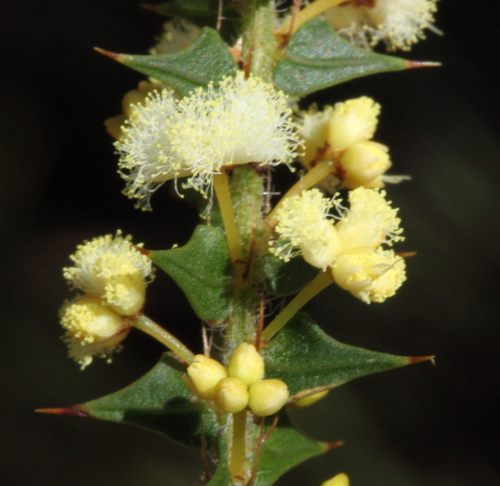
Acacia hastulata Sm. is a slender, spreading, prickly shrub that usually grows with an intricate habit, reaching 0.3 to 2.0 metres (1 to 7 ft) in height. It has long, thin red to orange-brown branchlets that grow straight or arch downward; the branchlets are sparsely to moderately covered with soft long hairs, and bear setaceous to narrowly triangular stipules 2.5 to 4 mm (0.098 to 0.157 in) long. Like most Acacia species, it has phyllodes instead of true leaves. These evergreen phyllodes are crowded and spreading, with a narrow triangular shape that resembles a spearhead, tapering to a sharp point. The pungent, slender phyllodes are 3.5 to 6 mm (0.14 to 0.24 in) long and 2 to 3 mm (0.079 to 0.118 in) wide, and are glabrous, rigid, with a prominent central midrib. This species produces cream-yellow flowers between July and November. Its simple inflorescences grow singly in leaf axils, on glabrous stalks 2 to 4 mm (0.079 to 0.157 in) long. The spherical flower-heads hold three to five creamy yellow flowers. After flowering, it forms red-brown striated seed pods. The subglabrous, curved pods are terete, narrowed at both ends, reaching up to 5.5 cm (2.2 in) in length, with a diameter of 1.5 to 2 mm (0.059 to 0.079 in). The seeds inside are oblong to slightly elliptic, 2.5 to 3.5 mm (0.098 to 0.138 in) long, and have a terminal aril. This species is native to the south coast of Western Australia, growing in the Goldfields-Esperance, Great Southern and South West regions, where it most commonly occurs along watercourses and in swampy areas. Most of its population extends from south of Nannup and the Scott River in the west to around Albany in the east, with a single isolated population located much further east near Esperance. It grows in forests that usually contain Melaleuca or Banksia species, and also occurs within karri forest communities.