About Acacia filicifolia Cheel & M.B.Welch
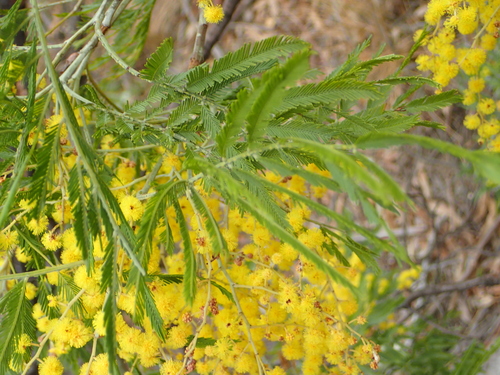
Acacia filicifolia, commonly called fern-leaved wattle, is an erect shrub or tree that reaches a height of 3 to 14 meters (10 to 50 feet). It has smooth grey or dark brown bark that develops fissures as it ages. Its smaller branches are roughly cylindrical, marked with fine longitudinal ridges. Its leaves are compound, with a 7 to 23 millimeter (0.3 to 0.9 inch) long petiole that bears between one and five prominent glands. The leaf rachis is usually 40 to 120 millimeters (2 to 5 inches) long, has irregularly scattered glands, and typically holds five to fourteen pairs of pinnae that are 30 to 80 millimeters (1 to 3 inches) long. Each pinna contains 25 to 100 pairs of pinnules, the smallest divisions of the leaf blade. Each pinnule is narrow oblong to linear in shape, 4 to 10 millimeters (0.2 to 0.4 inches) long, and about 0.5 millimeters (0.02 inches) wide. The inflorescence is a branching panicle, with flowers arranged in spherical heads attached to 2 to 4 millimeter (0.08 to 0.2 inch) long peduncles. Each flower head is 3 to 6 millimeters (0.1 to 0.2 inches) in diameter, and holds fifteen to thirty individual yellow to bright yellow flowers. Flowering occurs between July and October. The resulting fruits are legumes or pods, 35 to 130 millimeters (1 to 5 inches) long and 6 to 17 millimeters (0.2 to 0.7 inches) wide. The pods are roughly flat with straight sides. Fern-leaved wattle grows in forest on sandy soil, most often in gullies and near creeks. Its range extends from south-eastern Queensland to Batemans Bay in southern New South Wales, and it occurs mostly on the coast and adjacent nearby tablelands.