About Acacia excelsa Benth.
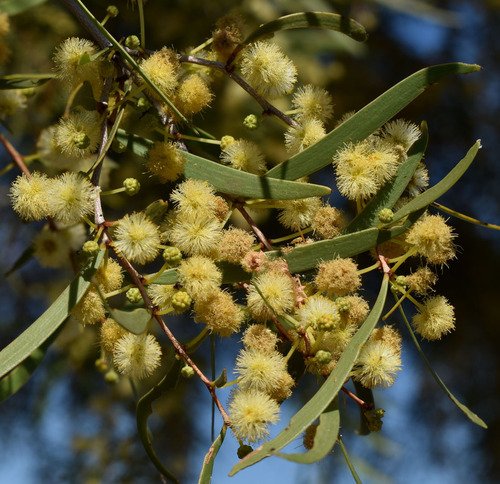
Acacia excelsa Benth. is most often a tree that typically grows to a maximum height of 20 m (66 ft), and sometimes it grows as a shrub reaching 3 m (9.8 ft) in height. It often has a weeping growth habit. The bark is hard, dark grey, and fissured, and its branchlets are glabrous. Its phyllodes are narrowly elliptic, straight to curved downward, and glabrous. Most phyllodes are 40–65 mm (1.6–2.6 in) long and 3–16 mm (0.12–0.63 in) wide, with three to seven subprominent veins on each side. Flowers grow in spherical heads positioned in leaf axils, on peduncles 5–15 mm (0.20–0.59 in) long. Each flower head is 5–8 mm (0.20–0.31 in) in diameter and holds 25 to 35 creamy-white to pale or bright yellow flowers. Flowering occurs from March to June. The seed pods are linear and flat, growing up to 110 mm (4.3 in) long and 6–9 mm (0.24–0.35 in) wide, and break apart into one-seeded segments. The seeds are broadly elliptic, 5–6 mm (0.20–0.24 in) long, dull brown, and lack an aril. This species has a wide but scattered distribution across inland southern Queensland, extending into northern and central New South Wales. In New South Wales, it occurs as far south as Condbolin and as far east as Warialda. It grows in sandy loam soils, as a component of open woodland or savannah grassland plant communities. Subspecies angusta has a wide scattered distribution from south of Mount Isa to the northwest plains of northern New South Wales, mostly along the western edge of the range of subsp. excelsa. Subspecies excelsa occurs mainly south of 20°S in Queensland, extending to the Condobolin area of central New South Wales. Like all Acacia species, the bark of A. excelsa contains appreciable amounts of tannins and is astringent. It can be used for medical purposes: when used internally it treats diarrhoea and dysentery, and when used externally it treats wounds, haemorrhoids, and some eye problems. The stems of these trees produce gum that is also taken internally to treat haemorrhoids and diarrhoea. The wood of A. excelsa is close-grained, very tough, hard, and elastic, making it suitable for cabinet work and instrument fretboards. Indigenous Australian peoples used this wood to make boomerangs and spearthrowers.