About Acacia euthycarpa (J.M.Black) J.M.Black
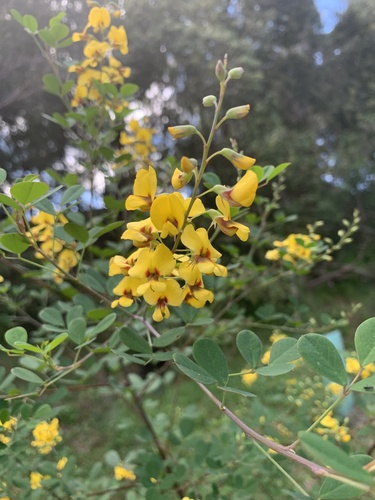
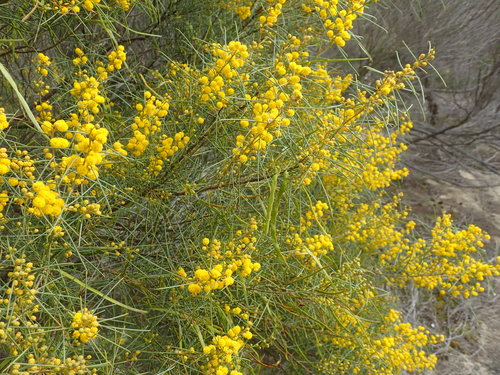
Acacia euthycarpa (J.M.Black) J.M.Black is most often a shrub that typically reaches 2–4 m (6 ft 7 in – 13 ft 1 in) in height, and occasionally grows as a tree up to 10 m (33 ft) tall. Its new shoots and branchlets are glabrous. The phyllodes are linear to lance-shaped, with the narrower end oriented toward the base, and are mostly 20–100 mm (0.79–3.94 in) long and 1–6 mm (0.039–0.236 in) wide. Flowers are arranged in spherical to shortly oblong heads on a 3–10 mm (0.12–0.39 in) long peduncle; each head usually holds 25 to 60 golden yellow flowers. Flowering takes place from August to October. The seed pods are linear, glabrous, and range from leathery to more or less crusty in texture, growing up to around 150 mm (5.9 in) long and 3.5–7 mm (0.14–0.28 in) wide. The seeds are oblong to elliptic, 4–6 mm (0.16–0.24 in) long, dull to slightly shiny dark brown to black, and have a club-shaped aril. This species occurs from Mount Finke, the Gawler Ranges, Eyre Peninsula, Kangaroo Island and the Barossa Ranges to Goolwa in South Australia, extending east into the Murray Mallee of north-western Victoria. Subspecies euthycarpa occurs mostly in scrub or woodland, and is common in the west and central west of Victoria, as well as Eyre Peninsula, southern Mount Lofty Ranges and Murray Lands in South Australia. Subspecies oblanceolata grows in scrub or open woodland, often on rocky sites. It is only known from Wychitella Flora and Fauna Reserve and Yowang Hill in central western Victoria, near Kimba on Eyre Peninsula, and near Murray Bridge; the specimen from near Murray Bridge was collected in 1848 and the subspecies may no longer occur there. Acacia euthycarpa is a food plant for larvae of the Icilius blue butterfly.