About Acacia disparrima M.W.McDonald & Maslin
Scientific name: Acacia disparrima M.W.McDonald & Maslin
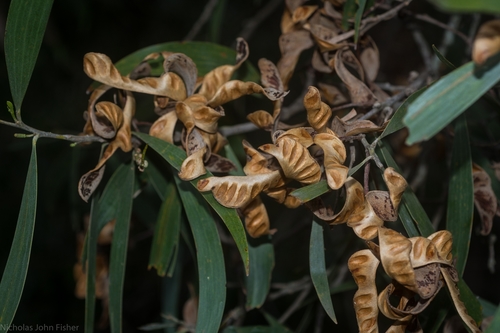
Description: Acacia disparrima grows as a tree-like shrub reaching 3 to 5 m (9.8 to 16.4 ft) in height, or a small tree reaching 3 to 9 m (9.8 to 29.5 ft) tall, and may occasionally grow to 12 m (39 ft). It has slender branchlets that are angled at their tips. Its phyllodes are dimidiate, roughly sickle-shaped, and measure 50–140 mm (2.0–5.5 in) long by 4–30 mm (0.16–1.18 in) wide. The phyllodes bear many parallel longitudinal veins, with 3 to 7 of these veins being more prominent than the others. Pale yellow to lemon yellow flowers are arranged in spikes up to four per axil; each spike is 20–70 mm (0.79–2.76 in) long, and borne on peduncles 3–8 mm (0.12–0.31 in) long. Flowering timing differs between subspecies. The seed pods are narrowly oblong, straight to moderately curved, 25–90 mm (0.98–3.54 in) long and 10–20 mm (0.39–0.79 in) wide, with a crusty texture. The seeds are elliptic to oval, 3–6 mm (0.12–0.24 in) long and 2–3 mm (0.079–0.118 in) wide, glossy black to very dark brown, and have a variable aril.
Distribution and habitat: Common name southern salwood, this species is native to coastal Queensland and northern New South Wales (Australia), with its range extending into adjacent eastern tablelands in northern Queensland. Two recognized subspecies have distinct ranges, habitats and flowering times: - Subspecies calidestris, commonly called dry-land salwood: Restricted to north-east Queensland, occurring from the Mount Carbine-Mount Molloy area south to near Townsville, and in coastal areas north of Cooktown. This subspecies flowers from March to June. - Subspecies disparrima, with common names including salwood, southern salwood, brush ironbark wattle, and hickory: Occurs mainly in coastal, near-coastal, and nearby tableland areas from Mackay (Queensland) south to the Bellinger River (New South Wales). It grows in open forest, woodland, along rainforest edges, and behind coastal sand dunes in wet sclerophyll forest. This subspecies flowers from January to May.