About Acacia cochlearis (Labill.) H.L.Wendl.
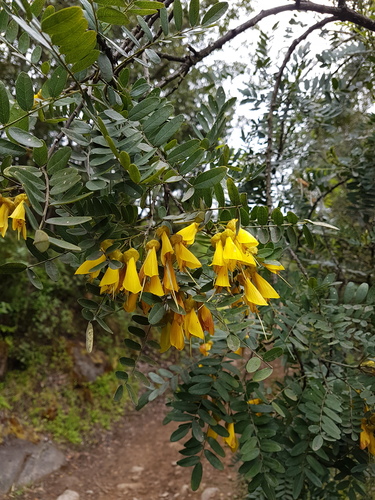
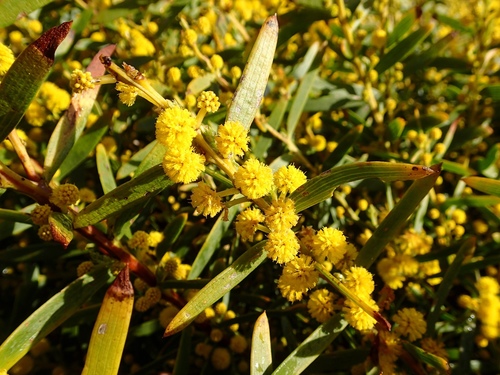
Acacia cochlearis, commonly called rigid wattle, is a bushy, erect, sharply pointed shrub that typically grows 0.5 to 3 meters (1 foot 8 inches to 9 feet 10 inches) tall. It has ribbed branchlets that are either hairless or sparsely covered with straight, soft hairs that lie pressed against the branchlet surface. Its phyllodes are sessile, with shapes ranging from tapering-linear, narrowly elliptic to oblong, and are straight to slightly curved. Most phyllodes are 20 to 50 millimeters (0.79 to 1.97 inches) long and 2 to 10 millimeters (0.079 to 0.394 inches) wide, with sharp tips, and a texture from thinly leathery to almost rigid. Up to three glands form 5 to 20 millimeters (0.20 to 0.79 inches) above the base of each phyllode. Stipules are only present on new, young shoots. The flowers are arranged in up to three spherical heads, held on peduncles 3.5 to 8 millimeters (0.14 to 0.31 inches) long. Each flower head is 4 to 5 millimeters (0.16 to 0.20 inches) in diameter and holds 30 to 50 deep golden yellow flowers. Flowering occurs between July and October. After flowering, it produces pendent, linear, leathery seed pods that are slightly raised over the seeds inside. The pods grow up to 45 millimeters (1.8 inches) long and 3 to 5 millimeters (0.12 to 0.20 inches) wide, and are covered with soft hairs pressed against the surface. Each pod holds 10 to 15 oval seeds, around 3 millimeters (0.12 inches) long. The seeds are dull, mottled black, and have a helmet-shaped aril. Rigid wattle grows in sandy soils in coastal sandplains and sand dunes. It occurs along the coast of south-western Western Australia from Lancelin to Israelite Bay, across the Avon Wheatbelt, Esperance Plains, Geraldton Sandplains, Hampton, Jarrah Forest, Mallee, Swan Coastal Plain, Warren and Yalgoo bioregions. It grows either as solitary plants or in dense thickets. This shrub is sold as a suitable medium-sized shrub for gardens located in coastal regions or areas with sandy soils. It is also used to stabilize dunes and other coastal areas. A. cochlearis establishes quickly and reliably in stabilized soils. While it must be protected from high winds, it is used in mixed plantings alongside other species such as Acacia rostellifera and Scaevola crassifolia. It is considered an indicator of good quality dunes, since the species is vulnerable to disturbance after it becomes established. In horticulture, Acacia cochlearis can be grown from seed. Before planting, seeds should be soaked in hot water or lightly abraded with fine sandpaper. Seeds should be sown in free-draining soil, and can benefit from the addition of disease-free soil taken from existing populations to transfer Rhizobium bacteria that are important for nitrogen fixation. Plants require a position in full sun to grow well.