About Acacia buxifolia A.Cunn.
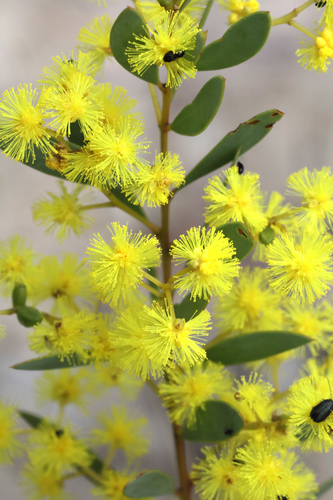
Acacia buxifolia is an erect or spreading shrub that typically grows between 1 and 4 meters (3 feet 3 inches to 13 feet 1 inch) tall, and has glabrous branchlets. Its phyllodes range from narrowly elliptic to oblong or egg-shaped, with the narrower end oriented toward the base. They measure 10 to 45 millimeters (0.39 to 1.77 inches) long and 2 to 11 millimeters (0.079 to 0.433 inches) wide, and are colored green to glaucous. The flowers are arranged into spherical heads, with 2 to 14 heads held in racemes 5 to 80 millimeters (0.20 to 3.15 inches) long that grow from leaf axils. Each inflorescence sits on a peduncle 2 to 5 millimeters (0.079 to 0.197 inches) long, and each spherical head contains 7 to 29 bright yellow flowers. Flowering occurs between July and November. The seed pods are usually firmly papery to thinly leathery, measuring 30 to 70 millimeters (1.2 to 2.8 inches) long and 4.5 to 7 millimeters (0.18 to 0.28 inches) wide. The pods contain oblong to egg-shaped black seeds 4.0 to 4.5 millimeters (0.16 to 0.18 inches) long, with a club-shaped aril. Box-leaf wattle grows in forest, woodland and heath, most often on rocky outcrops. Acacia buxifolia subsp. buxifolia occurs in scattered locations from Stanthorpe in south-eastern Queensland, through eastern New South Wales, to north-eastern Victoria. Acacia buxifolia subsp. pubiflora occurs in scattered locations from near Tambo in Queensland to Tenterfield in northern New South Wales, and is mostly found near Emmaville in New South Wales. In horticulture, Acacia buxifolia is a hardy winter-flowering ornamental plant that attracts birds and insects, but it should not be planted within 2 meters (6 feet 7 inches) of sewer mains.