About Acacia aneura F.Muell. ex Benth.
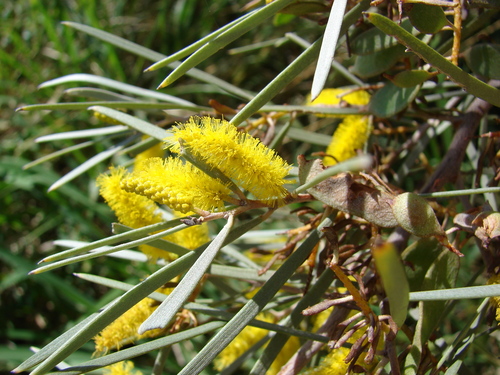
Acacia aneura is a variable shrub or small tree that typically grows 2.5 to 7 metres (8 ft 2 in to 23 ft 0 in) tall, and can sometimes reach up to 10 metres (33 ft). It is often multistemmed with a bushy crown. Its phyllodes are flat, shaped from narrowly linear to narrowly elliptic, 40 to 100 mm (1.6 to 3.9 in) long and mostly 1.5 to 3 mm (0.059 to 0.118 in) wide, and are straight or slightly curved. Flowers grow in cylindrical heads located in the axils of phyllodes, on a hairy peduncle 3 to 10 mm (0.12 to 0.39 in) long. The flower heads are 15 to 25 mm (0.59 to 0.98 in) long and bright yellow. Flowering occurs between March and May, or in August. The seed pod is more or less straight and flat, 20 to 40 mm (0.79 to 1.57 in) long and 7 to 15 mm (0.28 to 0.59 in) wide, with a winged edge. Pods are papery and range from brown to greyish-brown, containing elliptic to oblong or egg-shaped seeds 3.5 to 5 mm (0.14 to 0.20 in) long and 2.5 to 3.0 mm (0.098 to 0.118 in) wide, with a small whitish or cream-coloured aril. Aboriginal peoples of the Coober Pedy area in South Australia refer to mulga trees as Umoona, which means "long life". Mulga is endemic to Australia, and is found in Western Australia, the Northern Territory, South Australia, Queensland and New South Wales. In Western Australia, it grows across a variety of soils and habitats in the Central Ranges, Coolgardie, Gascoyne, Gibson Desert, Great Sandy Desert, Great Victoria Desert, Little Sandy Desert, Murchison, Nullarbor, Pilbara and Tanami bioregions. In the Northern Territory, it occurs in the Burt Plain, Central Ranges, Channel Country, Davenport Murchison Ranges, Finke, Gawler, Gibson Desert, Great Sandy Desert, Great Victoria Desert, Little Sandy Desert, MacDonnell Ranges, Mitchell Grass Downs, Mount Isa Inlier, Murchison, Pilbara, Simpson Strzelecki Dunefields, Stony Plains and Tanami bioregions. In South Australia, mulga occurs in scattered populations in the north-west of the state. In Queensland, it is found in the south-west, but also extends northwards through the Mitchell Grass Downs bioregion and west into the Channel Country. In New South Wales, Acacia aneura is mainly found west from Nyngan and Griffith, and possibly extends as far east as the Hunter Valley. Mulga savanna and mulga codominant tussock grasslands cover roughly 20% of the Australian continent, equal to around 1.5 million square kilometres. The mean annual rainfall across much of Acacia aneura's habitat in Australia is roughly 200 to 250 mm, but reaches as high as 500 mm per year in New South Wales and Queensland. The lowest mean annual rainfall where this species grows is about 50 to 60 mm. Both summer and winter rainfall are necessary to maintain mulga populations, and the species is absent from semiarid regions that experience summer or winter drought. Mulga scrub is distinctive and widespread, with the Mulga Lands of eastern Australia defined as a specific bioregion. Mulga is the dominant species in these woodlands, with poplar box (Eucalyptus populnea) becoming an increasingly important codominant in the eastern districts. The amount of ground cover in mulga woodlands varies with the canopy density of the overstorey, and ground cover becomes almost non-existent in extremely dense stands. In more open stands, the herbaceous layer is made up of wire grasses (Aristida spp.), mulga oats (Monocather sp.), mulga mitchell (Thyridolepis sp.), wanderrie (Eriachne spp.), finger grasses (Digitaria spp.) and love grasses (Eragrostis spp.). Various other woody species are also significant components of mulga woodlands, particularly hop bushes (Dodonaea spp.), Eremophila and cassia (Senna spp.). Unlike the eucalypt woodlands that dominate much of Australia, mulga woodlands are not well adapted to regular fire, and species in mulga communities vary in their ability to survive fires. Many species, including mulga itself, have very limited ability to resprout after fire, and instead rely on seed production for species survival. Many plants in these communities produce hard, woody fruits or seeds, which can not only survive intense heat, but also may require the stimulus of fire to scarify seeds and promote germination. Long-lived seed stores stored in soil are also common in these woodlands.