About Acacia alata R.Br.
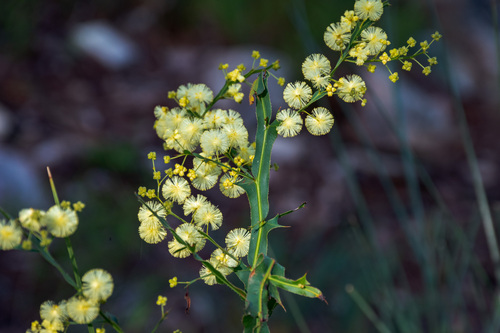
Acacia alata R.Br. is a heavily branched shrub that usually reaches between 0.3 and 2.1 metres (1 foot 0 inch to 6 feet 11 inches) in height, and produces characteristic zig-zag shaped branches. Its phyllodes connect directly to the branches and are arranged along both sides of the branches, measuring 2 to 20 millimetres (0.079 to 0.787 inches) wide. Phyloodes are narrowest in sections of the branch that bear flowers. The free, projecting ends of the phyllodes are 5 to 70 millimetres (0.20 to 2.76 inches) long, and sometimes end in a spiny tip. One to three prominent glands grow on a small triangular spur. One or two spherical flower heads grow from leaf axils on a stalk called a peduncle that is 4 to 12 millimetres (0.16 to 0.47 inches) long. Each flower head holds 4 to 15 individual flowers that range in colour from white to golden. Flowering time differs between varieties of the species. After flowering, the plant produces a flat, curved seed pod that is 20 to 80 millimetres (0.79 to 3.15 inches) long and 5 to 11 millimetres (0.20 to 0.43 inches) wide. The pod has a hard crust-like texture, is covered in dense hairs, and contains oblong to elliptic seeds. The seeds measure 2.5 to 4.5 millimetres (0.098 to 0.177 inches) long and have an aril at one end. This species is native to south-western Western Australia, where it grows in a range of soil types across sites including areas near water, rocky hills, breakaways, salt pans, and clay flats. Its overall range extends between Port Gregory and Albany, across the Avon Wheatbelt, Geraldton Sandplains, Jarrah Forest, Swan Coastal Plain, and Warren bioregions. Acacia alata variety alata has a discontinuous distribution, with populations occurring between Perth, Collie, Cape Naturaliste and Manjimup, and between Denmark and Albany, plus an isolated outlier population near Three Springs; this variety most often grows near creeks in forest and woodland. Variety biglandulosa grows between Port Gregory and Mount Michael, around 35 kilometres (22 miles) south-east of Geraldton, in loam and sand, most commonly in heath habitat. Variety platyptera grows in clay, loam, or gravel in gullies, hills, and flats near Mogumber. Variety tetrantha has a disjunct distribution: it most often grows near watercourses in low open forest and woodland between Eneabba and Cervantes, with a separate isolated population at Yanchep. In horticulture, this plant can tolerate frosts down to −7 °C (19 °F).