About Abudefduf vaigiensis (Quoy & Gaimard, 1825)
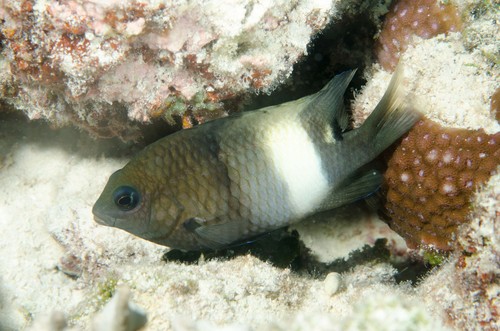
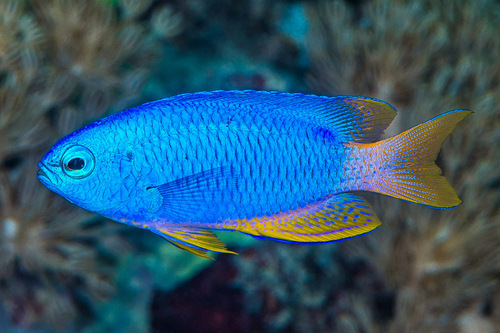
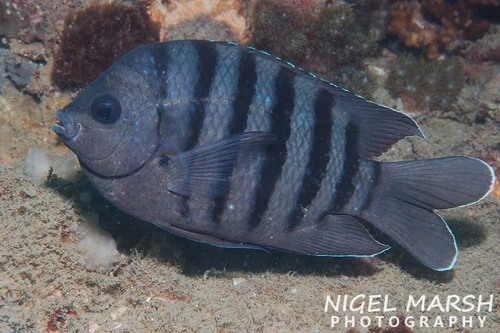
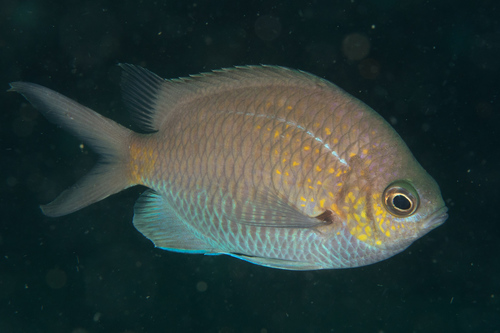
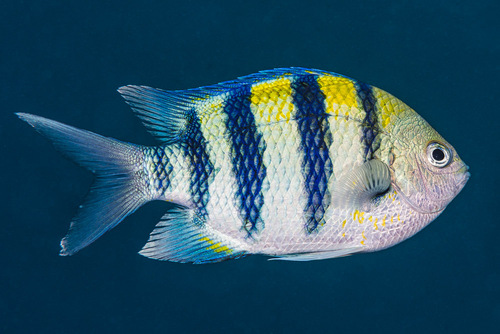
Abudefduf vaigiensis, also called the Indo-Pacific sergeant, has a bluish-white body with a yellow upper portion, a black spot surrounding its dorsal fin, and yellow eyes. Its dorsal fin contains 13 dorsal spines and 11 to 14 soft dorsal rays, while its anal fin has 2 anal spines and 11 to 13 soft anal rays. The maximum recorded total length of this fish is 20 centimetres (7.9 inches), and juveniles reach maturity at 12 centimetres (4.7 inches). Males develop a stronger blue coloration during the spawning season. This species is often confused with Abudefduf saxatilis, a closely related species native to the Atlantic Ocean.
The Indo-Pacific sergeant is native to the Indo-Pacific region, including the Red Sea. In the Indian Ocean, it occurs in the Red Sea, Gulf of Aden, Arabia, Persian Gulf, Arabian Sea, Maldives, eastern Africa, Tanzania, Madagascar, Seychelles, Sri Lanka, Andaman Sea, Indonesia, Malaysia, and Australia. In the Pacific Ocean, it is found in the Gulf of Thailand, Malaysia, Indonesia, Philippines, Taiwan, Japan, Yellow Sea, Great Barrier Reef off Australia, New Zealand, and Pacific islands extending as far as Hawaii. It was likely introduced to the Mediterranean Sea through the Suez Canal, and its distribution there remains unclear due to possible confusion with Abudefduf saxatilis and Abudefduf troschelii.
Adult Indo-Pacific sergeants inhabit coral reefs, tide pools, and rocky reefs, while the larvae of this species live in the open sea. It occurs in tropical and subtropical waters, and is typically found at depths between 1 and 15 metres (3.3 to 49.2 feet).