About Abudefduf troschelii (Gill, 1862)
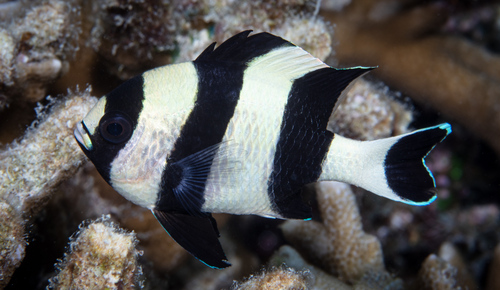
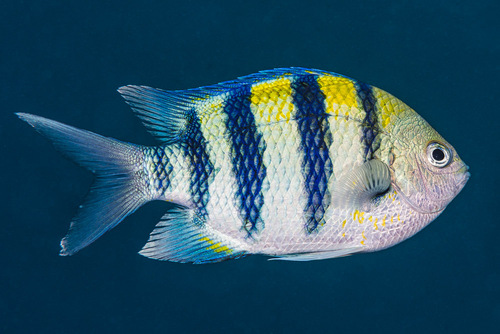
Abudefduf troschelii (Gill, 1862) has distinct physical characteristics that support its lifestyle. Five dark bands run along the sides of its body, with yellow spaces between these bands on the dorsal region. The dark bands extend toward the ventral side, forming black stripes; this striking coloration is one reason the species is popular in aquariums. Its pectoral fins are elongated, slender, and paddle-shaped, enabling fast swimming and quick direction changes around coral reefs, a common body shape for reef-dwelling fish. The pectoral fins have a long, straight hydrodynamic leading edge and a rounded hydrodynamic trailing edge, which lets the fish maneuver easily around rocks and coral. Compared to other damselfish, A. troschelii has relatively large eyes, a long angular head, and a mouth positioned higher on the front of the body. This higher mouth position allows the species to successfully feed on suspended plankton in the oceanic pelagic zone. Abudefduf troschelii is widespread and endemic to the Eastern Pacific, and is commonly found across Colombia, Costa Rica, Ecuador, El Salvador, Guatemala, Honduras, Mexico, Nicaragua, Panama, Peru, and the United States. Within this range, the species is abundant on coralline and sandy bottoms, but can also occur in large aggregations on rocky bottoms and in tide pools. It can also be found feeding on plankton in the pelagic area of the neritic zone, which typically consists of massive corals, deep rocky walls, and shallow exposed reef. Abudefduf troschelii spawns within nine days before or after the new moon. Hatching occurs four days after spawning, and newborns hatch in the hour after sunset. Extended spawning periods can happen during seasonal increases in plankton productivity driven by upwelling, which also increases the species' total egg production. The reproductive process lasts three to four days in the wet season, and can extend to eight days in the dry season, resulting in clear seasonal reproductive patterns that are most distinct during wet seasons. This species' reproductive timing provides two key benefits: hatching at dusk coincides with favorable tides that carry newborns away from reef predators present around the new moon, and the timing also reduces predation risk for unhatched embryos in nests. During the spawning period, males selected by females clear and defend spawning sites on pieces of dead coral and rock, where females later lay their adhesive eggs. The male continues to defend the eggs after laying. A single male mates with one to five females over 1 to 3 days, producing a total of 250,000 eggs, and defends the developing young for 4 to 5 days after spawning. When they hatch, newborns already have well-developed eyes and are capable of controlled directional swimming. Like other damselfishes, A. troschelii larvae spend several weeks in open-water plankton before settling on reefs as juveniles.