About Abronia graminea (Cope, 1864)
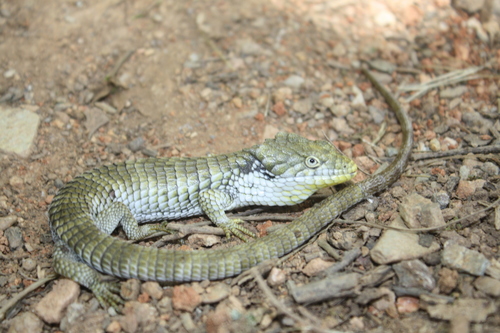
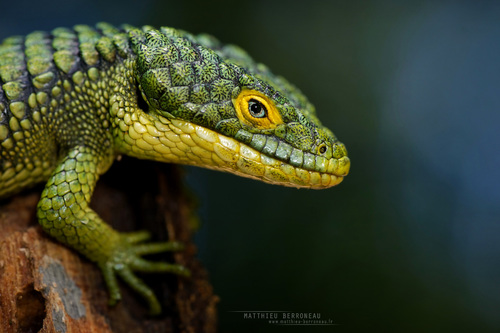
Abronia graminea, commonly called the Mexican alligator lizard, has a dorsoventrally flattened body, a flattened triangular head, and a weak lateral fold. It reaches a maximum snout–vent length of about 10.6 cm (4.2 in), and maximum tail length of 16.0 cm (6.3 in). Two recorded specimens had weights matching their sizes: one with a 9.8 cm (3.9 in) snout–vent length weighed 21.2 g (0.75 oz), and another with a 10.0 cm (3.9 in) snout–vent length weighed 20.7 g (0.73 oz). This species has a prehensile tail that can regrow if lost, plus long strong limbs and digits suited to its arboreal (tree-dwelling) lifestyle. Adult coloration differs noticeably from juvenile coloration. Adult males are usually bright emerald green, while adult females have dorsal coloration ranging from bright to dull orange. Additional color features seen in adult individuals include bright yellow skin around the eyes, blue markings on the supralabial scales, and yellow coloring on the snout, lower jaw, and throat. The basal half of each dorsal scale has varying amounts of dark pigment. Females occasionally keep the dark crossband pattern that is characteristic of juvenile coloration. Juveniles usually have a light tan base body color with 9 irregular black crossbands on the body and 19 on the tail, plus a dirty yellow belly. The typical scale pattern for A. graminea is as follows: 12 longitudinal rows of ventral scales, 25 to 29 transverse dorsal scale rows, 4 to 6 longitudinal nuchal scale rows, 12 to 14 longitudinal dorsal scale rows, 11 supralabial scales, and 2 rows of infralabial scales (5 scales in the first row, 6 scales in the second row). Preauricular scales are granular, dorsal scales are slightly keeled, head plates are often thickened and rough (creating the species' triangular head shape), and dorsal scales are typically larger than ventral scales. The Mexican alligator lizard is widely distributed but endemic to the highlands of Mexico along the Sierra Madre de Oaxaca mountain range. Its total estimated distribution area is approximately 11,500 km², covering the Mexican states of Puebla, Veracruz, and Oaxaca. It inhabits areas at elevations between 1,350 and 2,743 meters above sea level. This species lives in mesic montane forest environments, most commonly in cloud forests or pine-oak forests with humid temperate climates that often see large temperature differences between day and night. As an arboreal species, it lives among epiphytic vegetation, especially bromeliads, but also lichens and orchids. It can be found as high as 40 meters up in forest canopies, and cannot survive in degraded habitats. A. graminea is viviparous, meaning it gives birth to live young. Females usually reach sexual maturity in their third year of life, and can give birth to litters of 1 to 12 offspring. While copulation has not been observed in the wild, mating is thought to occur in summer or fall, with birth taking place in the spring. The gestation period lasts approximately 6 to 8 months.