About Ablennes hians (Valenciennes, 1846)
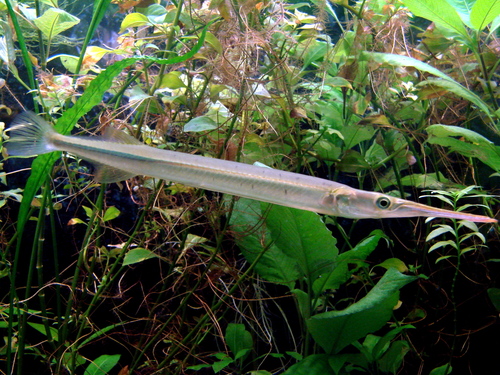
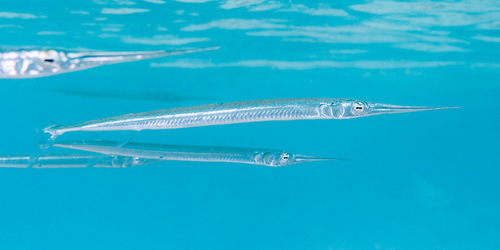
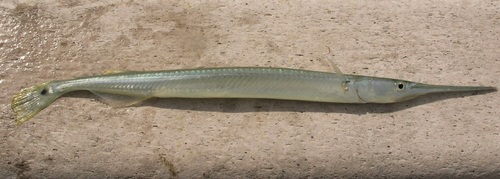
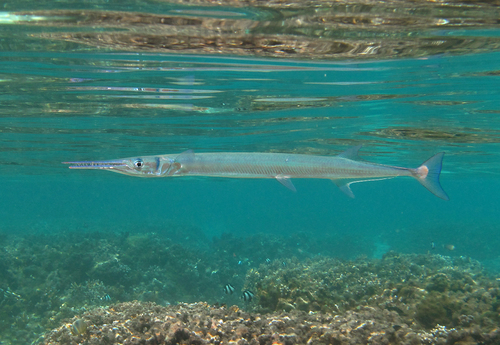
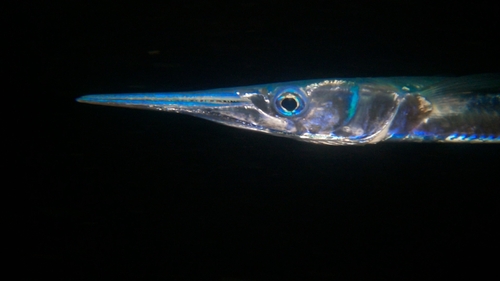
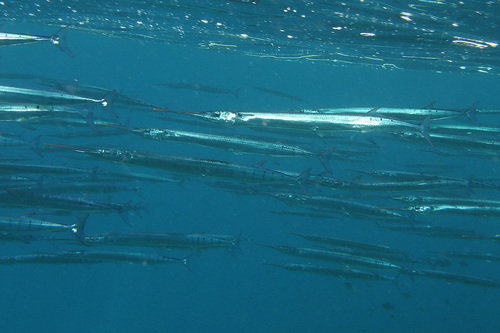
Flat needlefish, scientific name Ablennes hians (Valenciennes, 1846), have no spines, but do have several soft rays. Their dorsal fin has 23 to 26 soft rays, and their anal fin has 24 to 28. They have between 86 and 93 vertebrae. Their dorsal side is blueish, while their ventral side is white. Their bodies have dark blotches, and 12 to 14 vertical bars across their midsections. They have elongated bodies, with scythe-shaped pectoral and anal fins. They also have a dark lobe on the posterior portion of their dorsal fins. The longest recorded flat needlefish reached 140 cm in measured body length; length measurements for this species exclude the caudal fin and head, because the fish’s long jaws are often broken off. The heaviest recorded individual had a weight of 4.8 kg. This species is found worldwide in tropical and temperate seas. In the Eastern Atlantic, its range extends from Cape Verde and Dakar to Moçamedes, Angola. In the western Atlantic, it occurs from Chesapeake Bay south to Brazil. It is found throughout the Indian Ocean, and in the western Pacific its range stretches from the southern islands of Japan to Australia and Tuvalu. A small number of specimens have been collected between Syria and Israel in the Mediterranean Sea, and these are likely migrants that entered from the Red Sea. Flat needlefish typically inhabit neritic ocean waters near islands, estuaries, and coastal rivers, where they feed on smaller fish and will occasionally gather in large schools. They are oviparous; their eggs attach to floating debris via filaments on each egg’s surface. In both sexes, only the left gonad develops, and the right gonad is sometimes completely absent in males.