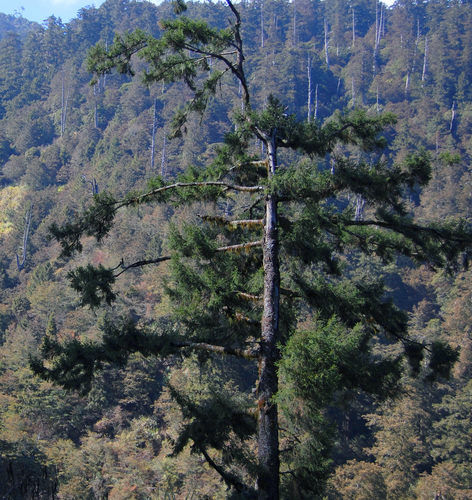
About Abies koreana E.H.Wilson
Abies koreana E.H.Wilson, commonly known as Korean fir, is a small to medium-sized evergreen coniferous tree. It typically reaches 10–18 m (33–59 ft) in height, with a trunk diameter of up to 0.7 m (2 ft 4 in); it grows smaller and sometimes takes a shrubby form at the tree line. Its bark is smooth, grey-brown, and marked with resin blisters. Its leaves are needle-like and flattened, measuring 1–2 centimetres (0.4–0.8 in) long, 2–2.5 millimetres (0.08–0.10 in) wide, and 0.5 mm (0.02 in) thick. The upper surface of the leaves is glossy dark green, while the lower surface has two broad, vividly white bands of stomata, and the leaf tip is slightly notched. Leaves are arranged in a spiral pattern on shoots, but each leaf has a variably twisted base that makes most leaves lie on either side of and above the shoot, with fewer leaves below the shoot. Young shoots are green-grey, and mature to pinkish-grey, with scattered fine pubescence. Cones are 4–7 cm (1.6–2.8 in) long and 1.5–2 cm (0.6–0.8 in) broad, and are dark purple-blue before maturity. The scale bracts are long, green or yellow, and protrude out between the scales of the closed cone. Winged seeds are released when cones disintegrate at maturity, about 5–6 months after pollination. The largest population of wild Korean fir grows on Hallasan Mountain on Jeju Island, South Korea. Korean fir is a very popular ornamental plant for parks and gardens in temperate climates. It is grown both for its foliage and its heavy cone production, which occurs even on young trees that are only 1–2 m (3 ft 3 in – 6 ft 7 in) tall. Four cultivars and the species itself have received the Royal Horticultural Society's Award of Garden Merit: the unmodified species A. koreana, which reaches ≥ 12 m; the cultivar A. koreana "Cis", which reaches 0.5–1 m; the cultivar A. koreana "Kohout's Ice Breaker", which reaches 0.5–1 m; and the cultivar A. koreana "Silberlocke", which reaches 2.5–4 m. Korean fir is also used as a Christmas tree.