About Abies grandis (Douglas ex D.Don) Lindl.
Scientific name: Abies grandis (Douglas ex D.Don) Lindl.
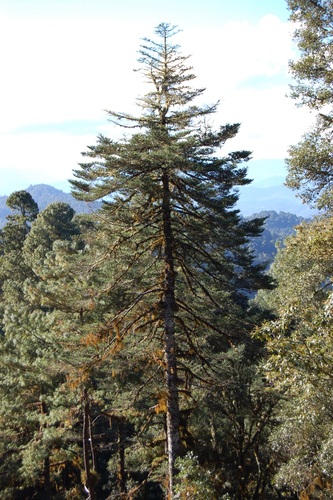
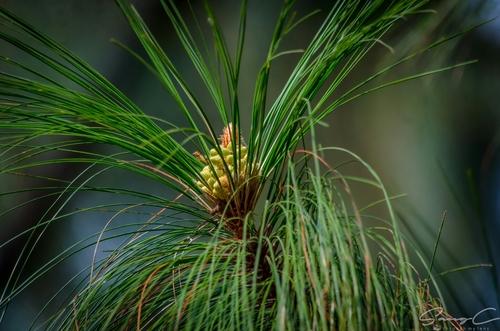
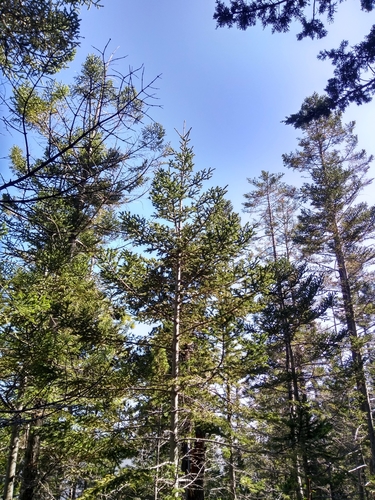
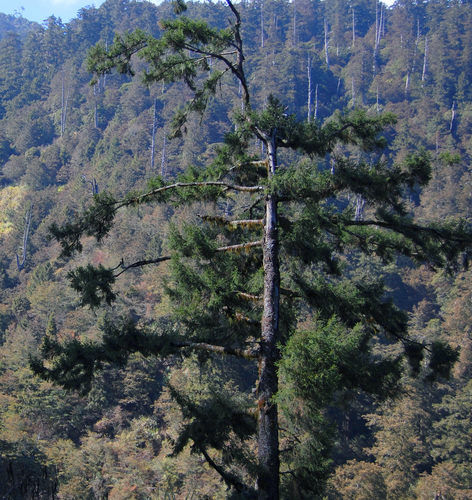
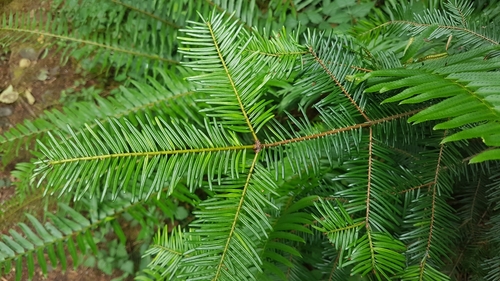
Description: Abies grandis (grand fir) is a large evergreen conifer that grows 40–70 metres (130–230 feet) tall, reaching an exceptional maximum height of 100 m (330 ft), with a trunk diameter of up to 2 m (6+1⁄2 ft). The dead tops of mature trees sometimes fork to produce new growth. The bark is up to 5 centimetres (2 inches) thick, reddish to gray on the outside (purple internally), furrowed, and divided into slender plates. Its leaves are needle-like, flattened, 3–6 cm (1+1⁄8–2+3⁄8 in) long, 2 millimetres (3⁄32 in) wide and 0.5 mm thick. They are glossy dark green on the upper surface, with two green-white bands of stomata on the lower surface, and have a slightly notched tip. Leaves are arranged in a spiral pattern along the shoot, but each leaf has a variably twisted base that places all leaves in two more-or-less flat ranks on opposite sides of the shoot, making the leaves nearly coplanar with two prominent green-white stomatal bands on their lower surface.
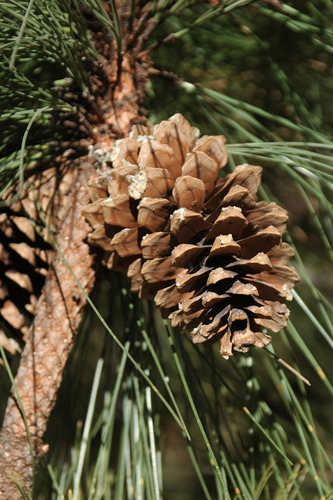
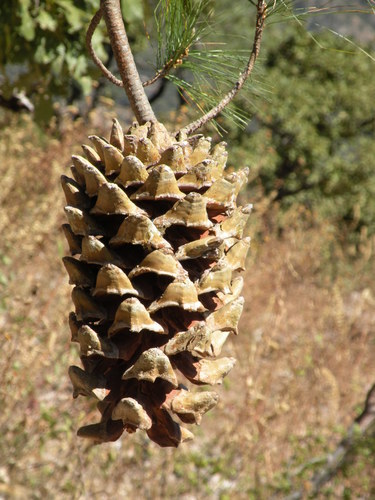
The green-to-reddish cones of Abies grandis are 6–12 cm (2+1⁄4–4+3⁄4 in) long and 3.5–4.5 cm (1+1⁄2–1+3⁄4 in) broad, holding around 100–150 scales. The scale bracts are short and hidden inside closed cones. Winged seeds are released when cones disintegrate at maturity, approximately 6 months after pollination.
Distribution and habitat: The coastal variety of grand fir grows in temperate rainforest habitats along the Pacific coast from southwest British Columbia to Northern California. The inland variety grows in montane conifer forests of eastern Washington, the Idaho Panhandle, and far western Montana. Grand fir occurs at elevations up to 1,700 m (5,600 ft). Its habitats typically receive at least 640 mm (25 in) of annual rainfall, but are too dry or fall outside the range of more shade-tolerant competitors such as western hemlock and western redcedar. Along with closely related white fir, grand fir is more shade tolerant than Douglas-fir.
Ecology: Widespread wildfire suppression allowed grand fir to increase in abundance in areas that were historically dominated by relatively fire-resistant inland Douglas fir, ponderosa pine, and western larch. The absence of frequent small fires lets grand fir and white fir saplings grow into a fuel ladder that enables crown fires. Grand fir has thinner bark than white fir, making it more susceptible to damage from fire and rot. Historically, grand fir specimens could live up to nearly 300 years, but under modern stressful conditions, a typical lifespan is 100 years.
Several species of defoliating insects threaten grand fir: in the late 20th century, western spruce budworm epidemics killed large populations of grand fir in the eastern Cascades and Blue Mountains. Grand fir cannot produce pitch to seal wounds (such as those from logging or small fires), a weakness that allows rot fungi to infect the tree. East of the Cascade crest, grand fir trunks are often infected by Indian paint fungus, which indicates a rotten core. Infected specimens are often waterlogged, so they split apart during freezing weather. Pileated woodpeckers search grand fir and white fir for insect prey and nesting sites. Rotten cores create shelter for many animals, including black bears.
Uses: Grand fir boughs can be used to build a rain shelter for humans. Native Americans used both grand fir and white fir, powdering bark or pitch to treat tuberculosis or skin ailments. The Nlaka'pamux people used grand fir bark to cover lodges and construct canoes, and used the branches as bedding. Some Plateau Indian tribes used the inner bark of grand fir to treat colds and fever. The Okanagan-Colville tribe used the species as a strengthening drug to reduce feelings of weakness. The foliage has a pleasant citrus-like scent. It is sometimes used for Christmas decorations in the United States, including as Christmas trees, though its stiff branches cannot be packed economically for transport. It is also planted as an ornamental tree in large parks.