About Abies fraseri (Pursh) Poir.
Scientific name: Abies fraseri (Pursh) Poir.
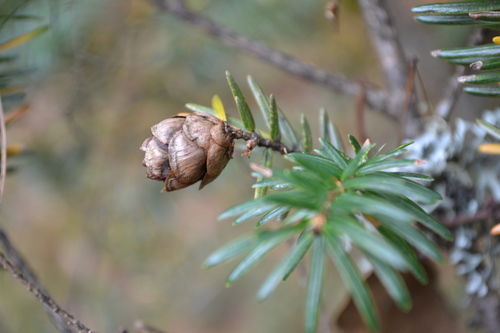
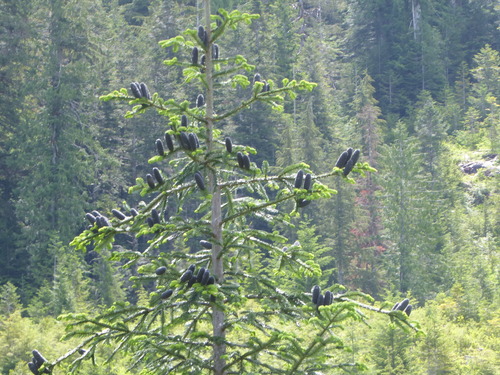
Description Abies fraseri is a small evergreen coniferous tree. It typically grows 10–15 m (30–50 ft) tall, and rarely reaches 25 m (80 ft), with a trunk diameter of 50–75 cm (20–30 in). It has a conical crown with straight branches that grow either horizontally or angled upward up to 40° from the trunk; the crown is dense in young trees and becomes more open as the tree reaches maturity. The bark is thin, smooth, and grayish brown, with numerous resinous blisters on juvenile trees, and becomes fissured and scaly at maturity. Its leaves are needle-like, arranged spirally on twigs, but their bases are somewhat twisted to form two rows that spread to either side of the twig, with some leaves growing above the twig and few or no leaves growing below the twig. The needles are 10–23 mm (0.39–0.91 in) long and 2–2.2 mm (0.079–0.087 in) broad, flat, flexible, with rounded or slightly notched apices (tips). The upper (adaxial) needle surface is dark to glaucous green, often with a small patch of stomata near the tip; the lower (abaxial) surface has two silvery white stomatal bands. The needles have a strong fragrance similar to turpentine. Its cones are erect and cylindrical, measuring 3.5–7 cm (1.4–2.8 in) long (rarely 8 cm / 3.1 in) and 2.5–3 cm (0.98–1.18 in) broad (rarely 4 cm / 1.6 in). They are dark purple when young, turning pale brown when mature, are often resinous, and have long reflexed bract scales in green, yellow, or pale purple. Cones disintegrate when mature at 4–6 months old to release winged seeds.
Distribution and habitat Abies fraseri is restricted to high elevations of the southeastern Appalachian Mountains in southwestern Virginia, western North Carolina, and eastern Tennessee. It occurs from 1,200 m (3,900 ft) up to the summit of the area's highest peak, Mount Mitchell, at 2,037 m (6,683 ft). It grows in acidic, moist, well-drained sandy loam, and is most commonly found mixed with Picea rubens (red spruce). Other tree species it grows alongside include Tsuga caroliniana (Carolina hemlock), Betula alleghaniensis (yellow birch), Betula papyrifera (paper birch), and Acer saccharum (sugar maple). Its native habitat has a cool, moist climate, with short cool summers and cold winters with heavy snowfall, and experiences frequent cloud coverage; frequent cloud coverage paired with cool temperatures maintains high soil moisture and improves the plant's water status.
Reproduction and growth Fraser fir is monoecious, meaning a single tree bears both male and female cones. Cone buds usually open from mid-May to early June. Female cones are produced mostly near the top of the crown and on the distal ends of branches. Male cones are produced below female cones, and are mostly located in the upper half of the crown. Seed production may begin when trees are 15 years old. Seeds germinate well on mineral soil, moss, peat, decaying stumps and logs, and even on sufficiently moist detritus or leaf litter.
Cultivation and uses While Abies fraseri is not an important timber source, its dense natural pyramidal form, strong limbs, soft needles that stay attached well, dark blue-green color, pleasant scent, and good shipping traits have made it widely used as a Christmas tree. It has been chosen as the White House Christmas tree more often than any other tree species. The Fraser fir Christmas tree trade is a multimillion-dollar industry in the southern Appalachians; North Carolina produces the majority of Fraser fir Christmas trees, and requires 7–10 years of field growth to produce a 1.8–2.1 m (6–7 ft) tall tree. In 2005, the North Carolina General Assembly passed legislation designating Fraser fir as the official Christmas tree of North Carolina. Fraser fir is cultivated from seedlings in several northern U.S. states and Quebec, primarily for the Christmas tree trade, and is also grown in Bedgebury National Pinetum and other botanical collections in the United Kingdom.