About Abies concolor (Gordon) Lindl. ex Hildebr.
### Scientific name: *Abies concolor* (Gordon) Lindl. ex Hildebr.
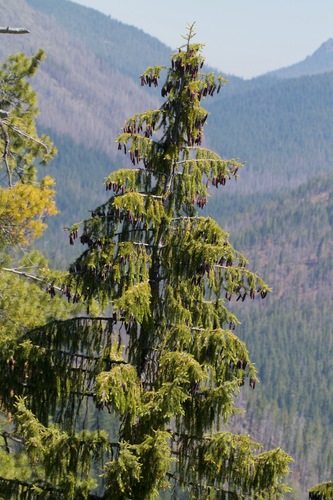
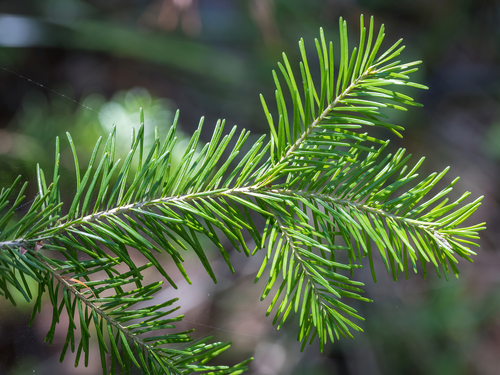
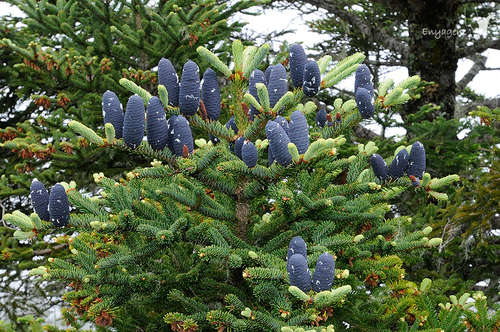
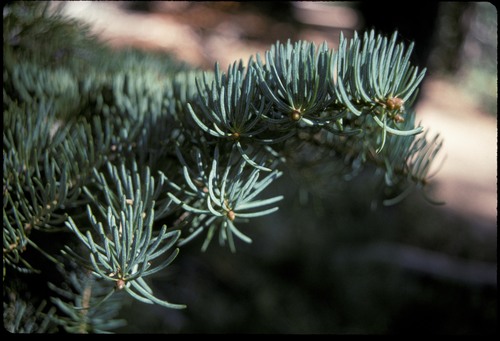
#### Description This large evergreen conifer grows best in California's central Sierra Nevada. A record specimen in Yosemite National Park was measured at 74.9 m (246 ft) tall and 4.6 m (15 ft) diameter at breast height (dbh). Typical mature white fir reach 25–60 m (82–197 ft) tall and up to 2.7 m (8 ft 10 in) dbh. The largest specimens are found in the central Sierra Nevada: a 1972 record from Sierra National Forest documented a specimen 58.5 m (192 ft) tall by 8.5 m (28 ft) in girth, and the tallest recorded specimen (78.8 m / 259 ft) grows on the west slope of the Sierra Nevada. *Abies concolor* subsp. *concolor* (Rocky Mountain white fir) rarely exceeds 38 m (125 ft) tall or 0.9 m (3 ft) dbh. In good soil, large (but not exceptional) specimens measure 40–60 m (130–200 ft) tall and 99–165 cm (39–65 in) dbh in California and southwestern Oregon, and 41 m (135 ft) tall and 124 cm (49 in) dbh in Arizona and New Mexico. Dead tree tops sometimes produce new forked growth. The bark is gray, usually at least 10 cm (4 in) thick, and brown internally. Leaves are needle-like, flattened, 2.5–8 cm (1–3+1⁄8 in) long, 2 mm (3⁄32 in) wide, and 0.5–1 mm (1⁄64–3⁄64 in) thick. They are green to glaucous blue-green on the upper surface, with two glaucous blue-white stomatal bloom bands on the lower surface, and have slightly notched to bluntly pointed tips. Leaf arrangement is spiral along the shoot, but each leaf variably twists at the base so leaves lie either in two more-or-less flat ranks on either side of the shoot, or upswept across the top of the shoot (not below it). Cones are 6–12 cm (2+1⁄4–4+3⁄4 in) long and 4–4.5 cm (1+5⁄8–1+3⁄4 in) broad. They start green or purple and ripen to pale brown, with 100–150 scales; scale bracts are short and hidden in the closed cone. Winged seeds are released when cones disintegrate at maturity, approximately 6 months after pollination. White fir can live over 300 years.
#### Distribution This tree is native to mountain ranges of western North America, ranging from the southern Cascade Range in Oregon, south through California to the Sierra de San Pedro Mártir in northern Baja California, and south across the Colorado Plateau and southern Rocky Mountains in Utah and Colorado, into the isolated mountain ranges of southern Arizona, New Mexico, and northern Mexico. It naturally occurs at elevations between 900 and 3,400 m (3,000 and 11,200 ft) above sea level.
#### Ecology White fir is very closely related to grand fir (*Abies grandis*) and intergrades with it in central Oregon; evidence suggests the entire subspecies *lowiana* has undergone genetic introgression from grand fir. Compared to grand fir, white fir occupies a different niche, including drier, higher elevation sites; it is more drought tolerant and has thicker, fire-resistant bark. In Mexico, it is replaced by its close relatives Durango fir (*A. durangensis*) and Mexican fir (*A. mexicana*). Like grand fir, white fir is more shade tolerant than Douglas fir, but less shade tolerant than western hemlock and western redcedar. It is a climax species, meaning it dominates mature forests that have reached the final stage of succession in western U.S. coniferous forests. White fir has coexisted with yellow pine (ponderosa pine/Jeffrey pine) for millennia in old-growth forests across its range. Over the past two centuries, young white fir have become highly abundant following logging of large-diameter trees and fire suppression that stops cleansing wildfires. Historically, the lumber industry considered white fir a pest species, but this view has changed. The Western Wood Products Association now lists white fir as one of the most important commercial softwoods. White fir retains lower limbs, which provides escape routes for medium-to-small forest birds (such as the spotted owl) from larger flying predators, and creates a drip zone around roots to collect moisture. However, retained lower limbs also act as fuel ladders that allow fire to climb to the tree canopy. In areas with higher risk of human-caused wildfire, limbing up lower branches (rather than removing medium and large diameter white fir) helps prevent canopy fire in other trees, particularly giant sequoia. Recent management concern for protecting sequoia groves has led land management agencies to call for white fir removal in the Sierra Nevada. While sequoia seedlings and young saplings are highly susceptible to death or severe injury from fire, mature sequoias are fire-adapted, with traits including fire-resistant bark, elevated canopies, self-pruning lower branches, latent buds, and serotinous cones. The giant sequoia ecosystem is incomplete without the mixed pine/fir and oak that make up its mid and understory, and giant sequoia cones release seeds when triggered to open by fire heat, while thick bark protects the inner cambium from fire damage. White fir is a host to two species of parasitic plants: fir mistletoe (*Phoradendron pauciflorum*) and fir dwarf mistletoe (*Arceuthobium abietinum*). It is also attacked by many insect species, such as the fir engraver beetle (*Scolytus ventralis*).
#### Uses Native Americans used white fir and grand fir for medicinal purposes: powdered bark or pitch was used to treat tuberculosis and skin ailments. The Nlaka'pamux people used bark to cover lodges and construct canoes, and used branches for bedding. White fir is a preferred construction wood for its nail-holding ability, light weight, and resistance to splitting, twisting, and pitch accumulation. It is straight-grained, non-resinous, fine-textured, stiff, and strong. It is also popular as a Christmas tree and for Christmas decoration, due to its soft needles, generally excellent needle retention, and abundant availability; it is often marketed as concolor or white fir.
#### Cultivation White fir is widely planted as an ornamental tree in parks and larger gardens, particularly cultivars of subsp. *concolor* selected for very bright glaucous blue foliage, such as cv. 'Violacea'. The dwarf cultivar 'Compacta', which grows to a maximum height and spread of 2.5 m (8.2 ft), has been awarded the Royal Horticultural Society's Award of Garden Merit.