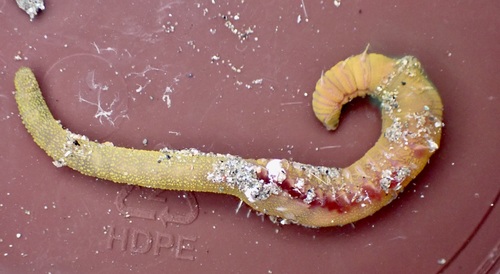
About Abarenicola pacifica Healy & Wells, 1959
Abarenicola pacifica Healy & Wells, 1959 is a large worm that grows up to fifteen centimetres long. It has an elongated, segmented body that tapers at both ends. Its head lacks appendages, palps, and eyes, but does have a prostomium and an evertable oesophagus. The worm’s body is split into three regions that sometimes differ in color. Its segments are wider than they are long, and most bear setae on parapodia. It has between four and seven pairs of oesophageal caeca, with the anterior caecum larger than the others. Some capillary setae are present, and segments in the middle region bear up to thirteen trunk-like sets of gills, which are red because hemoglobin circulates in the worm’s blood. The neuropodia of these middle segments are short and widely separated ventrally. No setae are present on segments of the posterior region.
A. pacifica occurs in intertidal and subtidal zones along the coasts of North America between Alaska and northern California, and also in Japanese waters. It lives beneath the surface of sand flats, muddy shores, and estuaries. It can tolerate salinities as low as 23% of normal seawater for short periods, while a more sustainable level is 50% of normal seawater salinity.
The Schmitt pea crab, Pinnixa schmitti, is a commensal of A. pacifica and often shares the worm’s burrow. The crab gains a protective environment from this arrangement, but it is not known if the worm benefits. A. pacifica may aid the recovery of beaches impacted by oil pollution: the worm moves sediment from lower depths to the surface, where aerobic microbes can break down pollutant hydrocarbons. It is considered a useful indicator species for monitoring ecological conditions after an oil spill, and is the second most useful organism after the Baltic clam Macoma balthica. This usefulness comes from the lugworm’s abundance and widespread distribution near oil facilities. The burrowing activity of A. pacifica may also release methylmercury and other heavy metals from underlying sediments into the overlying water. When A. pacifica is present, the breeding success of clams in the genera Macoma and Mya is reduced. Sediment disturbance caused by the worm is also linked to reduced abundance of the polychaete Pygospio elegans and the crustacean Cumella vulgaris, both of which are predators of juvenile lugworms. Adult and young A. pacifica are preyed on by the rock sandpiper Calidris ptilocnemis, shrimp of the genus Crangon, and the isopod Saduria entomon.


