About Abantiades latipennis Tindale, 1932
Abantiades latipennis, described by Tindale in 1932, has variable larval morphology that can be split into small and large size groups. Small larvae are generally 12 millimetres (0.47 inches) long, overall milky grey, with a light brown head capsule around 3 mm (0.12 in) wide. Large larvae reach 60 to 90 mm (2.4 to 3.5 in) long, and may be milky grey or dark green-brown, with a 6 to 9 mm (0.24 to 0.35 in) wide brown head capsule.
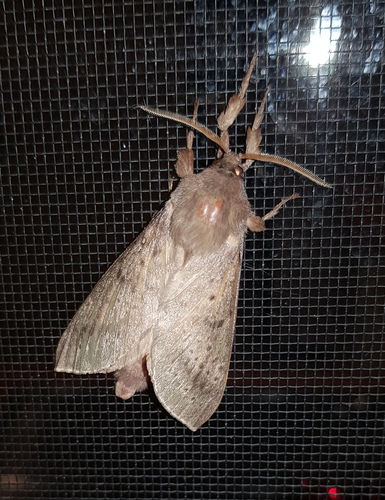
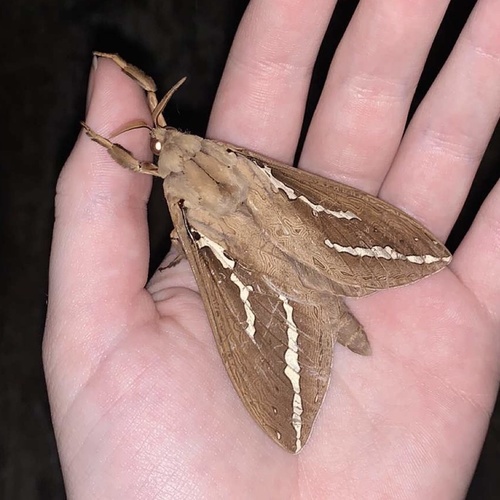
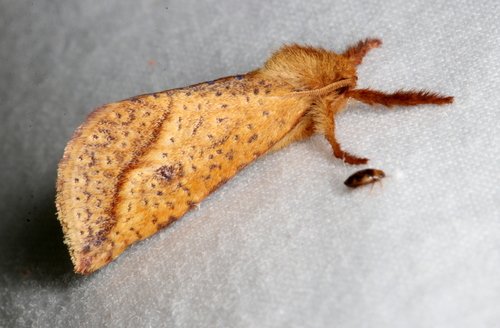
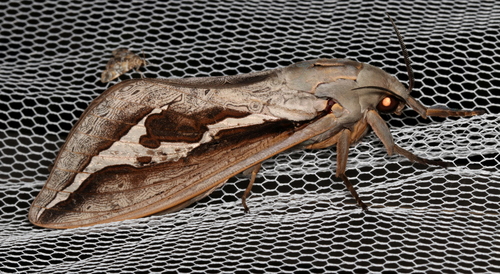
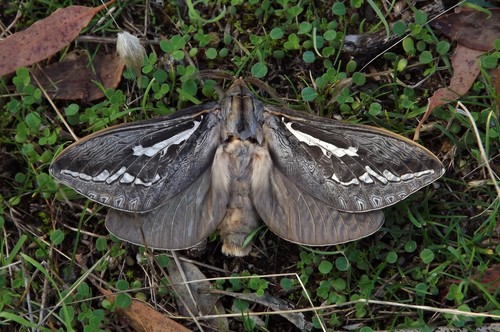
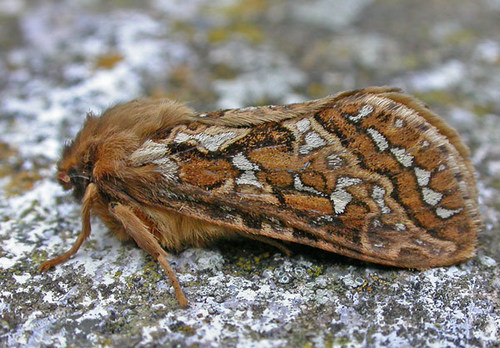
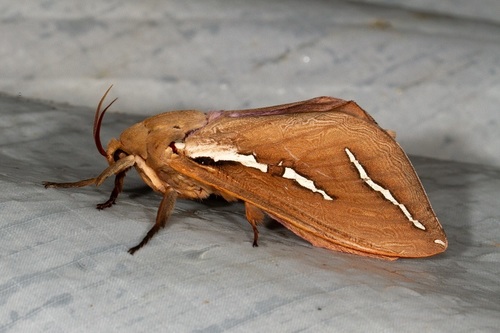
Adult females are larger than adult males. Males have an approximate wingspan of 80 mm (3.1 in); a 1979 collected female had a 108 mm (4.3 in) wingspan, while Tindale recorded female wingspans of 150 mm (5.9 in) in 1932. Both sexes have silvery-white bars on their forewings, but the bars on male wings are more prominent and have dark margins. Per Tindale's original notes, females are usually darker brown than the pale brown males, though one grey-brown female was collected in 1979.
As a member of the Hepialidae family, this species shares common family traits: it has short, pectinate antennae, and unusually for Lepidoptera, it lacks a functional proboscis or retinaculum, so adult moths do not feed. A. latipennis also has several other phylogenetically primitive morphological features. There is a distinct gap between the forewings and hindwings, and the wings are covered in scale-like hairs. A small lobe called a jugum at the base of the forewing joins the fore- and hindwings during flight. Female genitalia have an exoporian configuration, defined by an external groove that moves spermatophores from the copulatory opening (ostium bursae) to the ovipore for fertilization after mating.
A. latipennis is endemic to the Australasian region, and specifically inhabits New South Wales, Tasmania, Victoria, and the Australian Capital Territory in Australia. Like other species in the Abantiades genus, it lives in both primary and secondary temperate rainforest. During its larval stage, it feeds on tree roots, and its population growth is thought to have an economic impact on the timber industry.
Female moths scatter eggs while flying, and can release up to 10,000 eggs at a time. Larvae hatch from eggs in leaf litter on the forest floor, then tunnel into the ground to find suitable host roots. Neither the number of larval instars nor the total length of the larval stage is confirmed, though field observations suggest the larval stage lasts more than eighteen months.
Phytophagous A. latipennis larvae feed primarily on the root systems of two eucalypt tree species: Eucalyptus obliqua (messmate stringybark) and Eucalyptus regnans (mountain ash). Both tree species are present in old-growth forests and are dominant in regrowth forests, which supports the moth's success in its habitat. Caterpillars are subterranean, forming simple vertical silk-lined tunnels, and remain underground before and through pupation, only emerging to undergo metamorphosis. Tunnel entrances are 6 to 10 millimetres in diameter, covered with silk webbing and leaf litter. Tunnels can reach up to 60 centimetres (2 ft) deep, but most are 12 to 35 cm deep. Caterpillars chew a tree's tap and lateral roots, and feed on cambium growth that the tree produces at the injury site. Larvae may completely girdle a root, killing it, or create only partial lesions that leave the root functional but deformed.
The subterranean larval habitat generally protects larvae from predators, but larvae are sometimes parasitized by tachina flies. The parasitoid larvae of Rutilotrixa diversa, a tachinid that usually uses scarab beetles as hosts, have been found infecting A. latipennis.
Adult A. latipennis are crepuscular. Males are strongly attracted to lights, and form leks at dusk, most noticeably after rains in autumn and late summer. Females use pheromones to attract males for mating. As a primitive species, adult moths lack functional mouthparts so they cannot feed. Their adult winged lifespan is short, lasting approximately one week if they are not preyed on earlier. Common predators of adult moths include bats, owls, and possums; many other animals from spiders to cats also occasionally eat adults, contributing to their short lifespan.
In a study of clearfelling's impact on biodiversity in Tasmania's Weld Valley, researchers found that A. latipennis is one of the few species that thrives in regrowth forests that grew after clearfelling. An earlier study of the relationship between the moth and the two eucalypt species, conducted in other regions of southern Tasmania, reached the same conclusion. The larvae's tunnelling and feeding habit on these two eucalypts, which are the typical regrowth that grows in logged areas, is the main reason for the moth's abundance in clearfelled forests. This success may also be partially due to the caterpillar's lack of dependence on decaying vegetation, a shared characteristic of the Abantiades genus that differs from other Tasmanian genera such as Eudonia and Barea, which do not thrive in clearfelled forest.
The crowns of eucalypts infested with A. latipennis do not show consistent signs of root disturbance, and most studied trees appear healthy and are average size for secondary forest. E. regnans and E. obliqua grow slowly in regrowth stands, but this slow growth has been linked to strong root and crown competition between trees. Some trees showed chlorosis (yellowing of plant tissue caused by reduced chlorophyll), but this is not a reliable indicator of root infestation, and may be caused by other factors.
Long-standing clearfelling practices in Tasmania could create more favorable conditions for this species, and its population growth could lead to widespread eucalypt damage and pest issues, though the potential severity of this threat is still undetermined. Lesions on roots left by larval feeding create ideal sites for root rot-causing fungi to establish after larvae leave the root system to pupate. Armillaria sp. fungi were found growing in these old feeding lesion sites. In rarer cases, the pathogen Perenniporia medulla-panis was also found attacking roots at the damaged locations. Other cases of root decay and discoloration were observed, but were attributed to unidentified microorganisms.