About Abalistes stellatus (Anonymous, 1798)
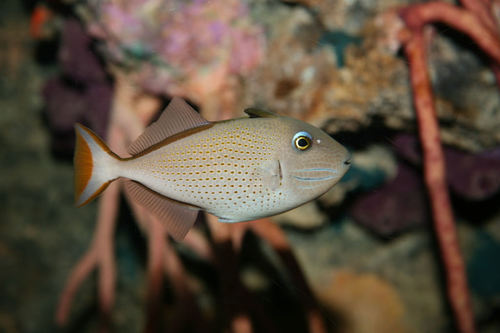
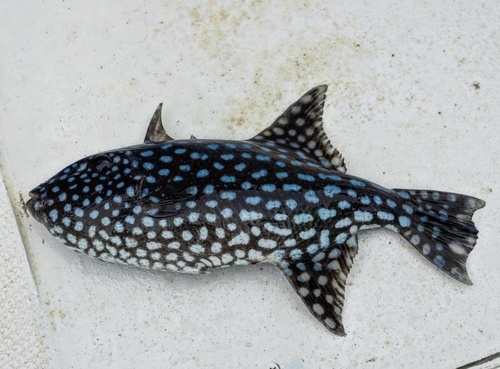
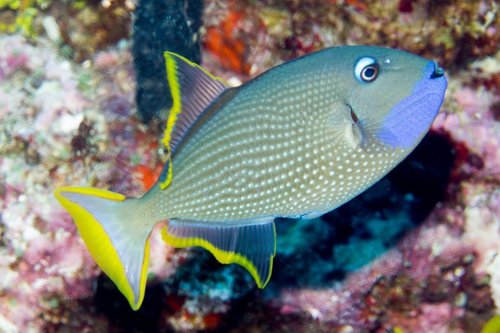
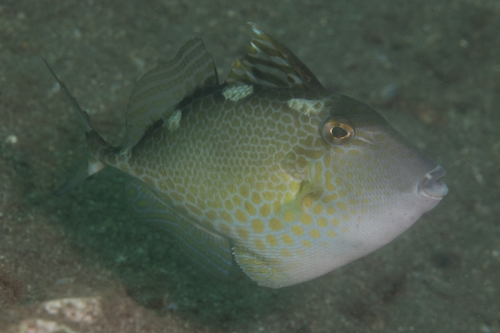
Abalistes stellatus (Anonymous, 1798) has 3 spines and 25 to 27 soft rays in its dorsal fin, and 24 soft rays in its anal fin. It has an oblique groove in front of the eye, and the scales behind the gill slit are large. The depth of its body measures between 2 and 2.5 times the species' standard length. The caudal peduncle is flattened, at least as wide as it is deep, narrow and tapering, with a length much greater than its depth. The caudal fin is double emarginate, and its two lobes get longer as the fish grows. The large scales behind the gill slit and above the pectoral fin base form a flexible tympanum. The scales toward the rear of the body are keeled, forming longitudinal ridges. The body is overall greyish to greenish-brown, fading to whitish on the ventral side. There are four large white blotches along the back; the last of these is located on the caudal peduncle. The body is marked with pale yellowish-brown spots, and there may be a white streak in the middle of the upper side. This species has a maximum published total length of 60 cm (24 in), with 40 cm (16 in) being a more typical size. Abalistes stellatus has a wide distribution across the Indian and Western Pacific Oceans. It can be found along the coast of eastern Africa from the Red Sea to Mossel Bay in the Western Cape, South Africa, across the Indian Ocean, and east into the Western Pacific Ocean as far as Fiji. Its range extends north to southern Japan, and south to northern and eastern Australia. It lives at depths between 4 and 120 m (13 and 394 ft), in areas with sand, sponge, and seaweed over deep slopes. Juveniles of this species frequently live in sheltered coastal bays and estuaries, in open areas scattered with rubble and other debris outcrops.