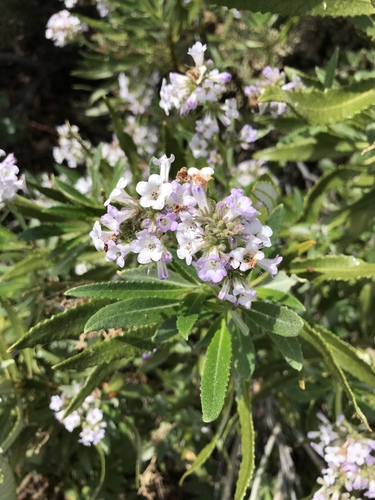
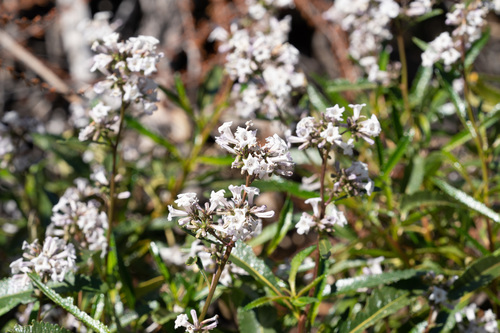
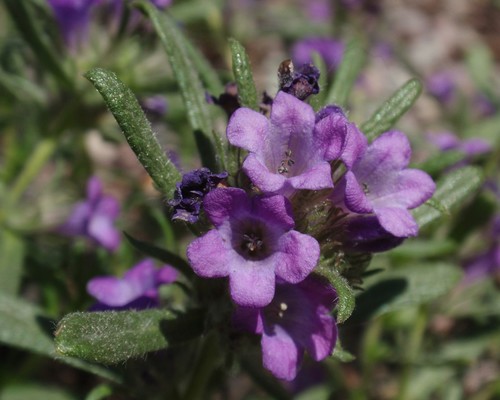
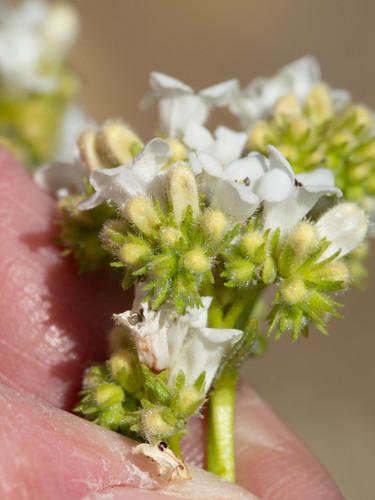
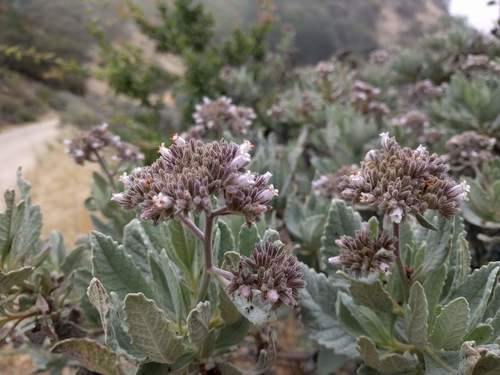
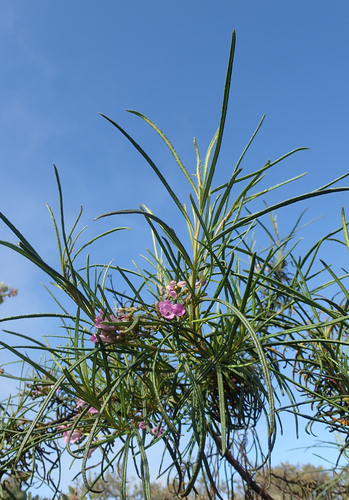
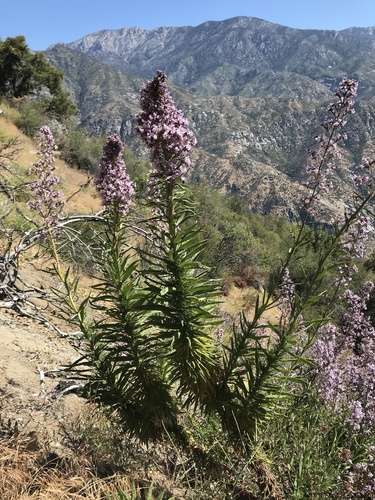
How to Identify Namaceae

Namaceae is a plant family in the Plantae kingdom, order Boraginales, class Magnoliopsida. The family contains 21 accepted species worldwide. Some species in this family are toxic — exercise caution when handling unknown specimens.

Key Identification Features

For instant identification in the field, use the iNature app — AI-powered, works offline.
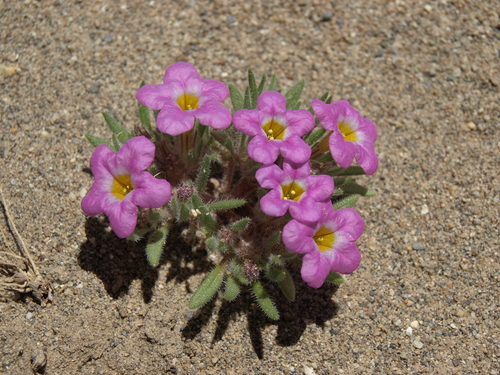
Representative Namaceae Species

How to identify Nama aretioides (Hook. & Arn.) Brand

Nama aretioides (Hook. & Arn.) Brand

Nama aretioides (Hook. & Arn.) Brand

Nama aretioides, or ground nama, is a low hairy annual flowering plant native to…

How to identify Eriodictyon trichocalyx A.Heller

Eriodictyon trichocalyx A.Heller

Eriodictyon trichocalyx A.Heller

Eriodictyon trichocalyx is a shrub native to Southern California and Baja Califo…

How to identify Eriodictyon californicum (Hook. & Arn.) Greene

Eriodictyon californicum (Hook. & Arn.) Greene

Eriodictyon californicum (Hook. & Arn.) Greene

Eriodictyon californicum is a fire-adapted evergreen shrub native to western Nor…

How to identify Nama lobbii A.Gray

Nama lobbii A.Gray

Nama lobbii A.Gray

Nama lobbii A.Gray is a mat-forming rhizomatous perennial herb recommended as gr…

How to identify Eriodictyon angustifolium Nutt.

Eriodictyon angustifolium Nutt.

Eriodictyon angustifolium Nutt.

Eriodictyon angustifolium is a Baja California plant whose extracts and tea are …

How to identify Eriodictyon sessilifolium Greene

Eriodictyon sessilifolium Greene

Eriodictyon sessilifolium Greene

Eriodictyon sessilifolium is a perennial lilac-purple flowered shrub native to n…

How to identify Eriodictyon crassifolium Benth.

Eriodictyon crassifolium Benth.

Eriodictyon crassifolium Benth.

Eriodictyon crassifolium is a native shrub of California and Baja California wit…

⚠️ Poisonous
How to identify Nama demissa A.Gray

Nama demissa A.Gray

Nama demissa A.Gray

Nama demissa (purple mat) is a low-growing flowering plant that blooms February–…

How to identify Eriodictyon tomentosum Benth.

Eriodictyon tomentosum Benth.

Eriodictyon tomentosum Benth.

Eriodictyon tomentosum is a silvery-haired shrub endemic to California Coast Ran…

How to identify Eriodictyon traskiae Eastw.

Eriodictyon traskiae Eastw.

Eriodictyon traskiae Eastw.

Eriodictyon traskiae is a gray-green woolly shrub endemic to California chaparra…

How to identify Eriodictyon altissimum P.V.Wells

Eriodictyon altissimum P.V.Wells

Eriodictyon altissimum P.V.Wells

Eriodictyon altissimum P.V.Wells is an erect shrub with characteristic bark, lea…

How to identify Turricula parryi (A.Gray) J.F.Macbr.

Turricula parryi (A.Gray) J.F.Macbr.

Turricula parryi (A.Gray) J.F.Macbr.

Turricula parryi, common name poodle-dog bush, is a perennial shrub endemic to s…

Browse all 21 Namaceae species →

Frequently Asked Questions

How do you identify Namaceae?

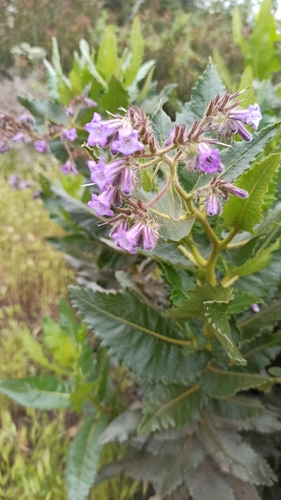
Namaceae plants belong to the Boraginales order in the Plantae kingdom. For identification, this species' flower clusters and hairy stem are similar to those of many plants in the genus Phacelia, but it can be distinguished by its greater height. For instant identification, use the iNature app — AI-powered and works offline.

What are the key characteristics of Namaceae?

Namaceae is classified in the order Boraginales, class Magnoliopsida, phylum Tracheophyta. Additional distinguishing features separate yerba santa from Turricula parryi.

⚠️ Are any Namaceae species poisonous?

Yes, some Namaceae species are toxic or poisonous. Always exercise caution with unknown specimens. View poisonous Namaceae species or browse the full poisonous species guide.

Sources: GBIF, iNaturalist, Wikipedia · Disclaimer

Start Exploring Nature Today

Download iNature for free. 10 identifications on us. No account needed. No credit card required.

Download Free on App Store