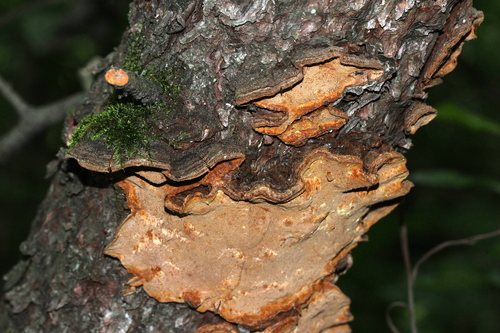
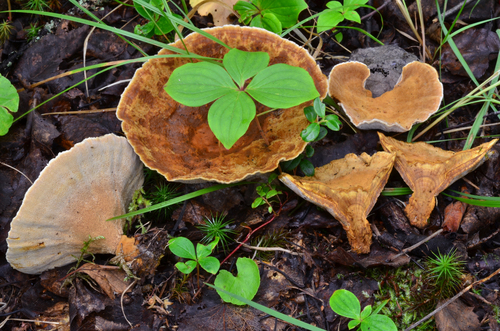
How to Identify Hymenochaetaceae

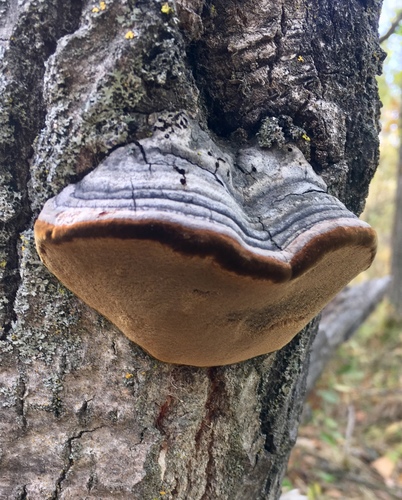
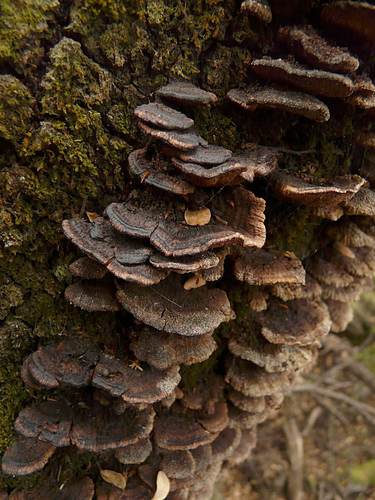
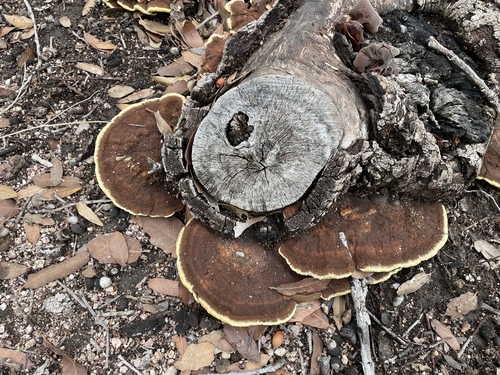
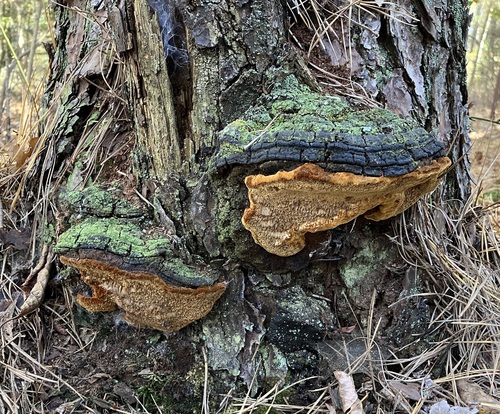
Hymenochaetaceae is a fungus family in the Fungi kingdom, order Hymenochaetales, class Agaricomycetes. The family contains 48 accepted species worldwide.

Key Identification Features

For instant identification in the field, use the iNature app — AI-powered, works offline.
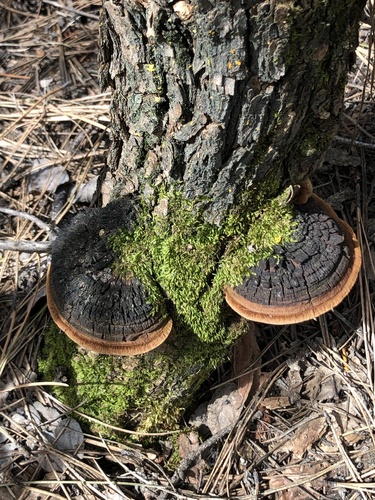
Representative Hymenochaetaceae Species

How to identify Phellinus robiniae (Murrill) A.Ames

Phellinus robiniae (Murrill) A.Ames

Phellinus robiniae (Murrill) A.Ames

Fulvifomes robiniae, the cracked cap polypore, is a Hymenochaetaceae fungus that…

How to identify Phellinus tremulae (Bondartsev) Bondartsev & P.N.Borisov

Phellinus tremulae (Bondartsev) Bondartsev & P.N.Borisov

Phellinus tremulae (Bondartsev) Bondartsev & P.N.Borisov

Phellinus tremulae, the aspen bracket, is a Hymenochaetaceae polypore that cause…

How to identify Inonotus hispidus (Bull.) P.Karst.

Inonotus hispidus (Bull.) P.Karst.

Inonotus hispidus (Bull.) P.Karst.

Inonotus hispidus is a fungus growing on North American hardwoods, used in tradi…

How to identify Nothonotus nothofagi (G.Cunn.) Y.C.Dai, F.Wu, L.W.Zhou, Vlasák & B.K.Cui

Nothonotus nothofagi (G.Cunn.) Y.C.Dai, F.Wu, L.W.Zhou, Vlasák & B.K.Cui

Nothonotus nothofagi (G.Cunn.) Y.C.Dai, F.Wu, L.W.Zhou, Vlasák & B.K.Cui

Nothonotus nothofagi is a parasitic Hymenochaetaceae fungus that causes white ro…

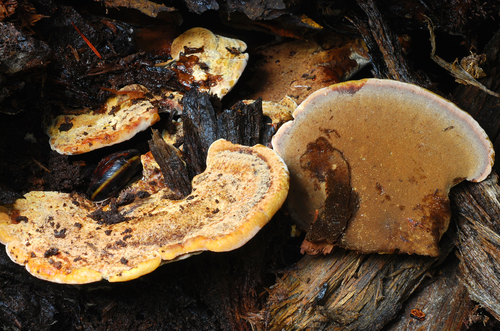
How to identify Phellinus gilvus (Schwein.) Pat.

Phellinus gilvus (Schwein.) Pat.

Phellinus gilvus (Schwein.) Pat.

Phellinus gilvus is a pathogenic fungus used in traditional Chinese medicine wit…

How to identify Porodaedalea pini (Brot.) Murrill

Porodaedalea pini (Brot.) Murrill

Porodaedalea pini (Brot.) Murrill

Porodaedalea pini is a non-edible pathogenic fungus that causes red ring rot in …

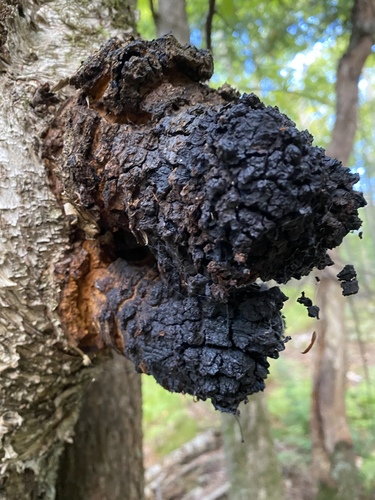
How to identify Inonotus obliquus (Fr.) Pilát

Inonotus obliquus (Fr.) Pilát

Inonotus obliquus (Fr.) Pilát

Inonotus obliquus, or chaga, is a boreal pathogenic fungus commonly marketed as …

How to identify Inonotus cuticularis (Bull.) P.Karst.

Inonotus cuticularis (Bull.) P.Karst.

Inonotus cuticularis (Bull.) P.Karst.

Inonotus cuticularis, the clustered bracket, is a plant pathogenic fungus in Hym…

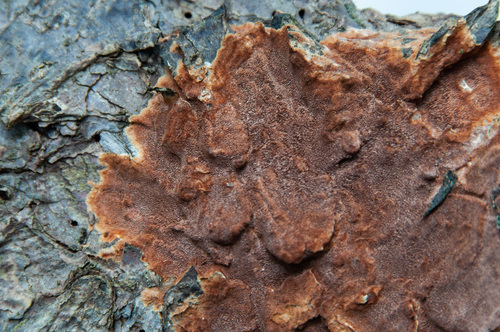
How to identify Phellinidium ferrugineofuscum (P.Karst.) Fiasson & Niemelä

Phellinidium ferrugineofuscum (P.Karst.) Fiasson & Niemelä

Phellinidium ferrugineofuscum (P.Karst.) Fiasson & Niemelä

Phellinidium ferrugineofuscum is a Hymenochaetaceae fungus native to Eurasia and…

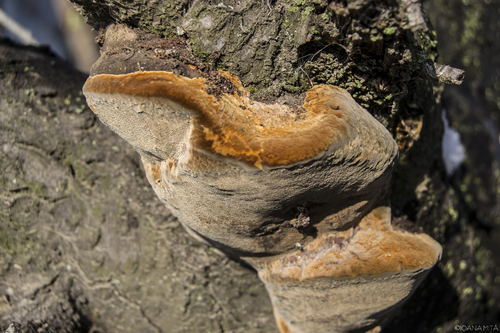
How to identify Phellinus pomaceus (Pers.) Maire

Phellinus pomaceus (Pers.) Maire

Phellinus pomaceus (Pers.) Maire

Phellinus pomaceus is a long-lived, weakly pathogenic plant fungus commonly foun…

How to identify Phellinus chrysoloma (Fr.) Donk

Phellinus chrysoloma (Fr.) Donk

Phellinus chrysoloma (Fr.) Donk

Phellinus chrysoloma is a near-threatened boreal forest fungus that parasitizes …

How to identify Onnia tomentosa (Fr.) P.Karst.

Onnia tomentosa (Fr.) P.Karst.

Onnia tomentosa (Fr.) P.Karst.

Onnia tomentosa is an inedible, pathogenic fungus that causes root rot in Canadi…

Browse all 48 Hymenochaetaceae species →

Frequently Asked Questions

How do you identify Hymenochaetaceae?

Hymenochaetaceae funguss belong to the Hymenochaetales order in the Fungi kingdom. In early decay, affected wood takes on a reddish to purplish color, and a cross-section of affected wood shows a distinct well-defined ring. For instant identification, use the iNature app — AI-powered and works offline.

What are the key characteristics of Hymenochaetaceae?

Hymenochaetaceae is classified in the order Hymenochaetales, class Agaricomycetes, phylum Basidiomycota. Cultivated chaga produces fewer phytosterols; this reduction is particularly notable for lanosterol, an intermediate in the synthesis of ergosterol and lanostane-type triterpenes.

Sources: GBIF, iNaturalist, Wikipedia · Disclaimer

Start Exploring Nature Today

Download iNature for free. 10 identifications on us. No account needed. No credit card required.

Download Free on App Store