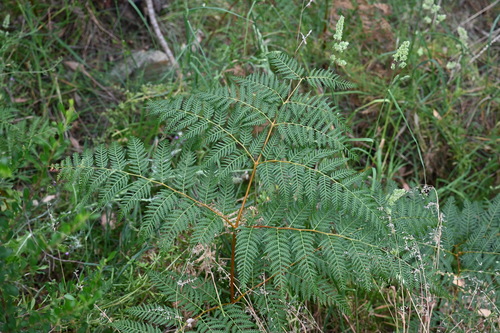
How to Identify Dennstaedtiaceae

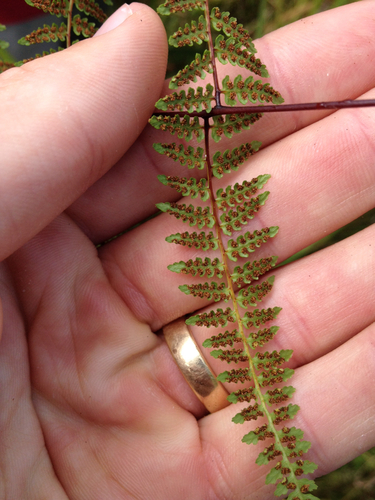
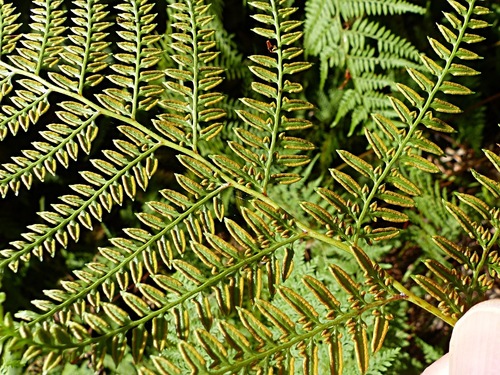
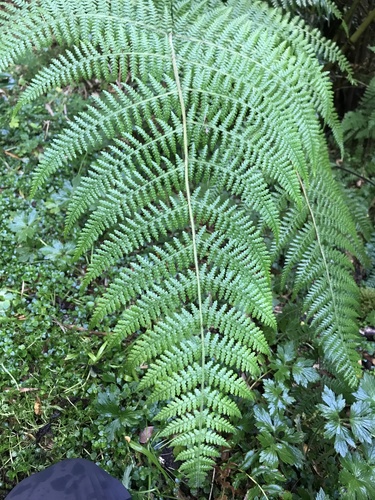
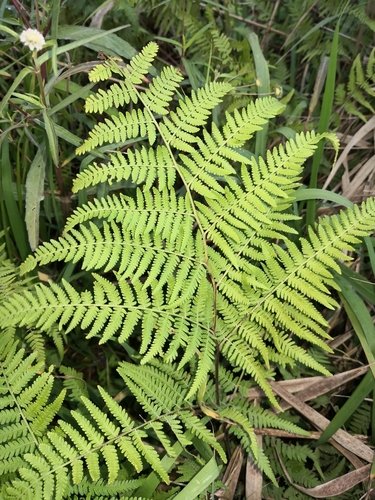
Dennstaedtiaceae is a plant family in the Plantae kingdom, order Polypodiales, class Polypodiopsida. The family contains 34 accepted species worldwide. Some species in this family are toxic — exercise caution when handling unknown specimens.

Key Identification Features

For instant identification in the field, use the iNature app — AI-powered, works offline.
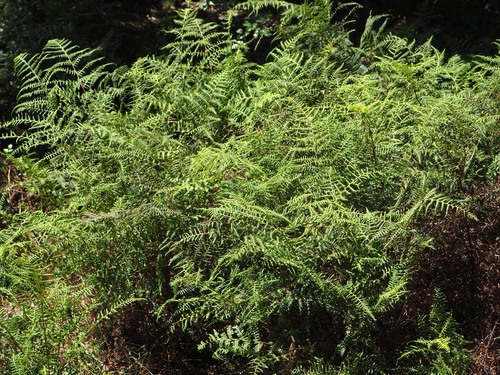
Representative Dennstaedtiaceae Species

How to identify Hypolepis ambigua (A.Rich.) Brownsey & Chinnock

Hypolepis ambigua (A.Rich.) Brownsey & Chinnock

Hypolepis ambigua (A.Rich.) Brownsey & Chinnock

Hypolepis ambigua is a New Zealand native perennial herbaceous fern that has nat…

How to identify Histiopteris incisa (Thunb.) J.Sm.

Histiopteris incisa (Thunb.) J.Sm.

Histiopteris incisa (Thunb.) J.Sm.

Histiopteris incisa, the bat's wing fern, is a medium southern hemisphere fern w…

How to identify Hypolepis sparsisora (Schrad.) Kuhn

Hypolepis sparsisora (Schrad.) Kuhn

Hypolepis sparsisora (Schrad.) Kuhn

Hypolepis sparsisora, the giant edgelobed fern, is a widespread Afrotropical fer…

How to identify Hypolepis punctata (Thunb. ex Murray) Mett.

Hypolepis punctata (Thunb. ex Murray) Mett.

Hypolepis punctata (Thunb. ex Murray) Mett.

Hypolepis punctata is a Polypodiaceae fern native to East Asia, growing in vario…

How to identify Pteridium aquilinum (L.) Kuhn

Pteridium aquilinum (L.) Kuhn

Pteridium aquilinum (L.) Kuhn

Pteridium aquilinum, common bracken, is a widespread toxic perennial fern with a…

⚠️ Poisonous
How to identify Hiya distans (Colenso ex Hook.) Brownsey & Perrie

Hiya distans (Colenso ex Hook.) Brownsey & Perrie

Hiya distans (Colenso ex Hook.) Brownsey & Perrie

Hiya distans, the scrambling ground fern, is a small fern native mainly to New Z…

How to identify Pteridium aquilinum subsp. pinetorum (C.N.Page & R.R.Mill) J.A.Thomson

Pteridium aquilinum subsp. pinetorum (C.N.Page & R.R.Mill) J.A.Thomson

Pteridium aquilinum subsp. pinetorum (C.N.Page & R.R.Mill) J.A.Thomson

Pteridium aquilinum subsp. pinetorum is a widely distributed toxic fern with a h…

How to identify Paesia scaberula (A.Rich.) Kuhn

Paesia scaberula (A.Rich.) Kuhn

Paesia scaberula (A.Rich.) Kuhn

Paesia scaberula (ring fern or mātata) is a distinctive lacy creeping fern found…

How to identify Hypolepis rugosula (Labill.) J.Sm.

Hypolepis rugosula (Labill.) J.Sm.

Hypolepis rugosula (Labill.) J.Sm.

Hypolepis rugosula is a fern identifiable by colored axes and distinct vascular …

How to identify Hypolepis muelleri Wakef.

Hypolepis muelleri Wakef.

Hypolepis muelleri Wakef.

Hypolepis muelleri is a common small soft-fronded fern found in eastern Australi…

How to identify Pteridium esculentum (G.Forst.) Cockayne

Pteridium esculentum (G.Forst.) Cockayne

Pteridium esculentum (G.Forst.) Cockayne

Pteridium esculentum is a widespread fern that quickly colonizes disturbed areas…

How to identify Pteridium esculentum subsp. arachnoideum (Kaulf.) J.A.Thomson

Pteridium esculentum subsp. arachnoideum (Kaulf.) J.A.Thomson

Pteridium esculentum subsp. arachnoideum (Kaulf.) J.A.Thomson

This is a description of Pteridium esculentum subsp. arachnoideum, covering its …

Browse all 34 Dennstaedtiaceae species →

Frequently Asked Questions

How do you identify Dennstaedtiaceae?

Dennstaedtiaceae plants belong to the Polypodiales order in the Plantae kingdom. Its fronds are typically 60–200 cm long, widely spaced, distinct, and slightly dimorphic: fertile lobes are slightly narrower than infertile lobes. For instant identification, use the iNature app — AI-powered and works offline.

What are the key characteristics of Dennstaedtiaceae?

Dennstaedtiaceae is classified in the order Polypodiales, class Polypodiopsida, phylum Tracheophyta. It grows up to 115 centimetres (45 inches) tall, produces yellow-green fronds and brown stalks, and has a distinctive smell.

⚠️ Are any Dennstaedtiaceae species poisonous?

Yes, some Dennstaedtiaceae species are toxic or poisonous. Always exercise caution with unknown specimens. View poisonous Dennstaedtiaceae species or browse the full poisonous species guide.

Sources: GBIF, iNaturalist, Wikipedia · Disclaimer

Start Exploring Nature Today

Download iNature for free. 10 identifications on us. No account needed. No credit card required.

Download Free on App Store