The Pieridae family includes the ubiquitous cabbage white butterfly — probably the most commonly seen butterfly in the Northern Hemisphere — along with sulphurs, orangetips, and brimstones. Many pierids are migratory, and some are significant agricultural pests in their caterpillar stage. This guide covers the most frequently encountered species.
🦋 Insect Guide
White Butterflies (Pieridae): Species & Identification
1
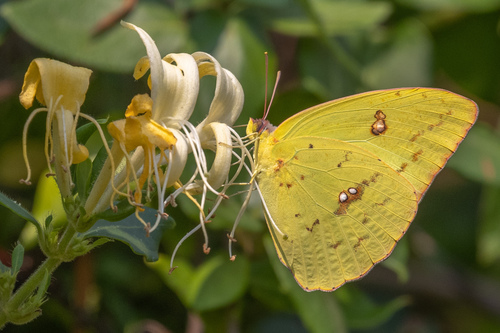
Phoebis sennae, the cloudless sulphur, is a mid-sized Pieridae butterfly found in the Americas across a wide range.
Phoebis sennae, commonly known as the cloudless sulphur, is a mid-sized butterfly belonging to the family Pieridae, found across the Americas. There are several species similar to it: the clouded sulphur (Colias philodice), the yellow angled-sulphur (Anteos maerula) which has angled wings, the statira sulphur (Aphrissa statira), and other much smaller sulphur butterflies. The species name of this ...
View full details → 2
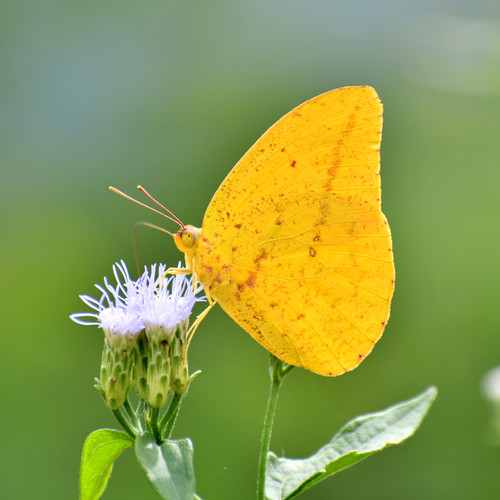
Phoebis agarithe, the large orange sulphur, is a Pieridae butterfly native to the Americas and introduced to Hawaii.
Phoebis agarithe, commonly known as the large orange sulphur, is a butterfly species belonging to the family Pieridae. Its native range extends from Peru northward to southern Texas and peninsular Florida. Rare stray individuals can be found as far north as Colorado, South Dakota, Wisconsin, and New Jersey. This species has also been introduced to Hawaii. It inhabits open tropical lowland environm...
View full details → 3
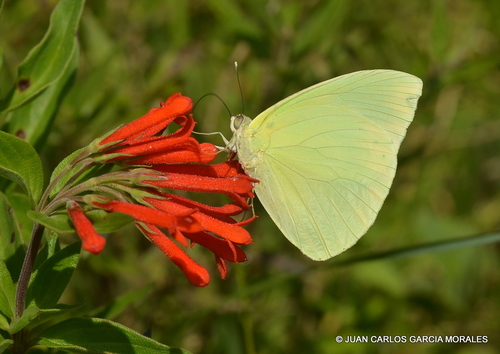
Aphrissa statira, the statira sulphur butterfly, is a migratory piercing butterfly found from Argentina to the southern US that acts as an important pollinator.
Aphrissa statira, first described by Cramer in 1777, has a wingspan ranging from approximately 2.37 inches (6.0 cm) to 3.12 inches (7.9 cm). Due to their yellow coloration, they can be hard to distinguish from cloudless sulphur butterflies while in flight. Wing color varies between individuals, with the highest amount of color variation recorded in Colombia, Central America, and Mexico. The subspe...
View full details → 4
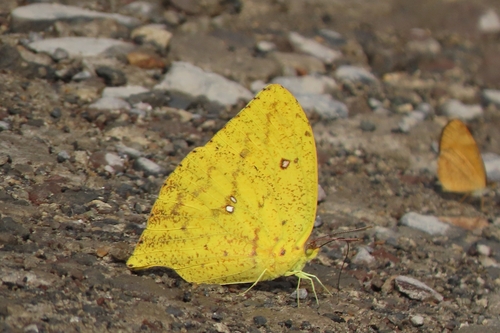
Phoebis neocypris, the tailed sulphur, is a Pieridae butterfly native to the Americas, with larvae feeding on Cassia fresh leaves.
Phoebis neocypris, commonly known as the tailed sulphur, is a butterfly species that belongs to the Pieridae family. This species is native to Mexico, Central America, and South America. A single record exists of a stray individual of this species being found in southern Texas. The larvae of Phoebis neocypris feed on the fresh leaves of plants from the genus Cassia.
View full details → 5
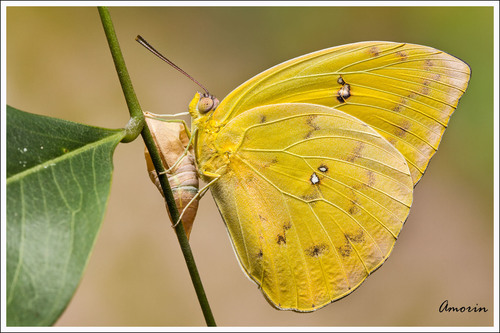
Phoebis philea, the orange-barred sulphur, is a butterfly species found in the Americas and the Caribbean.
Phoebis philea, commonly known as the orange-barred sulphur, is a species of butterfly that occurs in the Americas, including the Caribbean. Its wingspan measures 68 to 80 mm. In Florida, this species produces two to three generations per year, while in the northern portion of its range there is one generation annually, with adults active on the wing from mid to late summer. It inhabits tropical s...
View full details → 6
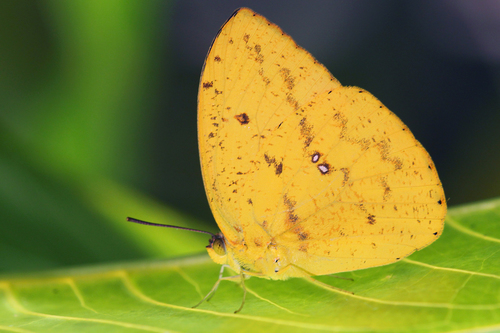
Phoebis argante is a butterfly species ranging from Mexico to Peru, the Antilles, and Cuba, with distinct sexual color differences.
Phoebis argante has a wingspan ranging from approximately 54 to 67 millimetres (2.1 to 2.6 inches). On males, the uppersides of the wings are bright orange, with a thin black or dark brown border along the forewings. Male hindwings are slightly paler in tone and feature two small whitish spots at their center. The base body color of females ranges from white to yellow, and females have dark wing b...
View full details → 7
Phoebis marcellina, the marcellina sulphur, is a Western Hemisphere butterfly elevated to full species status in 2020.
Phoebis marcellina, commonly called the marcellina sulphur, is a butterfly species that occurs in the Western Hemisphere, between approximately 34° North latitude and 30° South latitude. This range extends roughly from Los Angeles in the north to northern Argentina in the south. It was previously classified as a subspecies of Phoebis sennae. In 2020, it was raised to the status of a full species, ...
View full details → 8
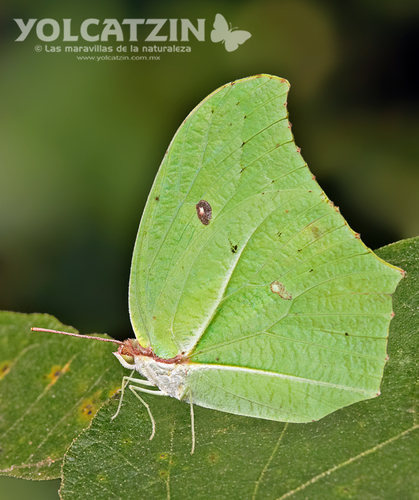
Anteos maerula, the angled sulphur, is a Pieridae butterfly found from Peru to Mexico with rare migrants reaching the southern US.
Anteos maerula, commonly known as the angled sulphur or yellow angled-sulphur, is a butterfly species that belongs to the Pieridae family. This species is native to the region ranging from Peru to Mexico. Rare migratory individuals have been recorded as far north as eastern Nebraska, southeastern Arizona, southwestern New Mexico, southern Texas, Mississippi, and Florida. The wingspan of adult Ante...
View full details → 9
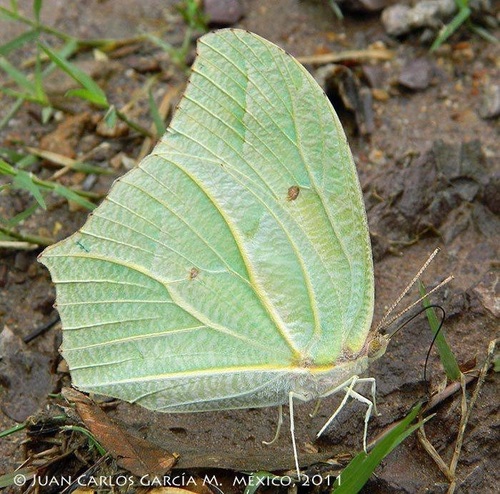
Anteos clorinde, the white angled-sulphur, is a Pieridae butterfly found across the Americas, with larvae feeding on Senna spectabilis.
Anteos clorinde, commonly known as the white angled-sulphur or the ghost brimstone, is a butterfly species belonging to the family Pieridae. This species was first described by Jean-Baptiste Godart in 1824. Its native range spans South America, Central America, and southern North America. The wingspan of adult Anteos clorinde measures 70–90 mm. Within the tropical portions of its distribution, the...
View full details → 10
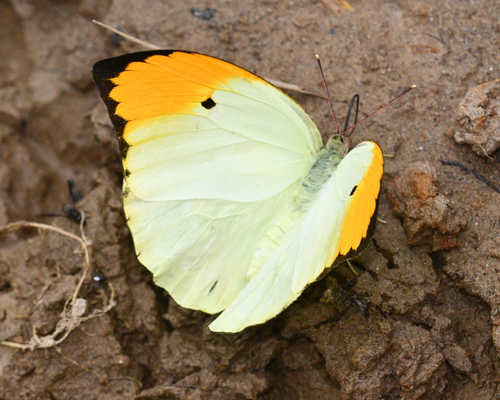
Anteos menippe is a fairly large butterfly found from Mexico to South America that inhabits lowlands and riverbanks.
Anteos menippe, also known by its scientific name Anteos menippe (Hübner, 1818), is a fairly large butterfly species that can reach a wingspan of 80–90 mm (3.1–3.5 in). For male individuals, the upperside of the wings is pale yellow, with large pale orange, sometimes pink orange, markings on the pointed forewing tips—this marking matches what is referenced in the species' common name. Males also h...
View full details → 11
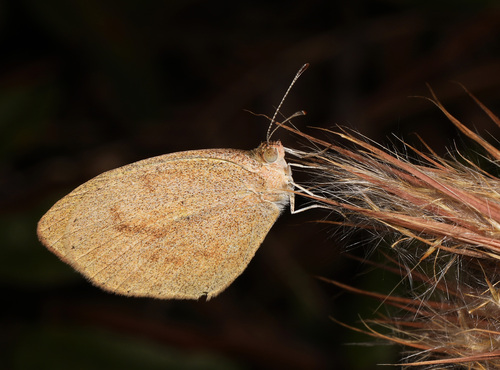
Eurema daira, the fairy yellow, is a Pieridae butterfly found from Argentina to the southern US, with strays further north.
Eurema daira, commonly known as the fairy yellow, barred yellow, or barred sulphur, is a butterfly species belonging to the family Pieridae. This species was first formally described by Jean-Baptiste Godart in 1819. Its established distribution ranges from Argentina northward to the southern United States. Non-breeding stray individuals have been observed as far north as southern Arizona, South Da...
View full details → 12
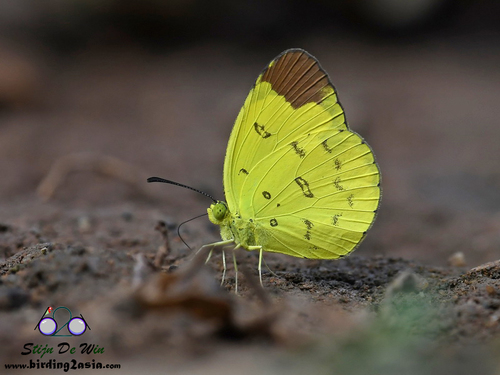
Eurema sari, the chocolate grass yellow, is a Southeast Asian Pieridae butterfly whose larvae feed on Leguminosae.
Eurema sari, commonly known as the chocolate grass yellow, is a butterfly species belonging to the family Pieridae. This species is native to Southeast Asia. Adults of Eurema sari have a wingspan ranging from 36 to 42 millimeters, which equals 1.4 to 1.7 inches. A key identifying feature of adult individuals is a distinct brown apex on the underside of the forewing. The larvae of Eurema sari feed ...
View full details → 13
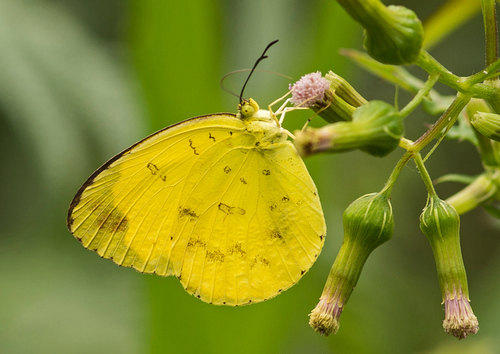
This is a morphological description of different seasonal forms of the butterfly Eurema blanda, listing its known food plants.
This description covers different seasonal forms of the butterfly Eurema blanda, originally described by Boisduval in 1836. Wet form: Males of the wet form have lemon-yellow upper wing surfaces. On the forewing, the outer marginal black band is broader at the anterior than it is in Sri Lankan specimens of Eurema hecabe; the posterior end of the band is shorter, and its inner edge slopes outward. T...
View full details → 14
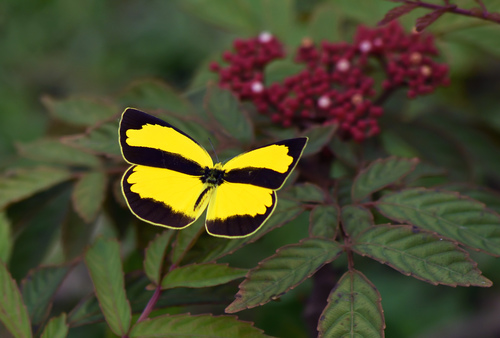
The scalloped grass yellow, Eurema alitha, is a Southeast Asian butterfly species first described in 1862 by the Felders.
Eurema alitha, commonly known as the scalloped grass yellow, is a butterfly species that belongs to the genus Eurema. It was first formally described in 1862 by father-and-son entomologists Cajetan Felder and Rudolf Felder, under the original name Terias alitha. This species is native to and found in Southeast Asia.
View full details → 15
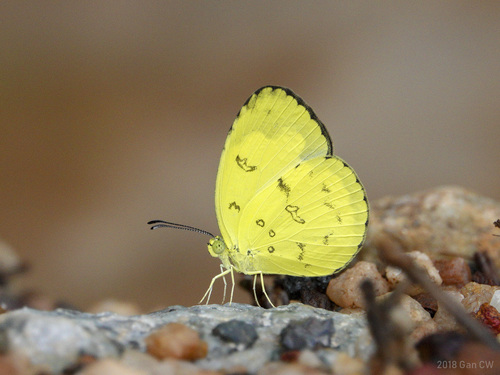
Eurema andersoni is a butterfly species with multiple subspecies across South and East Asia, whose larvae feed on Ventilago goughii.
Scientific name: Eurema andersoni (Moore, 1886). Description of the wet form: The male has the following characteristics. On the upper side, the outer marginal band of the fore-wing is moderately broad; its medial portion is inclined slightly inward, and its lower portion is inclined very slightly obliquely outward. The hind-wing has a moderately broad outer band. On the underside, ordinary markin...
View full details → 16
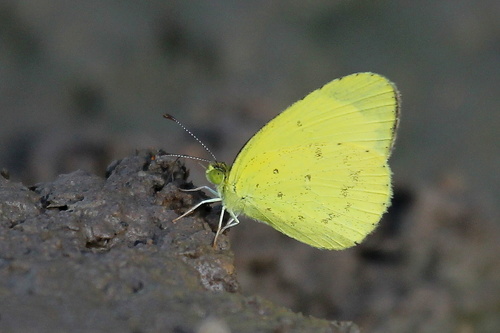
Eurema smilax is a small yellow Australian butterfly with seasonal colour variation and poison-secreting larvae.
Adults of Eurema smilax have a wingspan of 30–34 mm, with females slightly larger than males. They are yellow with black tips on the upper surface of the forewings, and their colouration varies depending on flight period. In southern Australia, summer-flying forms are typically pale yellow, with few or no brown markings on the undersides of the wings. Winter forms are brighter yellow, with distinc...
View full details → 17
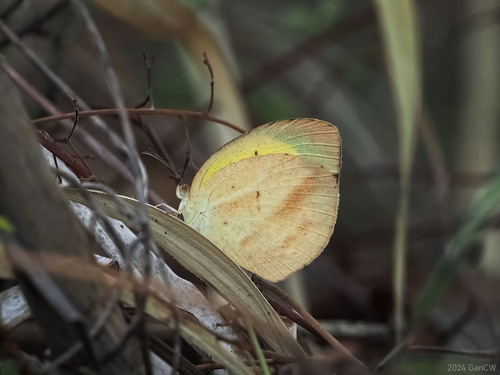
Eurema laeta has distinct wet and dry seasonal forms, differing in wing markings between males and females.
This description covers the wet and dry seasonal forms of Eurema laeta, separated by sex. For the wet form male: the upper side is pale yellow, with basal areas lightly dusted with grey-black scales. The forewing has a broad vinescent-black outer marginal band that curves from the middle of the costa to the upper median vein; below this point, the band curves inwards to the lower median vein, with...
View full details → 18
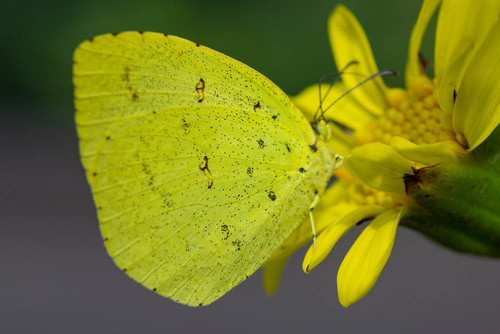
Eurema mandarina, the Japanese common grass yellow, is a coliadine butterfly species from the genus Eurema.
Eurema mandarina, commonly called the Japanese common grass yellow, is a species of coliadine butterfly in the genus Eurema.
View full details → 19
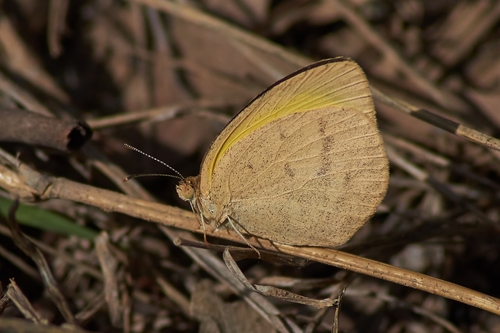
Eurema herla, the Pink Grass-Yellow, is a Pieridae butterfly found in northern and eastern Australia that feeds on Dwarf Cassia as larvae.
Eurema herla is most commonly known by the common names Pink Grass-Yellow and Macleay's Grass-Yellow. It is a butterfly species belonging to the family Pieridae. This species is found in northern and eastern Australia. Adult individuals are mostly yellow, with an evenly rounded black area on the tips of their forewings. They also have black dots on the edges of their hindwings, at the points where...
View full details → 20
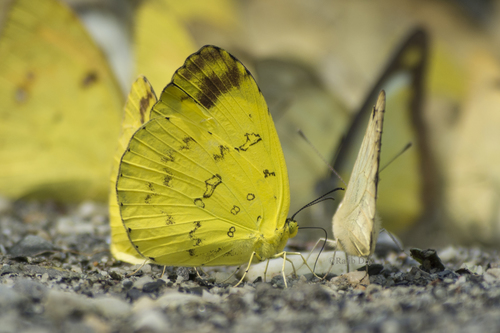
Eurema simulatrix, the changeable grass yellow, is a Pieridae butterfly found across Southeast Asia.
Eurema simulatrix, commonly known as the changeable grass yellow, is a species of butterfly that belongs to the Pieridae family. This butterfly species is distributed across the range from Burma to Sundaland, as well as in Cambodia and the Philippines. It inhabits secondary or disturbed environments, which include forest clearings, roadsides, riverbanks, parks, and gardens. For male individuals of...
View full details → 21
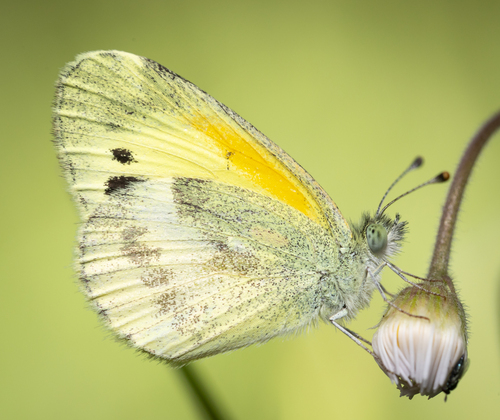
Nathalis iole, the dainty sulphur, is North America's smallest pierid butterfly with variable appearance and seasonal form differences.
Nathalis iole, the dainty sulphur, is the smallest pierid butterfly species found in North America. A rare population located in Homestead, documented by Smith et al. in 1994, mostly consists of white individuals. Many observers consider the dainty sulphur unique among pierids due to its wing shape and several structural features, leading to the suggestion that it should be placed in its own separ...
View full details → 22
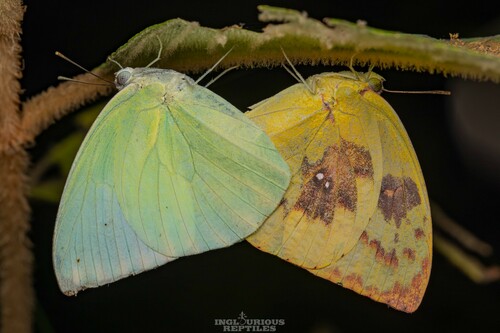
Catopsilia pomona has two Australian morphs differing in antenna color, linked to growth photoperiod and temperature.
Catopsilia pomona occurs in two morphs in Australia: a pale form and a dark form. The crocale form of this species has black antennae, while the pomona form has pinkish or red antennae. The development of these two distinct forms is connected to photoperiod and temperature conditions experienced during the species' growth period.
View full details → 23
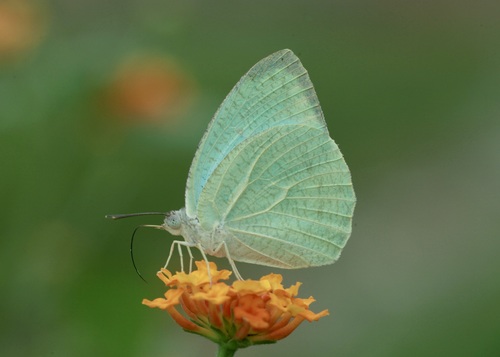
The mottled emigrant (Catopsilia pyranthe) is a medium-sized Pieridae butterfly found in South Asia, Southeast Asia, and parts of Australia.
Catopsilia pyranthe, commonly known as the mottled emigrant, is a medium-sized butterfly that belongs to the Pieridae family. It can be found across south Asia, southeast Asia, and parts of Australia. Its confirmed range includes India, Myanmar, Bangladesh, Malaya, and New Guinea.
View full details → 24
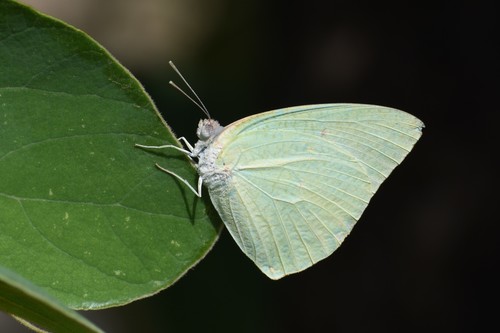
Catopsilia florella is a migratory Pieridae butterfly found across Africa, Arabia, and the Canary Islands.
Catopsilia florella, commonly known as the African migrant, African emigrant, or common vagrant, is a butterfly species belonging to the family Pieridae. This butterfly is found in Africa (including Madagascar), Arabia (specifically the United Arab Emirates, Saudi Arabia, and Oman), and the Canary Islands. Similar to Catopsilia pomona, this species has migratory habits. Many early authors reported...
View full details → 25
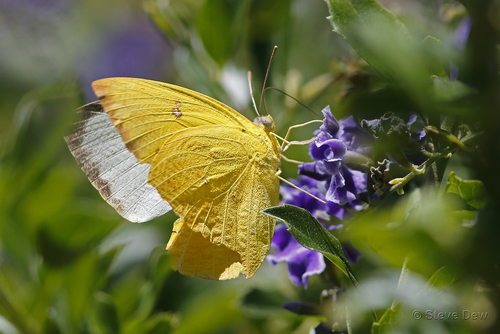
Catopsilia scylla is a butterfly species with distinct male and female wing patterns, distributed across South East Asia and Australasia.
Catopsilia scylla, first formally described by Linnaeus in 1763, has an adult body length of approximately 60 to 65 millimetres, which equals 2.4 to 2.6 inches. Males of this species have white forewings with black edges, and cadmium-yellow hindwings that usually have black spots along their margins. Females share a similar appearance to males, but have an extra cluster of black spots on the forew...
View full details → 26
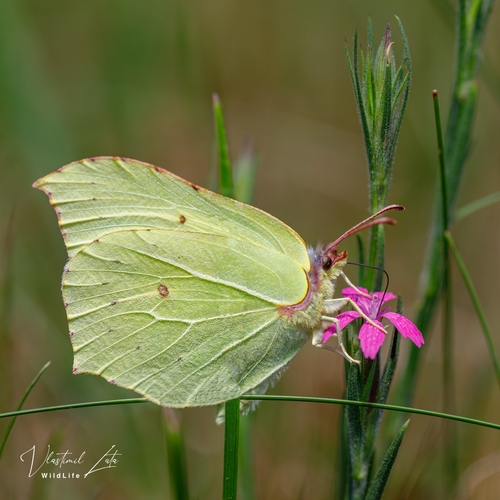
The common brimstone (Gonepteryx rhamni) is a long-lived Palearctic butterfly in the Pieridae family.
Gonepteryx rhamni, commonly called the common brimstone, is a butterfly belonging to the Pieridae family. It lives across the entire Palearctic zone, and is commonly found throughout Europe, Asia, and North Africa. Across most of its range, it is the only species in its genus, so it is often referred to simply as brimstone in local areas. Its wingspan measures 60–74 mm, which is equal to 2.4–2.9 i...
View full details → 27
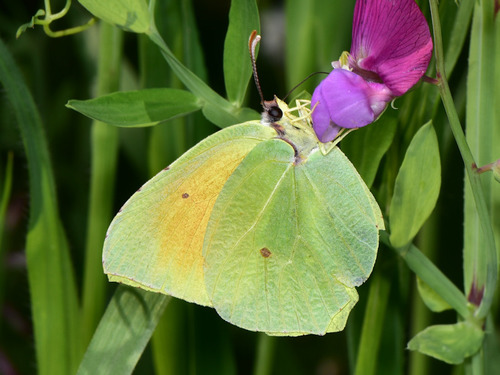
Gonepteryx cleopatra, the Cleopatra butterfly, is a medium-sized Pierid butterfly native to the Mediterranean region.
Gonepteryx cleopatra, commonly called the Cleopatra or Cleopatra butterfly, is a medium-sized butterfly belonging to the family Pieridae. This species is native to the Mediterranean region, which includes Southern Europe, North Africa, and West Asia. The Cleopatra butterfly lives in open woodland and scrub. Across most of its range, its flight period runs from May to August. Spain is an exception,...
View full details → 28
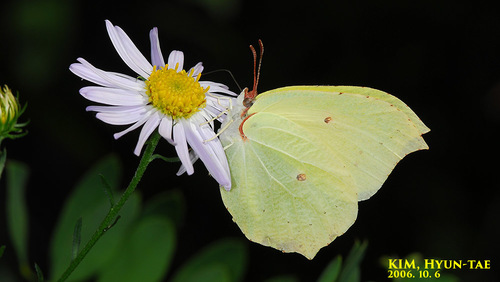
Gonepteryx mahaguru, the lesser brimstone, is a medium-sized Pieridae butterfly native to Kashmir, Uttarakhand, China, Korea, and Japan.
Gonepteryx mahaguru, commonly known as the lesser brimstone, is a medium-sized butterfly species. It belongs to the family Pieridae, which is the family of yellows and whites. This butterfly is native to Kashmir, Uttarakhand, China, Korea, and Japan.
View full details → 29
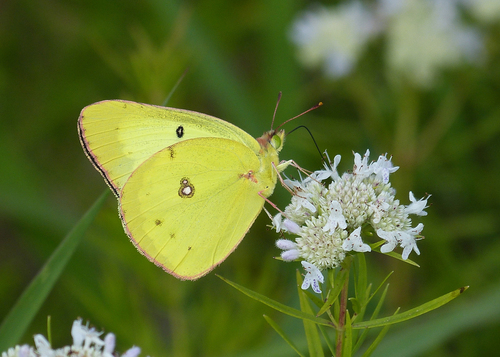
Colias philodice (common sulphur) is a North American butterfly species with distinct wing patterns and an uncommon white alba morph.
Colias philodice Godart, 1819 is a typical member of its genus. Unlike its close relative the orange sulphur, which can also appear yellowish, both males and females of this species usually have pale yellow upper wings with no orange at all. Males have unmarked clean wing borders, while females have yellow dots within this border area. Females occasionally develop a solid white color morph called ...
View full details → 30
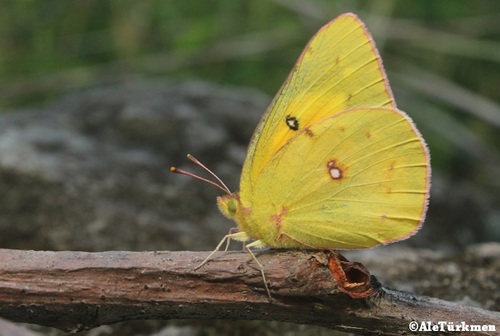
Colias eurytheme, the orange sulphur, is a North American pierid butterfly that occasionally acts as an alfalfa crop pest.
Colias eurytheme, commonly called the orange sulphur, is also known as the alfalfa butterfly; in its larval stage, it is called the alfalfa caterpillar. This butterfly belongs to the family Pieridae, and falls within the lowland group of "clouded yellows and sulphurs" in the subfamily Coliadinae. It occurs across North America, ranging from southern Canada to Mexico. Other close relatives of this ...
View full details →Frequently Asked Questions
How many species are in the Pieridae family?
This guide features 30 representative species from the Pieridae family. The full family contains many more species worldwide — explore them all on iNature.
How to identify Pieridae species?
Pieridae species share common features in their flowers, leaves, and growth patterns. This guide provides photos and descriptions for 30 species. For instant field identification, use the iNature app.
Sources: GBIF, iNaturalist, Wikipedia · Disclaimer
Identify any species instantly — even offline
iNature uses on-device AI to identify plants, animals, fungi and more. No internet needed.
Download iNature — FreeStart Exploring Nature Today
Download iNature for free. 10 identifications on us. No account needed. No credit card required.
Download Free on App Store
