Swallowtail butterflies are among the largest and most spectacular butterflies in the world, including the giant birdwings of Southeast Asia and the tiger swallowtails of North America. The Papilionidae family is named for their distinctive tail-like extensions on the hindwings. This guide showcases the most notable swallowtail species.
🦋 Insect Guide
Swallowtail Butterflies (Papilionidae) — Species & Photos
1
Atrophaneura varuna, the Common Batwing, is a tailless butterfly found across parts of South and Southeast Asia.
Atrophaneura varuna, commonly called the Common Batwing, has a wingspan ranging from 88 to 136 mm. Both males and females are tailless. Males have a rich velvety blue black upperside. Outward toward the forewing terminal margin, and across the entire hindwing except the dorsal area, the wings show a rich dark purple bloom in some light and a very dark green bloom in other light. The dorsal area an...
View full details → 2
Atrophaneura horishanus (Matsumura, 1910)
Atrophaneura horishanus (Matsumura, 1910)
🦋 Animalia Papilionidae
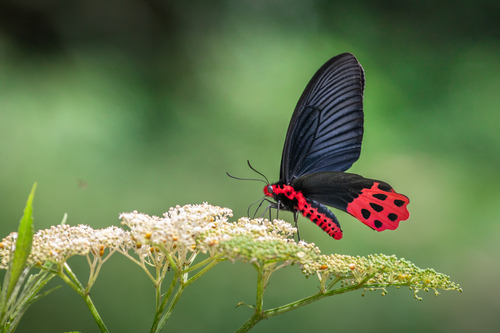
Atrophaneura horishanus, the aurora swallowtail, is a black Papilionidae butterfly found in Taiwan.
Atrophaneura horishanus, commonly called the aurora swallowtail, is a species of butterfly in the family Papilionidae, native to Taiwan. This species has a wingspan ranging from 110 to 130 millimeters. Its wings are primarily black, with white borders along all wing veins. Its body is covered in red hairs, and the underside of each hindwing features a large red patch.
View full details → 3
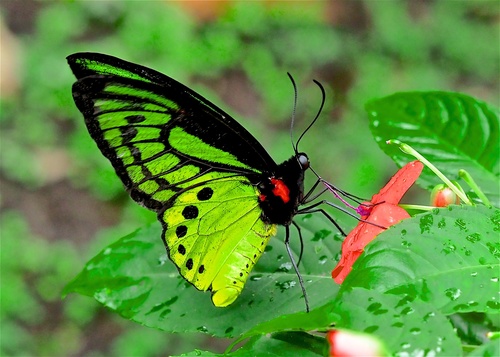
Ornithoptera priamus is a sexually dimorphic butterfly species with distinct forms for males, females, larvae, and pupae.
Ornithoptera priamus is a sexually dimorphic species. For males: The upperside of the forewings is velvety black. Most races have a green subcostal stripe, and most subspecies have a green marginal stripe that borders the termen, tormen, and dorsum of the wing. The sex brand is black and elongated. The underside of the forewing is black, with a chain of bluish or green postdiscal spots. The male h...
View full details → 4
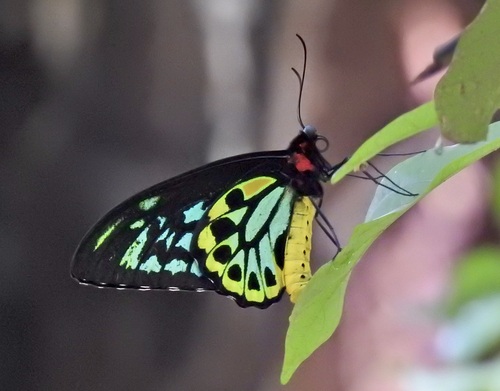
Ornithoptera euphorion, the Cairns birdwing, is a non-threatened Australian birdwing butterfly with distinct sexual dimorphism.
Ornithoptera euphorion, commonly known as the Cairns birdwing, has a maximum wingspan of 15 cm (5.9 in) for females and 12.5 cm (4.9 in) for males, with females being the larger of the two sexes. This species is closely related to Ornithoptera priamus, also called the New Guinea or Priam's birdwing, which reaches a wingspan of 19 cm (7.5 in) and is the largest butterfly species found in Australia,...
View full details → 5
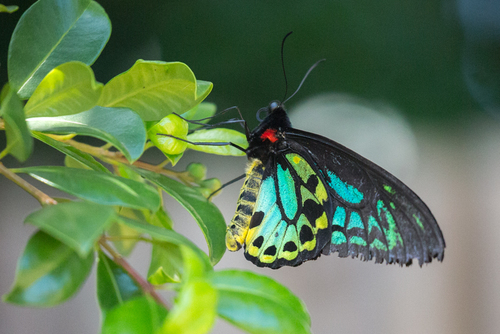
Ornithoptera richmondia (the Richmond birdwing) is the second smallest birdwing butterfly, endemic to restricted areas of eastern Australia.
Ornithoptera richmondia, commonly known as the Richmond birdwing, is a species of birdwing butterfly endemic to Australia. Among all birdwing species, it is the second smallest; the smallest species is Ornithoptera meridionalis. Historically, O. richmondia has been recorded in rainforests stretching south from Maryborough to the Clarence River in New South Wales. Widespread habitat loss across it...
View full details → 6
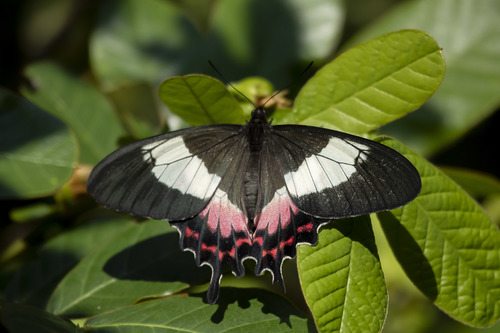
Parides ascanius (Cramer, 1775) is a butterfly species with distinct wing markings and light brown, tubercle-bearing larvae.
Parides ascanius, scientifically named Parides ascanius (Cramer, 1775), has a spatulate tail. Males and females of the species are similar in appearance. Males have an androconial hindmarginal fold on the hindwing, which is covered in white wool. Both wings have a black ground color crossed by a broad white median band; on the hindwing, this band is more or less rose red. The outer margin of the h...
View full details → 7
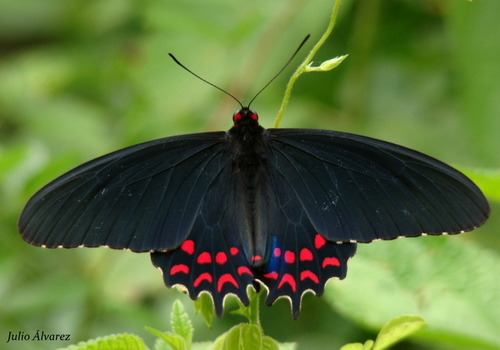
Parides photinus is a swallowtail butterfly found from Mexico to Costa Rica, with black wings and red hindwing spots.
Parides photinus has a wingspan of 90–100 millimetres, or 3.5–3.9 inches. Adult Parides photinus are black, and their hindwings have a blue-green metallic sheen, particularly in males. There are no wing bands. Two rows of red spots run along the margin of the hindwing. The submarginal spots are strongly arched, with the exception of the upper two or three spots and the anal spot. The anal anal spo...
View full details → 8
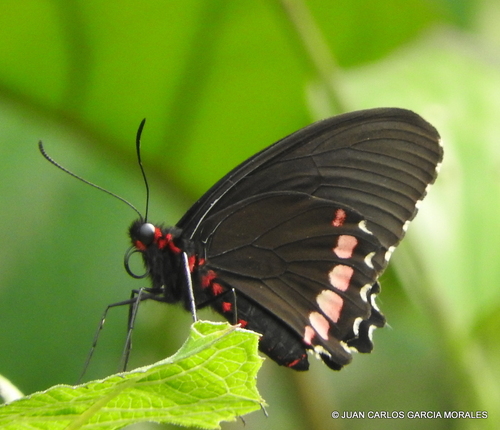
Parides erithalion is a butterfly ranging from Costa Rica to northern Venezuela, with multiple described subspecies.
Parides erithalion (Boisduval, 1836) is a butterfly species first described by Boisduval in 1836. The upperside of its wings is black, marked with a row of red postmedian spots. The underside of the wings is also black, with a row of pink and whitish spots. In males of some subspecies, the forewing uppersides bear a large olivaceous-green patch extending forward from the inner margin, plus a cream...
View full details → 9
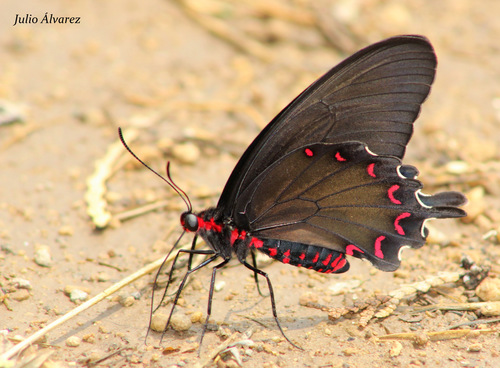
Parides montezuma is a non-threatened butterfly species found from Mexico to Costa Rica.
Scientific name: Parides montezuma (Westwood, 1842) Description: The upperside of this species' wings is black, with no band, and features one row of red crescents along the margin of the hindwing. The underside of the wings is nearly identical to the upperside. A complete formal description of Parides montezuma was published by Rothschild, W. and Jordan, K. in 1906. Distribution and habitat: Pa...
View full details → 10
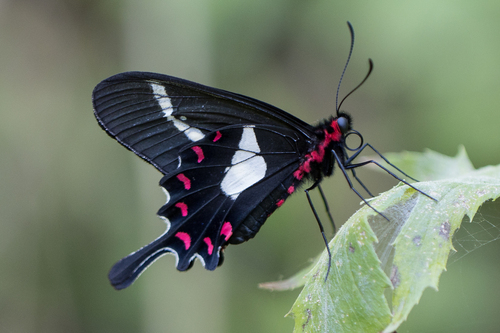
Parides agavus is a variable butterfly found across parts of South America, with little known of its early stages.
Scientific name: Parides agavus (Drury, 1782). This description is taken from Seitz. On the hindwing, the red anal spot is very large and Z-shaped. The abbreviated white band on the hindwing is somewhat variable. The species is quite common, even found in gardens near Rio de Janeiro, and especially favors damp, shady locations. We still have no knowledge of its early life stages. This insect visit...
View full details → 11
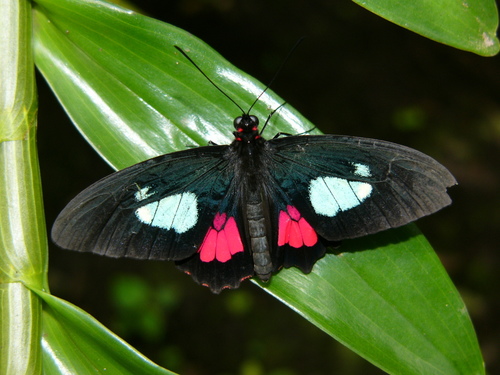
Parides eurimedes is a Neotropical swallowtail butterfly ranging from Mexico to northern South America, found in tropical forests.
Parides eurimedes (Stoll, 1782) has a wingspan ranging from 7 to 8.5 cm, which equals 2.8 to 3.3 inches. In the subspecies P. e. mylotes, the base wing color is black. Both sexes of this subspecies have a red patch on the dorsal side of the hindwing. Males have a triangular green patch on the dorsal side of the forewing, while females have a white patch on the dorsal forewing. A complete full desc...
View full details → 12
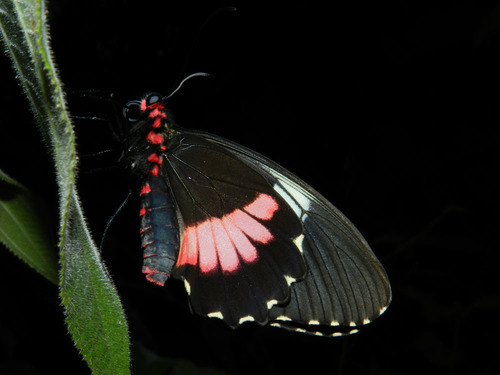
Parides iphidamas is a common poisonous butterfly native to Central and South America with several described subspecies.
Parides iphidamas (Fabricius, 1793) is a butterfly species with a wingspan of about 10 centimetres (3.9 in). On the dorsal side of the forewings, the base color is black, marked by a broad green patch that contains white spots; these markings are completely white in females. The dorsal side of the hindwings features a broad red band or spot, and many small yellow spots run along the wing edges. Th...
View full details → 13
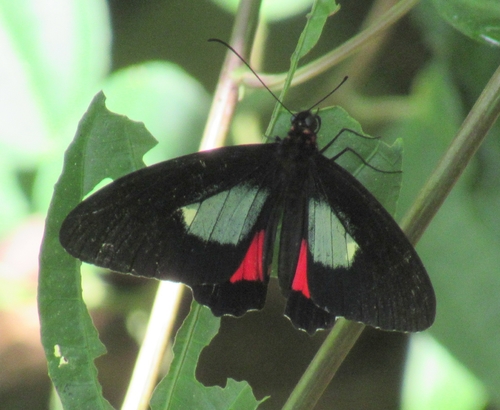
Parides panares is a butterfly species ranging from Guatemala to Ecuador, divided into three described subspecies.
Scientific name: Parides panares (Gray, 1853). Description sourced from Seitz, noting that Seitz misidentified panares panares as iphidamas, referencing P. lycimenes. Males are somewhat smaller than P. vertumnus. The red area on the male hindwing is less triangular, and its last spot is smaller. Females have slightly transparent forewing apices; their forewing spots are somewhat yellowish rather ...
View full details → 14
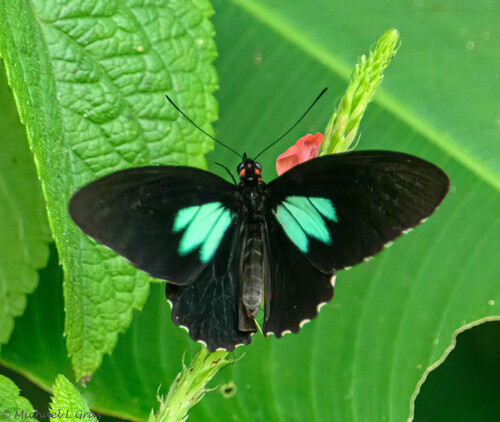
Parides sesostris is a non-threatened American butterfly with three recognized subspecies, larvae feed on Aristolochia species.
Parides sesostris (Cramer, 1779) has a wingspan of 100–110 millimetres (3.9–4.3 in). Its head, thorax, and abdomen are all black. On the upperside of its forewings, the base color is black, with large green areas covering the basal portion. The underside of the forewings is dark brown. The underside of the hindwings is dark brown, with a chain of red spots along the outer edge. The hindwings have ...
View full details → 15

Parides anchises is a swallowtail butterfly ranging from Colombia to southern Brazil and Paraguay, with multiple described subspecies.
This species is Parides anchises (Linnaeus, 1758), with the original description taken from Seitz. For the main species, the apex of the forewing is distinctly, though only slightly, transparent. In males, the tibiae and first segment of the tarsi are thickened and covered with fine hairs; the hindwing is blue and strongly iridescent. In females, the spot before the first median is larger than the...
View full details → 16

Parides bunichus is a common papilionid butterfly found in parts of South America, with multiple annual generations.
Parides bunichus is a butterfly species that belongs to the Papilionidae family. It is distributed across Brazil, Paraguay, Argentina, and Uruguay. The larva of this species is brownish black, marked with an oblique white band that extends laterally from the 6th body segment to the tubercle located on the 7th segment. The pupal stage of Parides bunichus lasts three weeks. This butterfly is very co...
View full details → 17
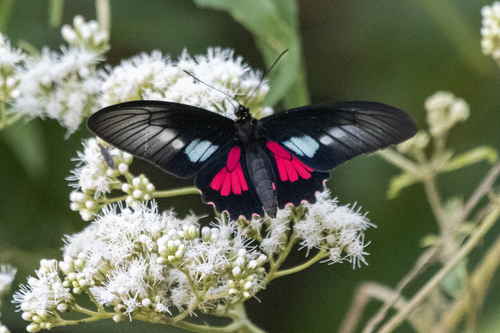
Parides neophilus is a butterfly species found across South America with multiple described subspecies.
Scientific name: Parides neophilus (Geyer, 1837) This description is reproduced from Seitz: For P. neophilus, in males, the cell of the upper surface of the hindwing is red almost all the way to the base. In both sexes, the second median vein of the hindwing arises at the same height as the subcostal vein. The species ranges from Colombia to Paraguay and southern Brazil, but is not found from Rio...
View full details → 18
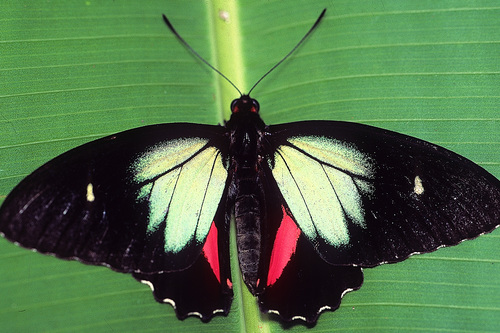
This is a description of the butterfly species Parides childrenae, including wing markings and two subspecies distributed from Guatemala to Ecuador.
Parides childrenae (Gray, 1832) has black wing uppersides. Males have a bright green patch and a small pale yellow subapical spot on the forewing, and a red patch on the hindwing. Females have a small white patch on the trailing edge of the forewing, a few pale subapical spots, and a band of red spots across the hindwing. The wing underside is also black. On the underside, males have small pale su...
View full details → 19
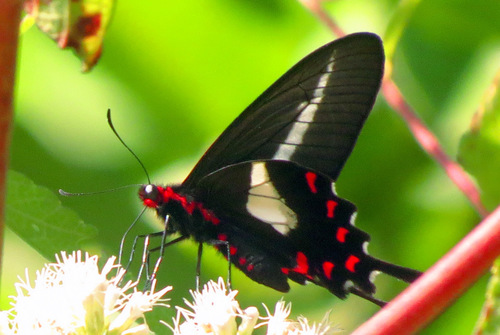
Parides proneus is a butterfly species with distinct wing markings, whose larvae feed on Aristolochia melastoma.
Parides proneus (Hübner, 1831) displays the following morphological traits in both males and females. Both pairs of wings bear a narrow white band. The red submarginal spots on the hindwing are straight or slightly curved, and the anal spot is not v-shaped. There is no discal spot located proximal to the anal submarginal spot. The width of the central band on the hindwing, and the number of spots ...
View full details → 20
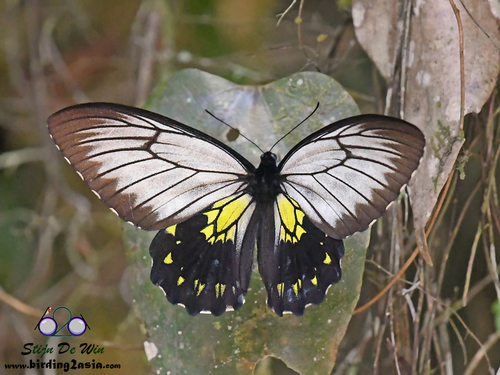
Troides andromache is a sexually dimorphic birdwing butterfly with distinct male and female wing patterns.
This species is sexually dimorphic. For females, the wingspan ranges from 150 to 180 mm, and the hindwings are discreetly scalloped. The body is black with yellow marks on the ventral abdomen. Males have black upperside forewings. The underside of male forewings is black, with white markings in the postdiscal area and between the veins. Male hindwings are yellow with black veins and a border of ma...
View full details → 21
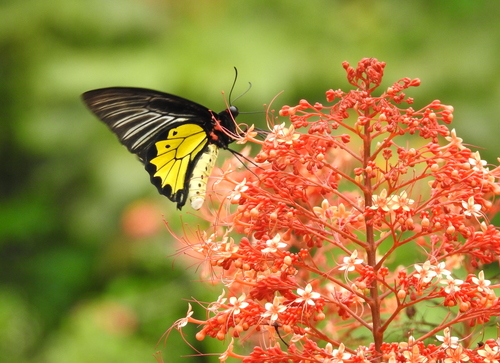
Troides minos is a Southern Indian butterfly whose pupae can produce noise when touched, and it is unpalatable to predators.
This entry describes the butterfly species Troides minos (Cramer, 1779), based primarily on a 1907 description from Charles Thomas Bingham in *The Fauna of British India, Including Ceylon and Burma, Butterflies Volume II*. Bingham notes that Troides minos differs from the related subspecies Troides helena cerberus in the following traits for males and females. For males: on the hindwing, the black...
View full details → 22
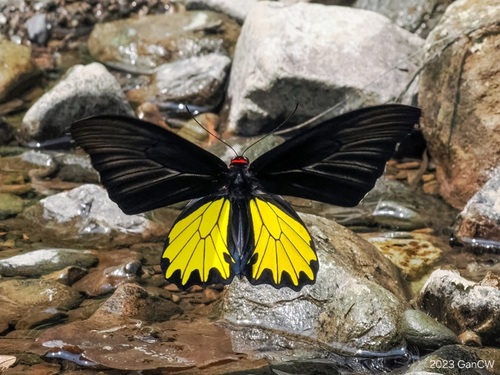
Troides helena, the common birdwing butterfly, is widely distributed across South and East Asia and was classified as vulnerable in 1985.
This entry covers the butterfly Troides helena (Linnaeus, 1758), commonly known as the common birdwing. Below is a description of the most common subspecies found in India, T. h. cerberus Felder. Troides helena has a wide distribution, and is locally common in forest habitats. Its global range covers Nepal, India, Bangladesh, Myanmar, peninsular and eastern Malaysia, Singapore, Indonesia, Laos, Ca...
View full details → 23
Troides aeacus (Felder & Felder, 1860)
Troides aeacus (Felder & Felder, 1860)
🦋 Animalia Papilionidae
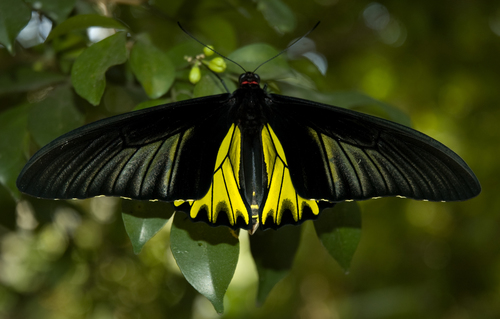
Troides aeacus is a large birdwing butterfly found across South and Southeast Asia, currently listed as Least Concern by the IUCN.
Troides aeacus, commonly known as the golden birdwing, has a wingspan that typically ranges from 150 to 170 millimetres (5.9 to 6.7 inches), and can reach up to 194 mm in the largest individuals. In males, the forewings are black with veins bordered by whitish color, while the hindwings are bright yellow. The underside of the wings is quite similar to the upperside. Females are larger than males, ...
View full details → 24
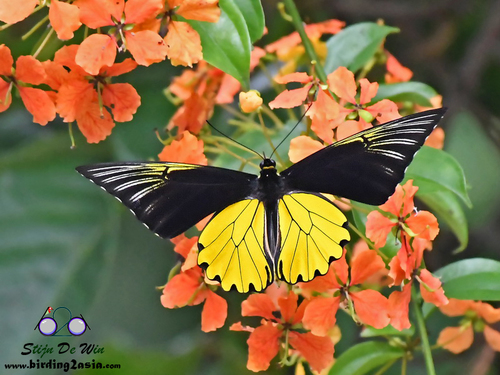
Troides amphrysus is a butterfly found across Indomalayan and Australasian rainforests, with distinct sexual wing coloration.
This is a description of Troides amphrysus (Cramer, 1779). For males, the upperside of the forewings is black or dark brown, with veins bordered by pale yellow. The upperside of the hindwings is golden yellow, with black veins and black spots along the edges. For females, the base body color is black or dark brown, with veins bordered by white. On the upperside of the female's hindwings, there is ...
View full details → 25
Troides magellanus (Felder & Felder, 1862)
Troides magellanus (Felder & Felder, 1862)
🦋 Animalia Papilionidae
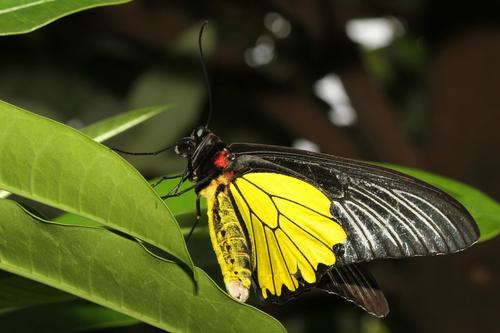
Troides magellanus is a sexually dimorphic swallowtail butterfly found in the Philippines and Taiwan's Orchid Island.
This species, Troides magellanus (Felder & Felder, 1862), shows strong sexual dimorphism between males and females. For males: the forewings have a black ground color, with veins bordered by white. The underside of the forewings is very similar to the upperside, except some veins are bordered by yellow instead. Male hindwings are golden yellow, with black veins and a black marginal edge. At a cert...
View full details → 26
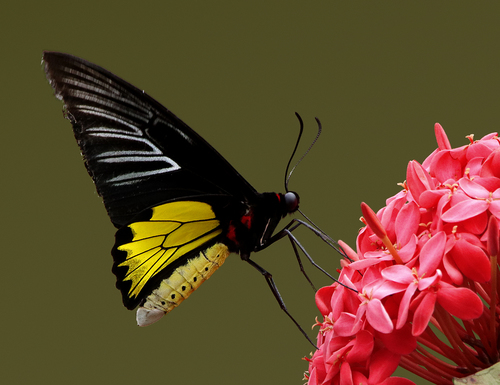
Troides rhadamantus, the tropical golden birdwing, is a large birdwing butterfly endemic to the Philippines, first described in 1835.
Troides rhadamantus, commonly known as the tropical golden birdwing, is a species of birdwing butterfly that lives in the Philippines. This species was first formally described by Hippolyte Lucas in 1835. Many subspecies of this butterfly are found across different islands of the Philippines, and some authors classify the related species Troides plateni and Troides dohertyi as subspecies of T. rha...
View full details → 27
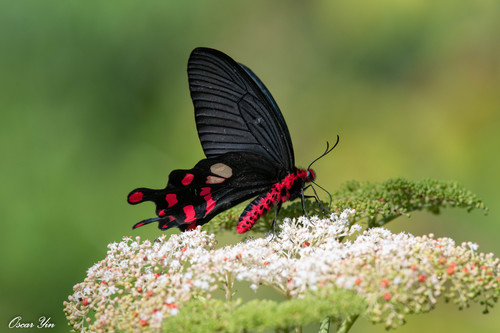
Byasa polyeuctes is a black, white and red swallowtail butterfly found across South and East Asia.
This species, Byasa polyeuctes, has a wingspan ranging from 110 to 140 mm. The sexes have identical appearance. The upper side of the wings is black and white, and the species has a prominent swallowtail shape on its wings. The body is red, and the tail has a red tip. The forewings are completely black on both the upper and undersides. The hindwings have two deep crenulations on each side of the s...
View full details → 28
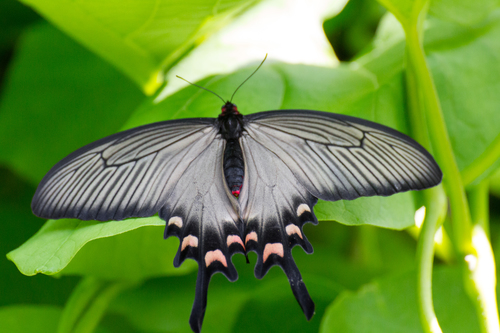
Byasa alcinous is a swallowtail butterfly found across East and Central Asia, that feeds on Aristolochia and overwinters as a pupa.
Byasa alcinous (Klug, 1836) has a wingspan of around 9 to 10 centimetres (3.5 to 3.9 inches). Its wings have a base color of black or dark brown. The hindwings feature long tails and a row of red spots along their edges. The thorax and abdomen are mostly black on both the upper and lower sides; they have several black spots, with all other areas colored red. Adult butterflies are active from May t...
View full details → 29
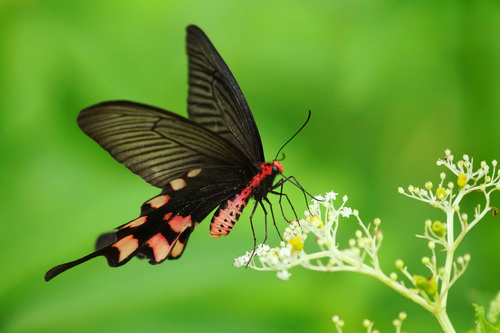
Byasa impediens, the pink-spotted windmill, is a Taiwanese Papilionidae swallowtail butterfly with black pink-spotted wings.
Byasa impediens, commonly known as the pink-spotted windmill, is a butterfly species belonging to the swallowtail family Papilionidae. It is found in Taiwan. This species has a wingspan of 10 to 11 cm. Its wings are black, marked with large light pink spots. The underside of the wings matches the appearance of the upper side. Part of the body is black, and the underside of the body is covered in r...
View full details → 30
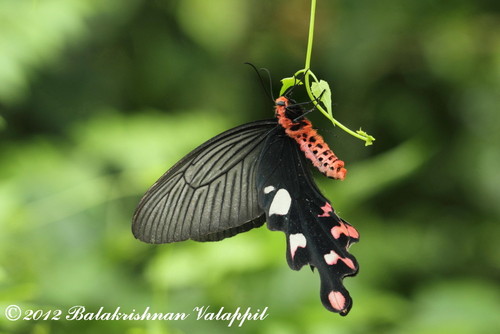
Byasa dasarada, the great windmill, is a beautiful non-threatened butterfly found across parts of South and East Asia.
This butterfly species has a wingspan ranging from 100 to 140 millimeters. It resembles the common windmill butterfly, but is typically larger and has broader tails. The marginal crescent marking on the upper side of its hindwing is white or cream-colored. Males and females have similar appearances, though females often have a complete discal band made of white spots on the hindwing. This butterfl...
View full details →Frequently Asked Questions
How many species are in the Papilionidae family?
This guide features 30 representative species from the Papilionidae family. The full family contains many more species worldwide — explore them all on iNature.
How to identify Papilionidae species?
Papilionidae species share common features in their flowers, leaves, and growth patterns. This guide provides photos and descriptions for 30 species. For instant field identification, use the iNature app.
Sources: GBIF, iNaturalist, Wikipedia · Disclaimer
Identify any species instantly — even offline
iNature uses on-device AI to identify plants, animals, fungi and more. No internet needed.
Download iNature — FreeStart Exploring Nature Today
Download iNature for free. 10 identifications on us. No account needed. No credit card required.
Download Free on App Store
