Plovers are charismatic shorebirds found along coastlines, riverbanks, and grasslands worldwide. The Charadriidae family includes the familiar killdeer, the endangered piping plover, and the long-distance migrating golden plovers. This guide covers the most commonly observed plover species and their distinctive identification features.
🐦 Bird Families
Plovers (Charadriidae): Species, Photos & Identification
1
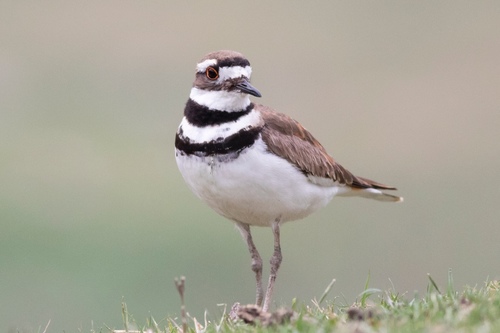
Charadrius vociferus (killdeer) is a distinctive two-banded North American plover with specific subspecies ranges and vocal behaviors.
Charadrius vociferus, commonly called the killdeer, is a tall, slender plover with a relatively long tail. Adult killdeer measure 20 to 28 cm (7.9 to 11.0 in) in length, have a wingspan of 59 to 63 cm (23 to 25 in), and typically weigh 72 to 121 g (2.5 to 4.3 oz). It has a short, thick, dark bill, flesh-colored legs, and a red eye ring. Its upperparts—including its cap, back, and wings—are mostly ...
View full details → 2
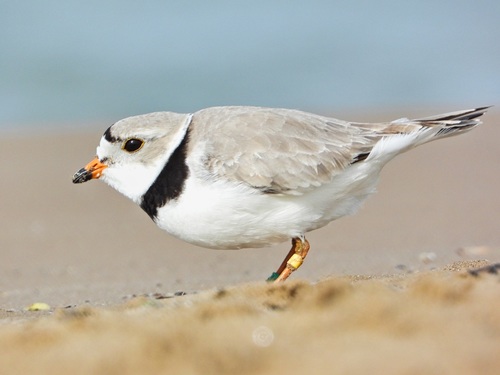
Piping plover (Charadrius melodus) is a small North American shorebird, discussed here with its traits, habitat, and climate change impacts.
The piping plover (Charadrius melodus Ord, 1824) is a stout sparrow-sized shorebird. It has a large rounded head, short thick neck, and stubby bill, with sand-colored dull gray or khaki plumage. Adults have yellow-orange legs and an orange bill with a black tip. During the breeding season, males have a prominent black band across the forehead between the eyes and a black ring around the neck, whil...
View full details → 3
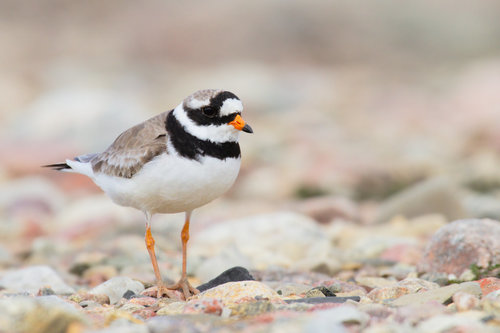
Common ringed plover (Charadrius hiaticula) is a small migratory shorebird with distinct plumage and webbing patterns.
Adults of this species measure 17–19.5 cm (6.7–7.7 in) in length, with a wingspan of 35–41 cm (14–16 in). They have grey-brown backs and wings, a white belly, and a white breast marked with a single black neckband. They have a brown cap, a white forehead, a black mask surrounding the eyes, and a short orange and black bill. Their legs are orange, and only the outer two toes are slightly webbed. Th...
View full details → 4
Charadrius semipalmatus Bonaparte, 1825
Charadrius semipalmatus Bonaparte, 1825
🦋 Animalia Charadriidae
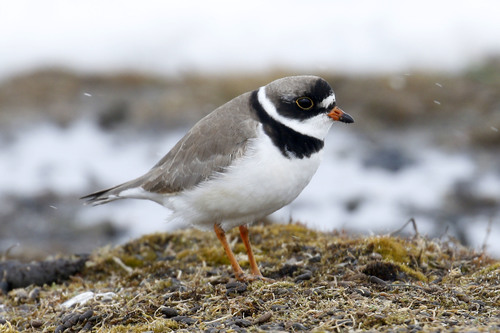
Charadrius semipalmatus is a small migratory plover that breeds in northern North America and winters further south.
This bird species, Charadrius semipalmatus Bonaparte, 1825, has an average weight of 47.4 g (1.7 oz) for males and 46.1 g (1.6 oz) for females. Overall body mass ranges from 37.6 to 54.7 g (1.3 to 1.9 oz), total body length measures 17–19 cm (6.7–7.5 in), and average wing length is 12–13 cm (4.7–5.1 in). Adult individuals have grey-brown backs and wings, a white belly, and a white breast marked wi...
View full details → 5
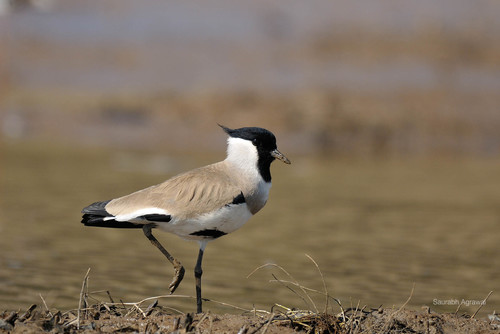
Vanellus duvaucelii, the river lapwing, is a 29–32 cm long bird with distinct plumage and a sharp call.
The river lapwing, scientifically named Vanellus duvaucelii (R.Lesson, 1826), measures 29 to 32 centimeters in length. It has black feathers on its crest, crown, face, and central throat, with grey-white coloration on the sides of its neck and nape. It features a grey-brown breast band, white underparts, and a black patch on its belly. Its back is brown, its rump is white, and its tail is black. T...
View full details → 6
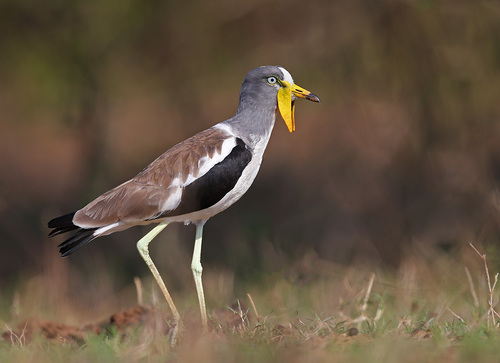
Vanellus albiceps is an easily identifiable lapwing with distinct plumage and coloration, with similar appearance across sexes and ages.
This species of lapwing, Vanellus albiceps Gould, 1834, is easily recognizable. It has strikingly black-and-white patterned wings and tail, a brown back, and white underparts. Its head has a particularly distinctive appearance: it is mostly grey, with a white crown and white foreneck. The eyering, facial wattles, and legs are all yellow. The plumage of females, males, and young birds is similar to...
View full details → 7
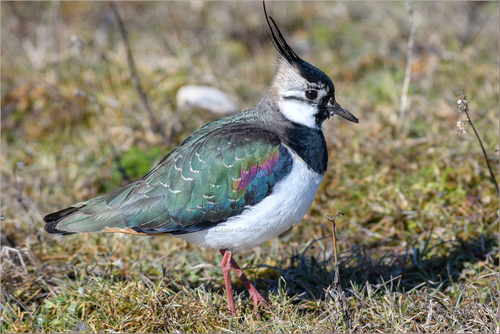
Vanellus vanellus, the northern lapwing, is a crested black-and-white lapwing with distinctive vocalizations, particularly in breeding season.
The northern lapwing, with the scientific name Vanellus vanellus (Linnaeus, 1758), measures 28–33 cm (11–13 in) in length, has a 67–87 cm (26–34 in) wingspan, and a body mass of 128–330 g (4.5–11.6 oz). It has rounded wings, a crest, and is the shortest-legged among all lapwings. Its plumage is primarily black and white, with a green tint on its back. Males have a long crest and black crown, throa...
View full details → 8
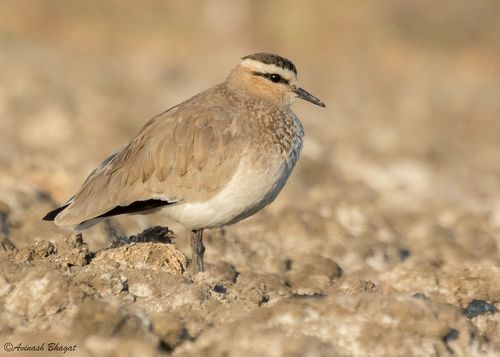
Vanellus gregarius, the sociable lapwing, is a medium-sized migratory lapwing that breeds in Kazakh steppes.
This is a medium-sized lapwing species, Vanellus gregarius, with moderately long black legs and a short black bill. It measures 27–30 cm (11–12 in) in length, and its call is a harsh kereck. Non-breeding winter-plumage individuals have light brown wings and a distinct head pattern: the crown is black, with a black eyestripe bordered above and below by white. The underside is white. In flight, the ...
View full details → 9
Vanellus leucurus (M.H.K.Lichtenstein, 1823)
Vanellus leucurus (M.H.K.Lichtenstein, 1823)
🦋 Animalia Charadriidae
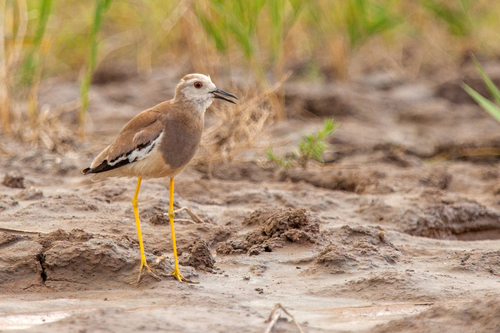
Vanellus leucurus, the white-tailed lapwing, is a long-legged migratory or resident wader covered by the AEWA conservation agreement.
The white-tailed lapwing, also called the white-tailed plover, scientific name Vanellus leucurus, is a wading bird in the lapwing genus Vanellus. The genus name Vanellus comes from Medieval Latin for lapwing, originating from vannus, the word for a winnowing fan. The specific epithet leucurus comes from Ancient Greek leukouros, meaning "white-tailed". This is a medium-sized lapwing with long legs ...
View full details → 10
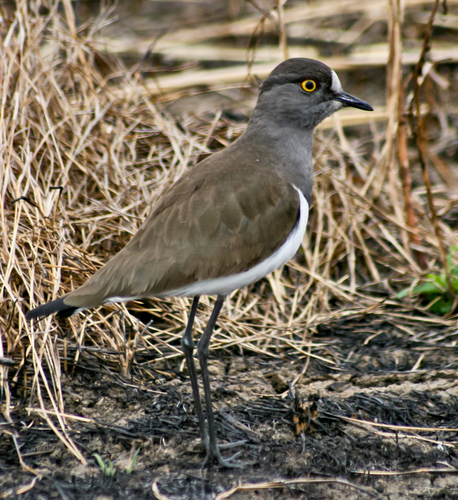
Vanellus lugubris, the Senegal or lesser black-winged lapwing, is a Charadriidae bird found in open grassy habitats across many African countries.
Note that the African wattled lapwing (Vanellus senegallus) is sometimes referred to as the Senegal wattled plover. Vanellus lugubris, commonly called the Senegal lapwing or lesser black-winged lapwing, is a species of bird in the family Charadriidae. It occurs across multiple African countries: Angola, Burundi, Cameroon, the Republic of the Congo, the Democratic Republic of the Congo, Ivory Coast...
View full details → 11
Vanellus crassirostris (Hartlaub, 1855)
Vanellus crassirostris (Hartlaub, 1855)
🦋 Animalia Charadriidae
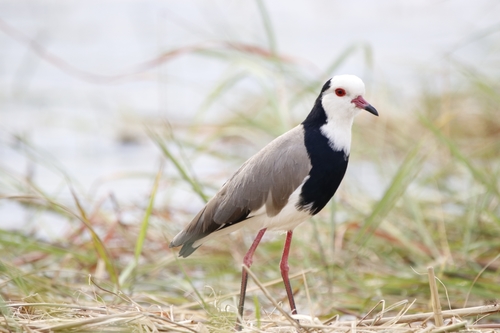
Vanellus crassirostris, the long-toed lapwing, is a lapwing species native to central and eastern Africa.
The long-toed lapwing, with scientific name Vanellus crassirostris (Hartlaub, 1855), measures 31 cm (12 in) in length and has a body mass of 162–225 g (5.7–7.9 oz). It is a lapwing colored brown, black, and white, with long red legs, long toes, and a red bill that has a black tip. It has short wing spurs and rounded wings; when in flight, it shows extensive white on the wing feathers, and its legs...
View full details → 12
Vanellus melanopterus (Cretzschmar, 1829)
Vanellus melanopterus (Cretzschmar, 1829)
🦋 Animalia Charadriidae
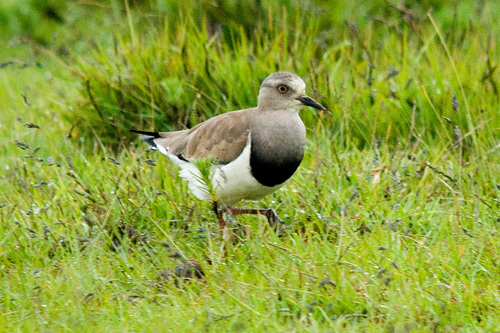
Vanellus melanopterus is a lapwing species distinct from the related Senegal lapwing, with specific physical traits, diet, and territorial behavior.
This lapwing has a black breast band that divides its grey head and neck from its white underside. Its wing coverts are brown. It has a variable but prominent white patch on the forehead, a feature it shares with its close relative the Senegal lapwing. Unlike the Senegal lapwing, this species shows a prominent white wingbar when in flight, bordered by black remiges. The two species also differ in ...
View full details → 13

Vanellus spinosus, the spur-winged lapwing, is a medium-large wader found across parts of Africa and western Eurasia.
The spur-winged lapwing, scientifically named Vanellus spinosus (Linnaeus, 1758), is a medium-large wader. It has a black crown, chest, foreneck stripe, and tail; its face, the remainder of its neck, and its belly are white, while its wings and back are light brown. Both its bill and legs are black, and it produces a distinctive loud did-he-do-it call. The species' common name comes from a small c...
View full details → 14
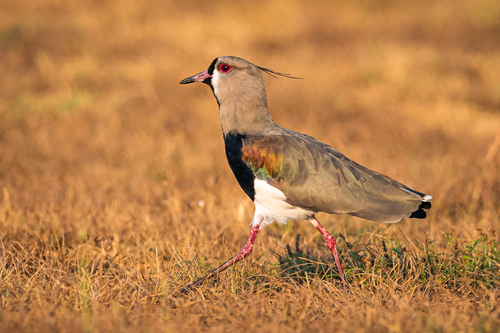
Vanellus chilensis is the only crested wader in South America, a ground-nesting bird found across open South American habitats.
Vanellus chilensis, commonly known as the southern lapwing, is the only crested wader native to South America. It measures 32 to 38 cm (13 to 15 in) in length and weighs approximately 250 to 425 g (8.8 to 15.0 oz). Its upperparts are mostly brownish grey, with bronze glossing on the shoulders. The head has a distinct striking pattern: it is primarily grey, with a black patch covering the forehead,...
View full details → 15
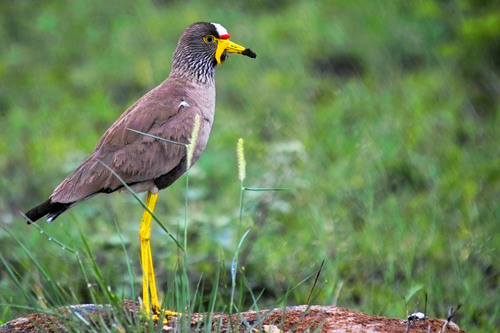
African wattled lapwing is a large Charadriidae wader that breeds in sub-Saharan Africa, covered by the AEWA conservation agreement.
The African wattled lapwing, whose scientific name is Vanellus senegallus, is also called the Senegal wattled plover or just wattled lapwing. It is a large lapwing, belonging to the group of moderately large wading birds in the plover family Charadriidae. It is a resident breeding species across most of sub-Saharan Africa, excluding rainforest regions, though it makes seasonal movements. These bir...
View full details → 16
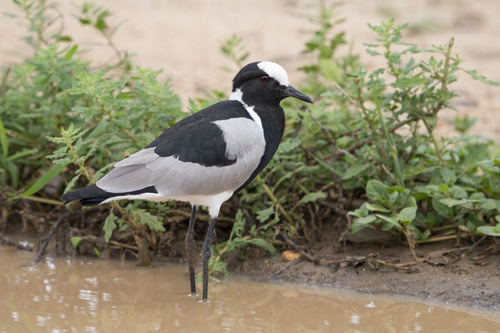
Vanellus armatus (blacksmith lapwing) is a boldly patterned African lapwing that nests near water and feeds on invertebrates.
Vanellus armatus, commonly called blacksmith lapwings, have a very bold, contrasting plumage pattern in black, grey, and white, which may act as a warning color to predators. It is one of five lapwing species (two African, one Asian, two Neotropical) that share red eyes, bold pied plumage, and a carpal spur on the wrist joint. This spur is a sharp black protrusion that the birds use to aggressivel...
View full details → 17
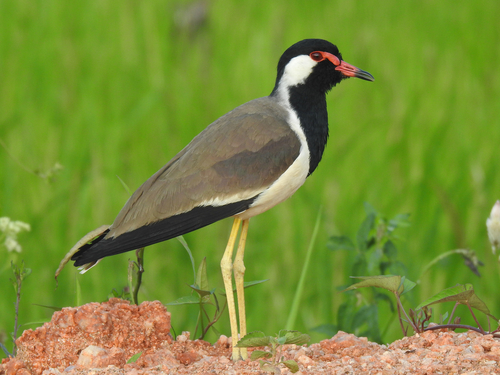
Vanellus indicus, the red-wattled lapwing, is a large resident wader widespread across much of South and West Asia.
Red-wattled lapwings (scientific name Vanellus indicus (Boddaert, 1783)) are large waders, approximately 35 cm (14 in) in total length. Their wings and back are light brown with a purple to green iridescent sheen, while their head, and a bib covering the front and back of the neck, are black. A prominent white patch runs between these two color sections, stretching from the belly and tail, along t...
View full details → 18
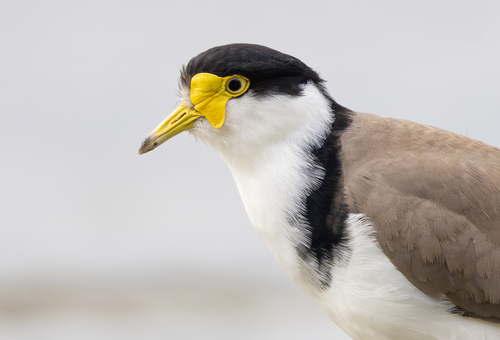
Vanellus miles, the masked lapwing, is the largest Charadriidae species with two distinct subspecies found across Australia, New Guinea and New Zealand.
This species, commonly called the masked lapwing, has the scientific name Vanellus miles (Boddaert, 1783). It is the largest member of the plover and lapwing family Charadriidae. Adults measure 30 to 37 cm (12 to 15 inches) in total length, with a wingspan ranging from 75 to 85 cm (30 to 33 inches). Each wing has a clearly visible yellow spur at the carpal joint. Body mass differs by subspecies: t...
View full details → 19
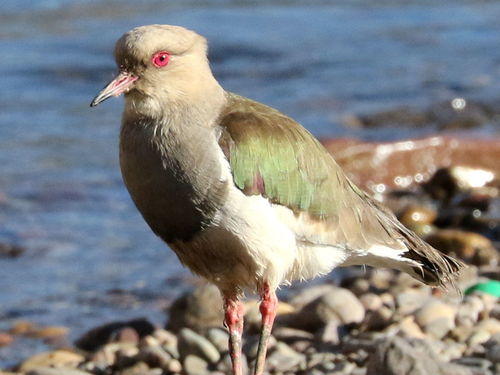
Vanellus resplendens, the Andean lapwing, is a 33 cm long plover found in Andean open habitats from Colombia to Argentina.
The Andean lapwing, scientifically named Vanellus resplendens (Tschudi, 1843), is approximately 33 cm (13 in) long and weighs between 193 and 230 g (6.8 to 8.1 oz). Males and females look identical, and the species does not undergo seasonal changes to its plumage. Adult Andean lapwings have a creamy gray head and neck, with a dark brownish gray patch surrounding the eye. Their upperparts are color...
View full details → 20
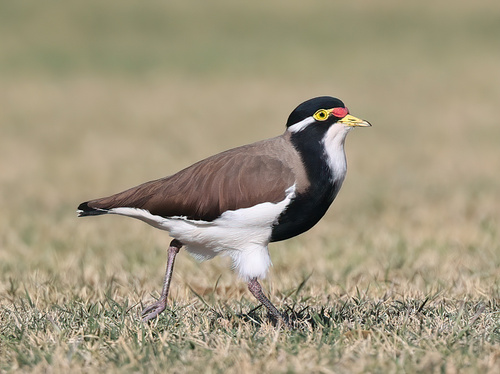
Vanellus tricolor, the banded lapwing, is a medium endemic Australian shorebird of open grassy habitats.
The banded lapwing (scientific name Vanellus tricolor (Vieillot, 1818)) is a medium-sized shorebird. Adults have short dark purplish legs, a dull red tibia, and measure 25 cm to 29 cm in length, with an average weight of 190 grams. Juveniles are 22 cm to 25.5 cm long and weigh between 124 and 133 grams. This species has an upright stance and walks slowly, breaking into a faster trot when alarmed. ...
View full details → 21
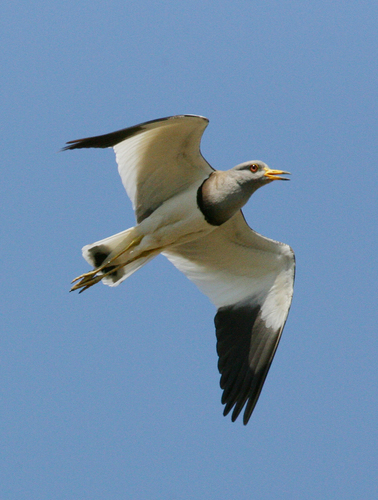
Vanellus cinereus, the grey-headed lapwing, is a 34–37 cm long wading bird with distinct plumage and a sharp chee-it call.
The grey-headed lapwing, Vanellus cinereus, measures 34–37 cm in total length. It has a grey head and neck, a darker grey breast band, and a white belly. Its back is brown, its rump is white, and its tail is black. This species is particularly noticeable when in flight: it has black primary flight feathers, white underwings and white upper wing secondaries, and brown upper wing coverts. Adult male...
View full details → 22
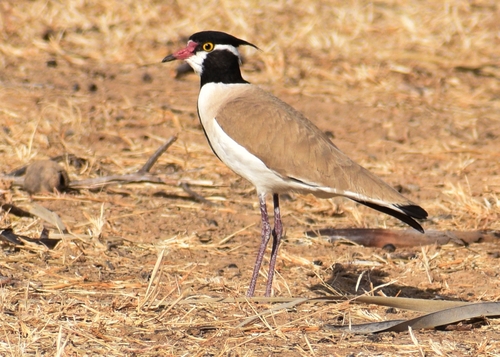
Vanellus tectus, the black-headed lapwing, is a distinctive large wader that breeds across sub-Saharan Africa.
The black-headed lapwing, also called the black-headed plover (Vanellus tectus), is a large member of the lapwing group, a category of medium-large wading birds in the family Charadriidae. It is a resident breeding species found across sub-Saharan Africa, ranging from Senegal to Ethiopia, though it makes seasonal movements. It lays two or three eggs in a scrape dug into the ground. These birds are...
View full details → 23
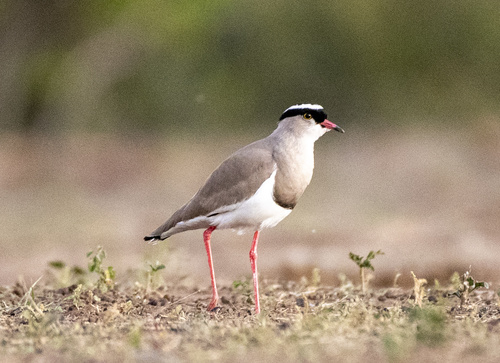
Vanellus coronatus, the crowned lapwing, is a distinctive African lapwing covered by the AEWA conservation agreement.
The crowned lapwing (Vanellus coronatus) is easily identifiable by its mix of brown and white plumage, most notably a black crown crossed by a ring-shaped white halo. Adult crowned lapwings are noisy and easy to spot. On average, males are 3% larger than females. Juveniles are duller versions of adults, with vermiculated patterns on their wings and mantle, yellowish legs instead of the adults' red...
View full details → 24
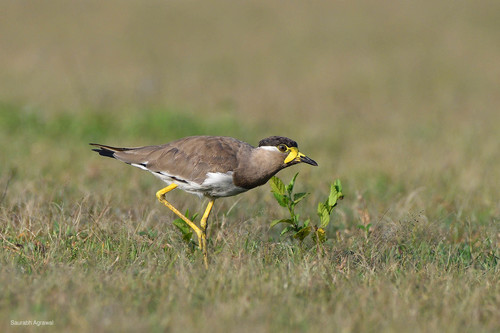
Vanellus malabaricus, the yellow-wattled lapwing, is a medium-sized wader found across South Asia with specific breeding and feeding behaviours.
This species is the yellow-wattled lapwing, with the scientific name Vanellus malabaricus (Boddaert, 1783). It is a conspicuous, easily identifiable medium-sized pale brown wader that inhabits dry stony ground, open grassland, and scrub habitats. Its key identifying features include: a black crown separated from the brown neck by a narrow white band, large yellow facial wattles, black chin and thr...
View full details → 25
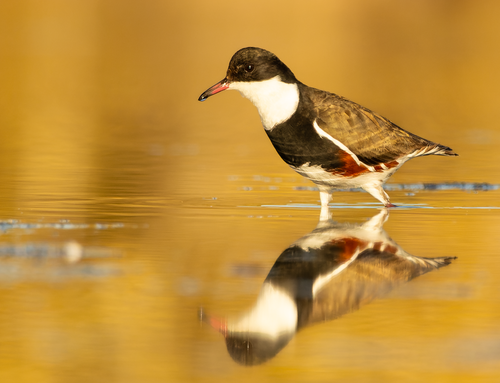
Erythrogonys cinctus, the red-kneed dotterel, is a distinctively marked bird native to Australia, New Guinea and Indonesia.
This species, Erythrogonys cinctus Gould, 1838, is commonly known as the red-kneed dotterel. Adult red-kneed dotterels have distinctively patterned plumage. They have a black cap or hood that starts at the bill, extends below the eyes, and blends into the grey-brown color of the back at the nape. Their chin and throat are white. A broad black band crosses the breast, connects to the nape, and exte...
View full details → 26
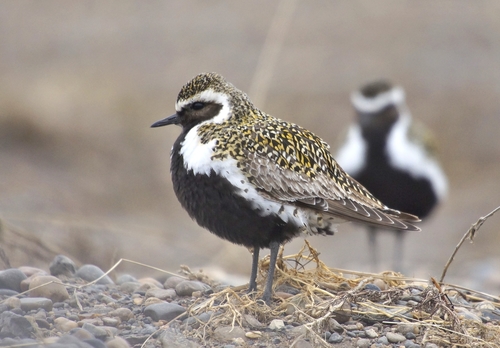
The European golden plover Pluvialis apricaria is a thickset bird with a distinct white S-shaped band, breeding across northern Eurasia and wintering further southwest.
This species, known as the European golden plover, has a fairly thickset build, with wings that are only slightly longer than its tail. Its most prominent distinguishing feature is a white S-shaped band that stretches from its forehead to its flanks. For breeding, the European golden plover typically occupies Arctic tundra and other moorland areas. Its breeding range extends west to Iceland, wher...
View full details → 27
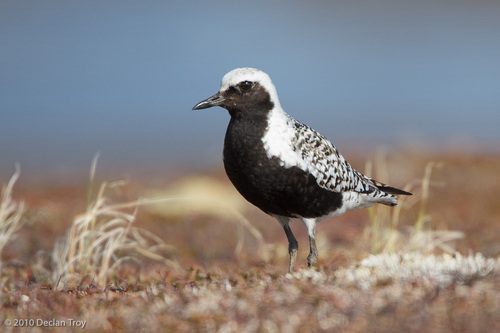
Pluvialis squatarola, the grey plover, is a medium-sized shorebird with distinct seasonal plumage, feeding on small invertebrates on beaches.
The grey plover, scientifically named Pluvialis squatarola, measures 27 to 30 centimeters (11 to 12 inches) in body length, with a wingspan ranging from 71 to 83 centimeters (28 to 33 inches). Its typical weight is 190 to 280 grams (6.7 to 9.9 ounces), which can reach up to 345 grams (12.2 ounces) when the bird prepares for migration. During spring and summer, from late April or May through August...
View full details → 28
Pluvialis dominica (P.L.S.Müller, 1776)
Pluvialis dominica (P.L.S.Müller, 1776)
🦋 Animalia Charadriidae
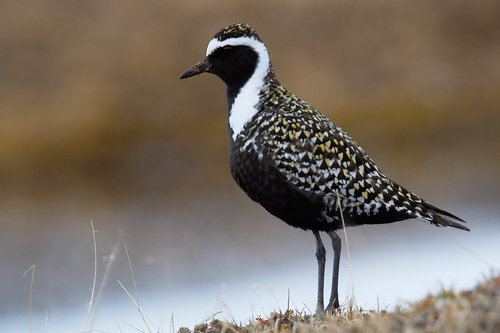
Pluvialis dominica (American golden plover) is a migratory shorebird that breeds in Arctic North America and winters in southern South America.
Pluvialis dominica, commonly known as the American golden plover, has the following measured dimensions: body length ranges from 24 to 28 cm (9+1⁄2–11 in), weight ranges from 122 to 194 g (4+5⁄16–6+13⁄16 oz), and wingspan ranges from 65 to 67 cm (25+1⁄2–26+1⁄2 in). Breeding adult American golden plovers have black coloration on the face, neck, breast, and belly, along with a white crown and nape t...
View full details → 29
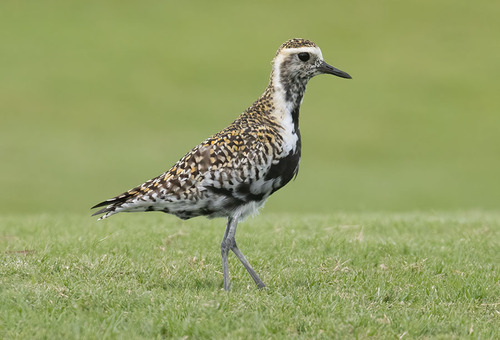
Pluvialis fulva, the Pacific golden plover, is a migratory shorebird that breeds in Arctic regions and winters across Asia, Australasia and Pacific islands.
Scientific name: Pluvialis fulva (J.F.Gmelin, 1789). Description: Adult Pacific golden plovers are around 25 cm (9.8 in) long, with an average wingspan of 61 cm (24 in). When fat-free at their lightest, these birds weigh approximately 135 g (4.8 oz). Birds begin putting on weight in March, and reach around 200 g (7.1 oz) just before departing for their Arctic breeding grounds. In breeding plumage,...
View full details → 30
Anarhynchus frontalis Quoy & Gaimard, 1832
Anarhynchus frontalis Quoy & Gaimard, 1832
🦋 Animalia Charadriidae
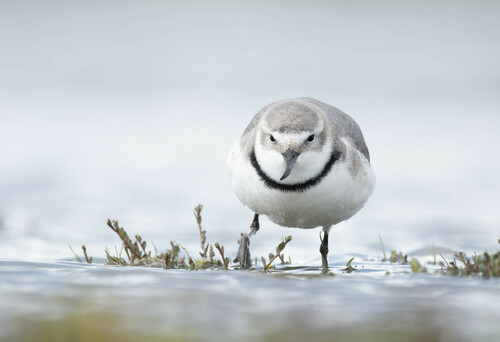
Anarhynchus frontalis (wrybill) is a small New Zealand plover, the only bird with a right-curved asymmetric bill.
Anarhynchus frontalis, commonly called the wrybill, is a small, plump plover. It measures 20 to 21 cm (7.9–8.3 in) in length and weighs between 43 and 71 g (1.5–2.5 oz). Its plumage shows slight sexual dimorphism. Males have a white forehead, pale grey crown, nape, back, wings and tail, and white throat, breast, belly and rump, with a thin black band across the breast. In females, this breast band...
View full details →Frequently Asked Questions
How many species are in the Charadriidae family?
This guide features 30 representative species from the Charadriidae family. The full family contains many more species worldwide — explore them all on iNature.
How to identify Charadriidae species?
Charadriidae species share common features in their flowers, leaves, and growth patterns. This guide provides photos and descriptions for 30 species. For instant field identification, use the iNature app.
Sources: GBIF, iNaturalist, Wikipedia · Disclaimer
Identify any species instantly — even offline
iNature uses on-device AI to identify plants, animals, fungi and more. No internet needed.
Download iNature — FreeStart Exploring Nature Today
Download iNature for free. 10 identifications on us. No account needed. No credit card required.
Download Free on App Store
