The Caryophyllaceae (pink or carnation family) includes carnations, pinks, baby's breath, and the common chickweed found in gardens worldwide. These plants typically have opposite leaves and distinctive notched petals. This guide covers the most commonly encountered species from alpine meadows to backyard weeds.
🌱 Plant Families
Pink Family (Caryophyllaceae): Species & Identification
1
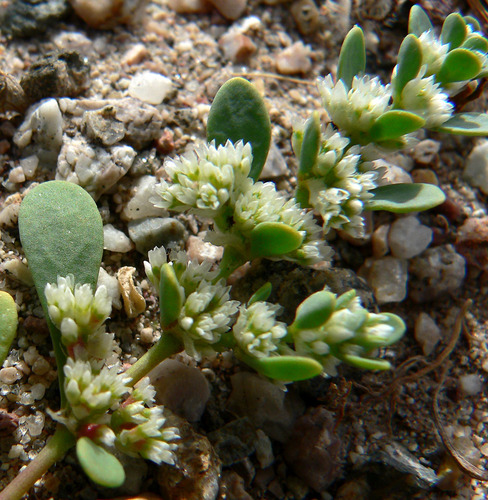
Achyronychia cooperi, the only species in genus Achyronychia, is a small mat-forming desert flower native to southwestern North America.
Achyronychia is a monotypic genus of flowering plant, holding only one species: Achyronychia cooperi, which has the common names onyxflower and frost-mat. This species is native to the Mojave and Sonoran Deserts, found in northern Mexico and the U.S. states of California, Nevada, Utah, and Arizona. In California, it has been recorded from San Diego, Imperial, Riverside, Los Angeles, San Bernardino...
⚠️ Toxicity: Insufficient toxicity evidence; avoid direct contact and ingestion.
View full details →
2
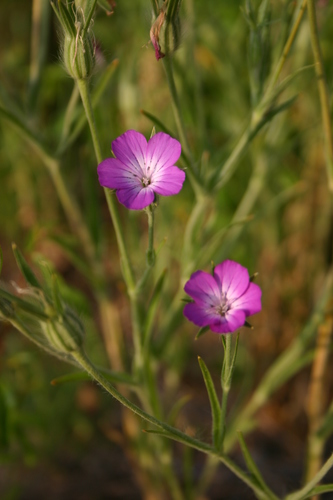
Agrostemma githago L., common corncockle, is a poisonous flowering plant now widespread as a weed in temperate regions with documented biological activities.
Agrostemma githago L. is an erect, hairy annual plant that grows up to 100 cm (39 in) tall, with few branches. Its leaves are pale green, opposite, narrowly lanceolate, held nearly erect against the stem, and measure 45–145 mm (1.8–5.7 in) long. Flowers are typically borne singly at the tips of stems and branches, are scentless, and range from 25–50 mm (1.0–2.0 in) up to 5 cm (2.0 in) in diameter....
⚠️ Toxicity: Toxicity risk detected (mainly via ingestion); avoid direct contact and ingestion.
View full details →
3
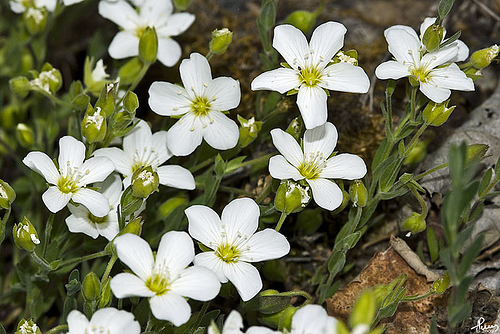
Arenaria montana L. is an evergreen perennial flowering plant that holds the Royal Horticultural Society's Award of Garden Merit.
Arenaria montana L. is an evergreen perennial plant that reaches a height of 14 to 22 centimeters (6 to 9 inches). It bears opposite leaves that are lanceolate or ovate in shape, range in color from green to grayish-green, and measure 10 to 30 millimeters (0.4 to 1.2 inches) long. From mid to late spring, it produces dense clumps of white to near-white flowers. Each flower is roughly 25 millimeter...
⚠️ Toxicity: Insufficient toxicity evidence; avoid direct contact and ingestion.
View full details →
4
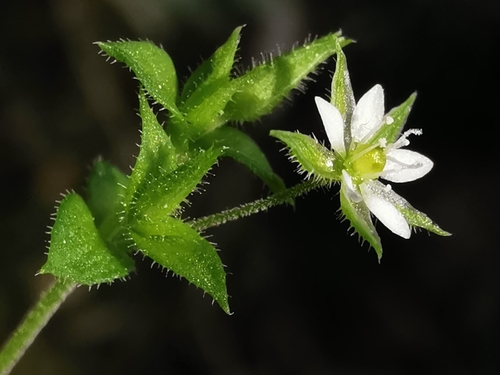
Arenaria serpyllifolia is an annual/biennial flowering plant with traditional medicinal uses for multiple conditions.
Arenaria serpyllifolia L., commonly called thyme-leaf sandwort or thyme-leaved sandwort, is an annual or biennial flowering plant belonging to the pink and carnation family Caryophyllaceae. It grows from Nepal to Pakistan, and also has wide distributions in the United Kingdom and southern Poland. This species has been introduced to Chile and is widespread across China. In its ecology, ants typical...
⚠️ Toxicity: Insufficient toxicity evidence; avoid direct contact and ingestion.
View full details →
5
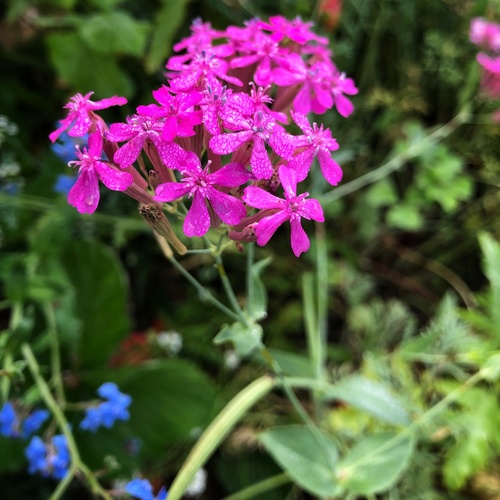
Atocion armeria is a flowering plant native to Europe, introduced and invasive in North America, blooming June to October in the British Isles.
Atocion armeria (L.) Raf. grows to a height of 20 to 70 centimetres, which equals 8 to 27 and one half inches. It produces numerous smooth leaves that are 2.5 to 5 cm (1 to 2 inches) long, with shapes ranging from elliptic to oval or narrowly oval. In the British Isles, its blooming season runs from June to October. Flower clusters of pink or lavender blooms grow at stem tips, and these clusters c...
⚠️ Toxicity: Insufficient toxicity evidence; avoid direct contact and ingestion.
View full details →
6
Cardionema ramosissima (Weinm.) A.Nelson & J.F.Macbr.
Cardionema ramosissima (Weinm.) A.Nelson & J.F.Macbr.
🌿 Plantae Caryophyllaceae
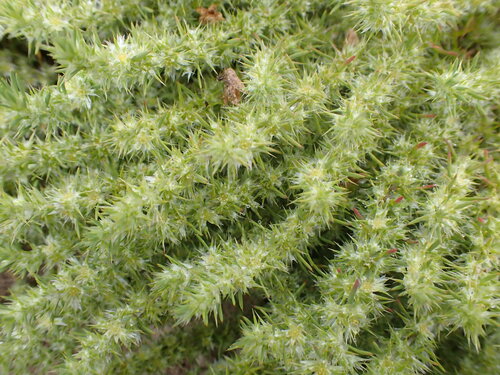
Cardionema ramosissima is a prostrate mat-forming perennial herb used for beach erosion control, with a disjunct range across the Americas.
Cardionema ramosissima (Weinm.) A.Nelson & J.F.Macbr. is a prostrate perennial herb. Its stems grow 5 to 30 centimeters (2.0 to 11.8 inches) long and form dense mats, with a pubescent covering of fine hairs across the entire plant. Stems are often hidden by numerous 4 to 8 millimeter (0.16 to 0.31 inch) long stipules that fill the spaces between leaves. Its leaves are needle-shaped with a fine sha...
⚠️ Toxicity: Insufficient toxicity evidence; avoid direct contact and ingestion.
View full details →
7
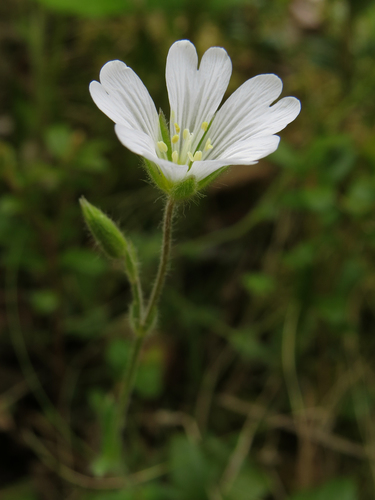
Cerastium alpinum (alpine mouse-ear) is a mat-forming perennial native to the north Atlantic region, grown in rock gardens.
Cerastium alpinum, commonly known as alpine mouse-ear or alpine chickweed, is a mat-forming perennial plant. This species was first formally described by Carl Linnaeus in 1753. It is native to Greenland, Canada, and northern Europe. It is cultivated for use in rock gardens, valued for its numerous small white flowers and silver-haired stems and foliage. There are three recognized subspecies of Cer...
⚠️ Toxicity: Insufficient toxicity evidence; avoid direct contact and ingestion.
View full details →
8
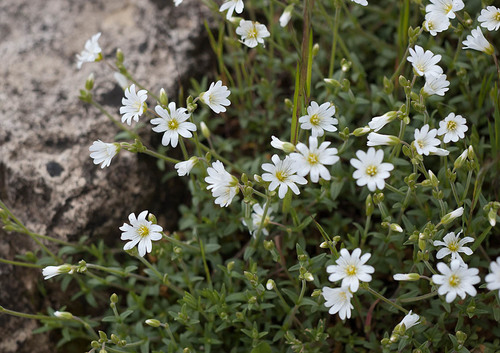
Cerastium arvense L. is a perennial herb with white flowers, and gardeners disagree on growing it.
Cerastium arvense L. (field mouse-ears) is a perennial herb that reaches a height of 30–45 cm (12–18 in). It can grow as a mat, clump, creeper, or upright flowering plant, and develops from either a taproot or a tangled network of rhizomes. Its texture is typically somewhat hairy, often with glandular hairs. The leaves are linear, lance-shaped, or oblong, and measure a few centimeters long. Its in...
⚠️ Toxicity: Insufficient toxicity evidence; avoid direct contact and ingestion.
View full details →
9
Cerastium brachypetalum Desp. ex Pers.
Cerastium brachypetalum Desp. ex Pers.
🌿 Plantae Caryophyllaceae
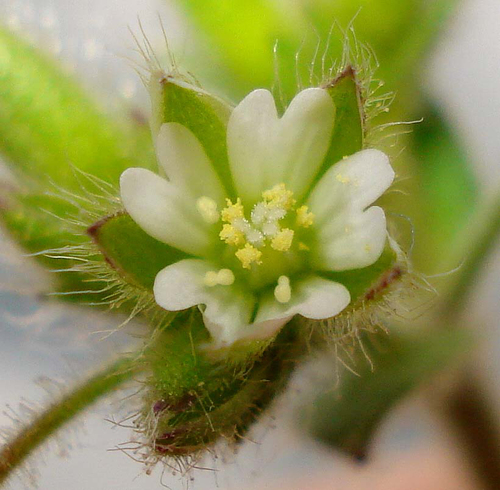
Cerastium brachypetalum is a spring-blooming annual chickweed, native to Eurasia and north Africa, naturalized in North America.
Cerastium brachypetalum Desp. ex Pers. is an annual spring-blooming plant species, commonly known by the common names gray chickweed, grey mouse-ear, and gray mouse-ear chickweed. Its native range covers Mediterranean and temperate Europe, northwestern Africa, the Caucasus, and Western Asia. It has been introduced to North America, where it is now naturalized. In the United Kingdom, the wild flowe...
⚠️ Toxicity: Insufficient toxicity evidence; avoid direct contact and ingestion.
View full details →
10
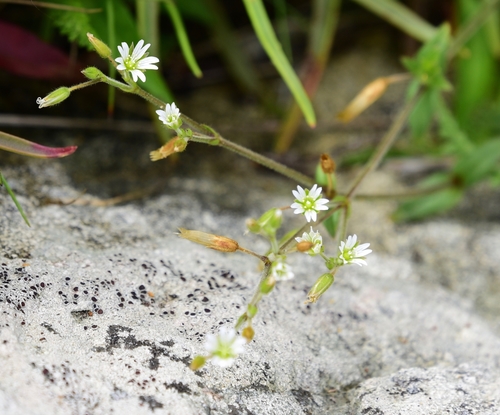
Cerastium fontanum Baumg. is a low-growing herb native to Eurasia and Greenland, widely introduced across much of North America and other regions.
Cerastium fontanum Baumg. is a low-growing species covered in small, non-sticky hairs that lack glandular tips. It produces erect flowering stems that can grow up to 45 cm (18 in) long, with opposite stalkless leaves that reach up to 20 mm (0.79 in) in length. It also has prostrate, non-flowering branches. Its petals are either shorter than the sepals or slightly longer, and are deeply divided. Ea...
⚠️ Toxicity: Insufficient toxicity evidence; avoid direct contact and ingestion.
View full details →
11
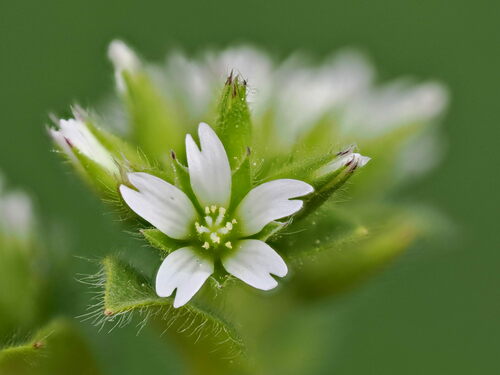
Cerastium glomeratum Thuill. is an annual herb with documented traditional food and medicinal uses.
Cerastium glomeratum Thuill. is an annual herb that grows from a slender taproot. It produces a branched stem up to 45 centimeters tall, covered in abundant glandular and non-glandular hairs. Its leaves are opposite, hairy, and grow up to 2 cm long; basal leaves typically die back before flowering begins. Bracts are green, hairy, and generally similar in appearance to the plant’s leaves. The inflo...
⚠️ Toxicity: Insufficient toxicity evidence; avoid direct contact and ingestion.
View full details →
12
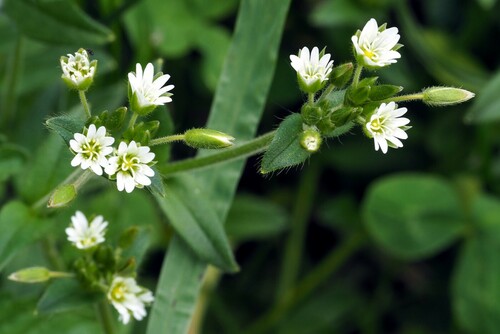
Cerastium holosteoides, common mouse-ear chickweed, is a widespread flowering weed from the Old World introduced globally.
Cerastium holosteoides, commonly known as common mouse-ear chickweed, is a species of flowering plant in the Caryophyllaceae family. It is native to temperate and subarctic regions of the Old World, including scattered countries across Africa, almost all of Eurasia, and extending to New Guinea. Classified as one of the most widespread weeds globally, it has been introduced to most of North America...
⚠️ Toxicity: Insufficient toxicity evidence; avoid direct contact and ingestion.
View full details →
13
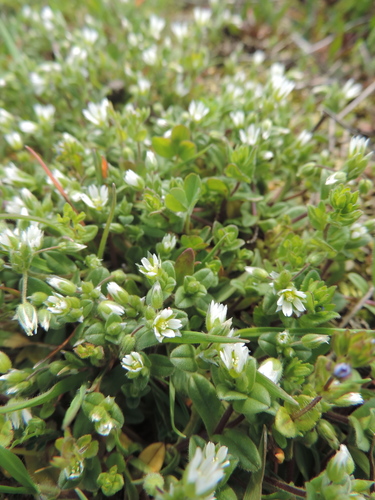
Cerastium semidecandrum L. is described with five - stamened flowers and emarginate petals, and is referenced in multiple botanical works with various descriptions.
Cerastium with five - stamened flowers and emarginate petals. References: Hort. cliff. 173, Fl. suec. 382, It. oel. 17, Roy. lugdb. 450, Gron. virg. 51, Gort. gelr. 90. Also described as Cerastium with a corolla shorter than the calyx in Fl. lapp. 193. It was referred to as the smaller hairy Cerastium with a small flower in Raj. angl. 3. p. 348. t. 15. f. 1. And as the smaller hairy field Myosotis...
View full details → 14
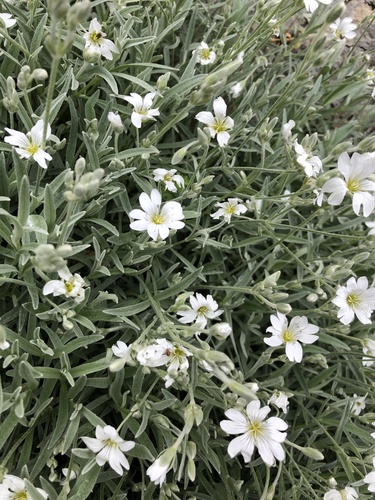
Cerastium tomentosum L. is a low-growing evergreen perennial herb, native to Italy, widely cultivated as an ornamental groundcover.
Cerastium tomentosum L. is an evergreen perennial herbaceous plant with creeping offshoots. It typically grows 15 to 30 centimeters tall, and rarely reaches up to 45 centimeters. The entire plant is covered in dense hair. Its leaves grow up to 30 millimeters long, shaped linear to lanceolate. Leaves are covered with silky, silvery, frizzy, entangled hairs that form a layer that looks like whitish ...
⚠️ Toxicity: Insufficient toxicity evidence; avoid direct contact and ingestion.
View full details →
15
Cherleria biflora (L.) A.J.Moore & Dillenb.
Cherleria biflora (L.) A.J.Moore & Dillenb.
🌿 Plantae Caryophyllaceae
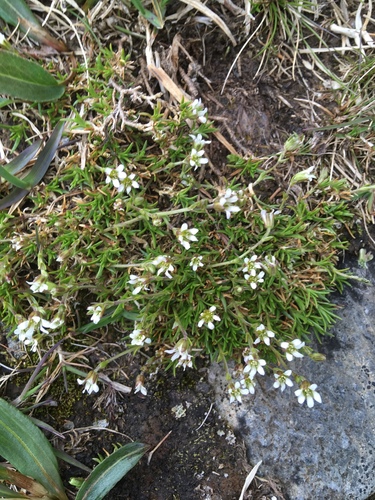
Cherleria biflora is a mat- or cushion-forming perennial found across the Northern Hemisphere in alpine, subalpine, and arctic rocky habitats.
Cherleria biflora (L.) A.J.Moore & Dillenb. is a perennial plant species that grows in the form of mats and cushions. It produces flowers from June through August each year. This species occurs in the upper subalpine and alpine zones across North America (including the Rocky Mountains and the Cascades), Central Europe, Northern Europe, and Asia. It grows in dry, gravelly to rocky slopes within the...
⚠️ Toxicity: Insufficient toxicity evidence; avoid direct contact and ingestion.
View full details →
16
Cherleria obtusiloba (Rydb.) A.J.Moore & Dillenb.
Cherleria obtusiloba (Rydb.) A.J.Moore & Dillenb.
🌿 Plantae Caryophyllaceae
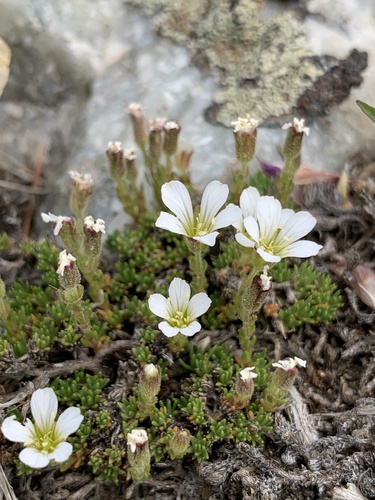
Cherleria obtusiloba, alpine sandwort, is a slow-growing alpine perennial cushion plant in the Caryophyllaceae family.
Scientific name: Cherleria obtusiloba (Rydb.) A.J.Moore & Dillenb., also known as alpine sandwort. Description: This is a perennial low-growing plant that forms tufts or mats. It reaches a maximum height of only 12 centimeters (4.7 inches), and most individuals grow just 1 to 5 cm tall, hugging the ground. It has a thick, woody taproot, and its mats can grow up to 40 cm (16 inches) across. Flowerl...
⚠️ Toxicity: Insufficient toxicity evidence; avoid direct contact and ingestion.
View full details →
17
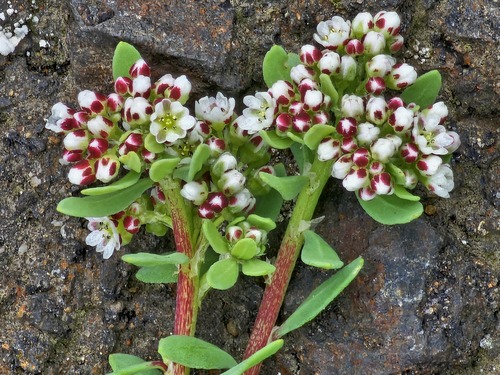
Corrigiola litoralis, or strapwort, is a flowering plant native to Europe and Africa, introduced to Australia and North America.
Corrigiola litoralis L. is a species of flowering plant with the common name strapwort. It is native to Europe and Africa, and has been introduced to Australia and North America. In Europe, it grows on shingly pool margins where water levels fluctuate. In Africa, it occurs across a wide variety of habitats.
⚠️ Toxicity: Insufficient toxicity evidence; avoid direct contact and ingestion.
View full details →
18
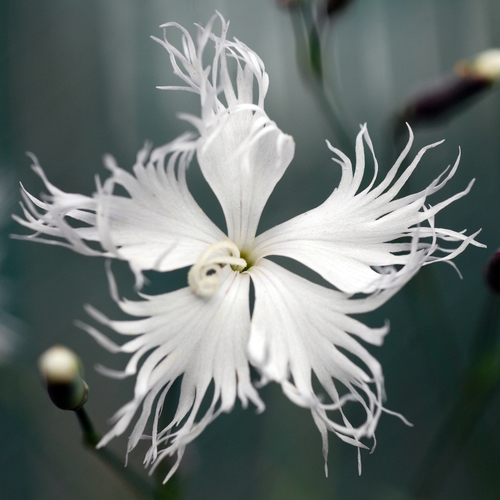
Dianthus arenarius (sand pink) is a European Dianthus species available commercially with the cultivar 'Little Maiden'.
Dianthus arenarius, commonly known as sand pink, is a Dianthus species. It most commonly grows on the shores of the Baltic Sea, but it also has other populations in colder regions of Europe that have sandy soils. Both the unimproved wild species and at least one cultivar, called 'Little Maiden', are sold by commercial plant suppliers.
⚠️ Toxicity: Insufficient toxicity evidence; avoid direct contact and ingestion.
View full details →
19
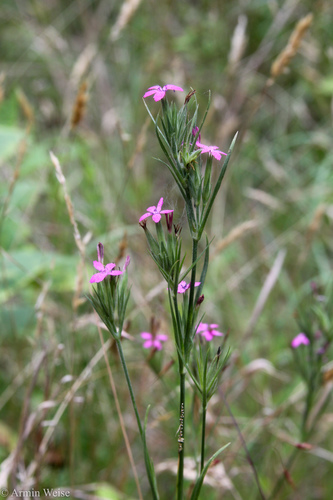
Dianthus armeria L. (Deptford pink) is a Eurasian flowering herb widely grown ornamentally, naturalized as an invasive in North America.
Dianthus armeria L. is an annual, biennial, or occasionally short-lived perennial herb that grows to roughly 60 centimetres (2.0 feet) tall and has a very slender appearance. It produces widely spaced, paired leaves; above these leaves, it branches rather sparingly. Its leaves are hairy, dark green, and narrow in shape. Short-stalked or stalkless clusters of deep-pink flowers grow at stem ends, su...
⚠️ Toxicity: Insufficient toxicity evidence; avoid direct contact and ingestion.
View full details →
20
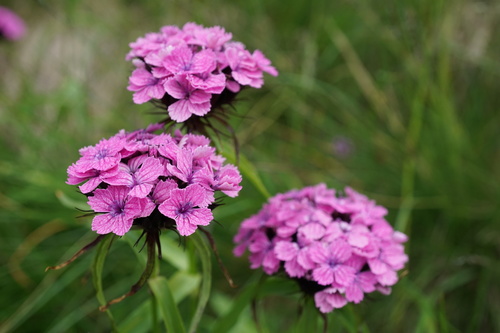
Dianthus barbatus, or Sweet William, is a popular ornamental Dianthus species with two recognized varieties.
Dianthus barbatus L., commonly called Sweet William, is a species of Dianthus. It grows naturally in the mountains of southern Europe, ranging from the Pyrenees east to the Carpathians and the Balkans, with one disjunct variety found in northeastern China, Korea, and the southeasternmost part of Russia. It reaches a height between 13 and 92 centimeters, a range that varies by variety. Its leaves a...
⚠️ Toxicity: Insufficient toxicity evidence; avoid direct contact and ingestion.
View full details →
21
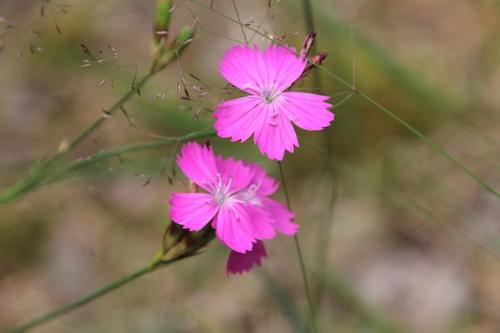
Dianthus borbasii is a carnation family Dianthus species native to Eastern Europe to western Asia, preferring sandy, low-competition sites.
Dianthus borbasii Vandas, commonly referred to as Dianthus borbasii, is a species in the Dianthus genus of the carnation family. It is native to steppes and open pine woodlands spanning from Eastern Europe through western Asia to Kazakhstan. This species favors growing in sandier soils or areas with mild disturbance, as these locations offer reduced competition from grasses.
⚠️ Toxicity: Insufficient toxicity evidence; avoid direct contact and ingestion.
View full details →
22
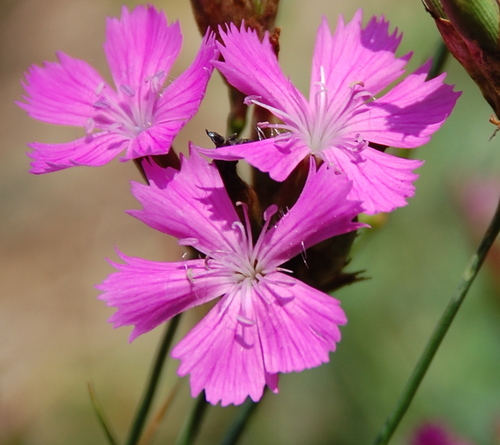
Dianthus carthusianorum (Carthusian pink) is a variable herbaceous perennial Dianthus species native to Europe.
Dianthus carthusianorum, commonly called Carthusian pink, is a species of the Dianthus genus. It is native to Europe, with a range extending from Spain north to Belgium and Poland, and east to Ukraine. It grows in dry, grassy habitats, and can be found at altitudes as high as 2,500 m (8,200 ft) in mountain areas. This is a variable herbaceous perennial plant that reaches a height of 60 cm (24 in)....
⚠️ Toxicity: Insufficient toxicity evidence; avoid direct contact and ingestion.
View full details →
23
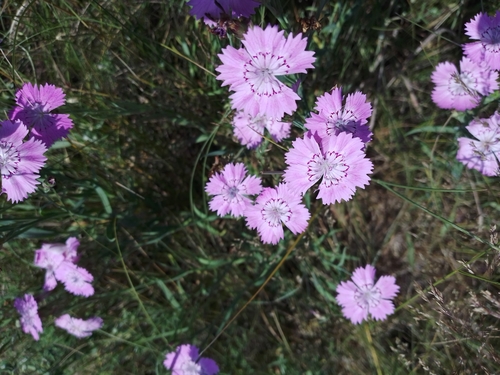
Dianthus chinensis L. is an East Asian flowering plant widely cultivated as an ornamental across temperate regions.
Dianthus chinensis L. has green to greyish-green, slender leaves that measure 3–5 cm long and 2–4 mm broad. It grows as a bush with several branched stems that form a loose clump. Basal leaves are usually already withered when the plant flowers, while leaves persist along the stems. Flowers are white, pink, or red, reach 3–4 cm in diameter, and are produced singly or in small clusters from spring ...
⚠️ Toxicity: Insufficient toxicity evidence; avoid direct contact and ingestion.
View full details →
24
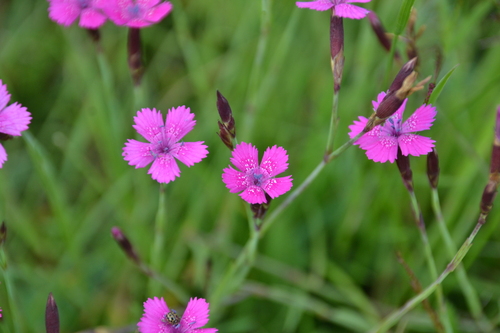
Dianthus deltoides (maiden pink) is a herbaceous perennial Dianthus grown widely as an ornamental garden plant.
Dianthus deltoides, commonly called maiden pink, is a Dianthus species native to most of Europe and western Asia. It is also an introduced species present across many parts of North America. This herbaceous perennial plant grows up to 45 centimeters (18 inches) in height. It produces very narrow green or glaucous leaves that form a loosely tufted growth habit. Its flowers measure 15 to 20 millimet...
⚠️ Toxicity: Insufficient toxicity evidence; avoid direct contact and ingestion.
View full details →
25
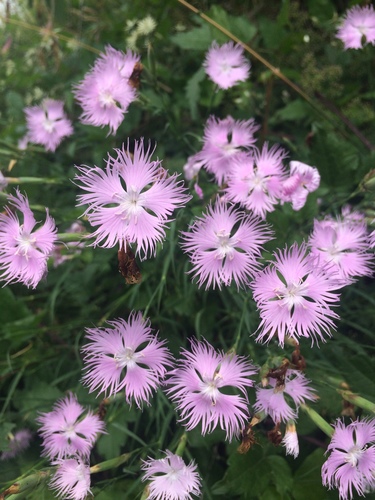
Dianthus hyssopifolius L. is a subshrub flowering plant of the Caryophyllaceae family native to the Iberian Peninsula and France.
Dianthus hyssopifolius L. is a species of flowering plant in the Caryophyllaceae family. It is commonly called fringed pink, a common name that it shares with Dianthus superbus. This species is a subshrub. It is native to Portugal, Spain, and France, and has been introduced to Great Britain. It can be purchased from commercial plant suppliers.
⚠️ Toxicity: Insufficient toxicity evidence; avoid direct contact and ingestion.
View full details →
26
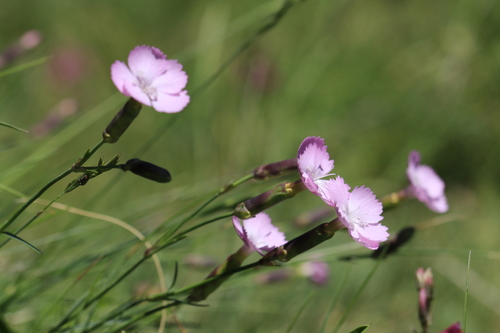
Dianthus sylvestris (wood pink) is a perennial Dianthus native to Europe, grown occasionally in rock gardens.
Scientific name: Dianthus inodorus Steud., 1821. Dianthus sylvestris, commonly called the wood pink, is a Dianthus species found in Europe, particularly in the Alps. It is also reported to have a disjunct distribution in the mountains of Greece. This plant is a perennial that prefers growing in drier, stony locations, and is occasionally planted in rock gardens.
⚠️ Toxicity: Insufficient toxicity evidence; avoid direct contact and ingestion.
View full details →
27
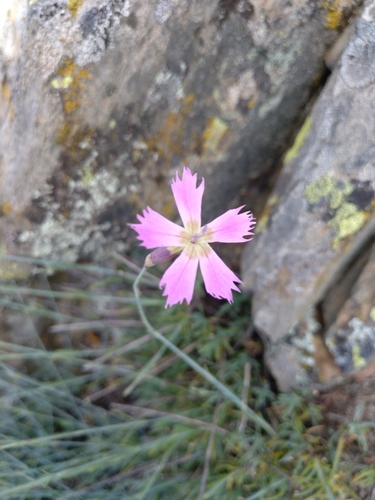
Dianthus lusitanus Brot. is a hardy perennial Dianthus native to parts of the Iberian Peninsula and Northwest Africa.
Dianthus lusitanus Brot. is a species of flowering plant in the Dianthus genus. This species is native to the Iberian Peninsula, as well as the Atlas Mountains of Morocco and Algeria. It is a hardy, tussock-forming perennial that grows on rocky slopes. Historically, its numerous stems were used to make brooms.
⚠️ Toxicity: Insufficient toxicity evidence; avoid direct contact and ingestion.
View full details →
28
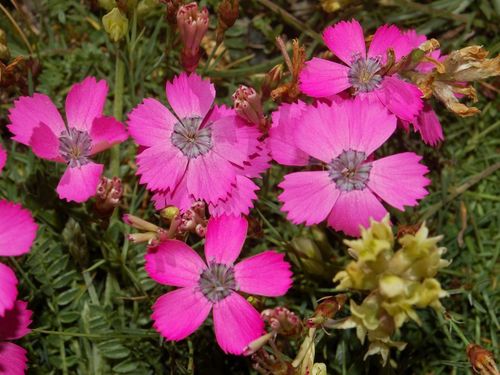
Dianthus pavonius is a short clumping carnation that grows in mountain grasslands of southern France, Italy and the Pyrenees.
Dianthus pavonius Tausch is a scapose hemicryptophyte that grows between 2 and 25 centimetres (0.79 to 9.84 inches) tall. This short-stemmed carnation forms dense clumps. It has pointed bluish-green leaves and purple-pink flowers with a blue or brown center. Its flowering season runs from April to May. It produces cylindrical fruit capsules that hold multiple flat brown seeds. This species occurs ...
⚠️ Toxicity: Insufficient toxicity evidence; avoid direct contact and ingestion.
View full details →
29
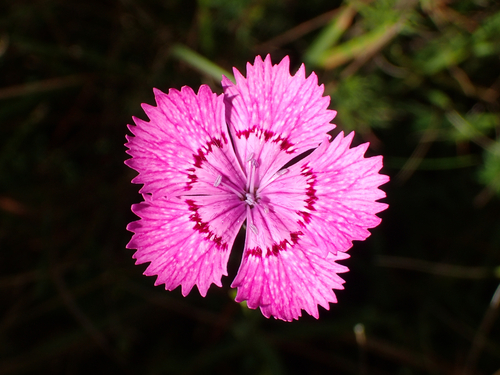
Dianthus seguieri is a flowering carnation species native to central and southern Europe that grows in dry meadows.
Dianthus seguieri Vill. is a hemicryptophyte scapose carnation that grows 25 to 60 centimetres (9.8 to 23.6 inches) tall. This species has green lanceolate leaflets and pink flowers with purple markings at the center. Its flowering season runs from June to September. It produces seed capsules that hold several brown seeds. Dianthus seguieri can be found in central and southern Europe, primarily oc...
⚠️ Toxicity: Insufficient toxicity evidence; avoid direct contact and ingestion.
View full details →
30
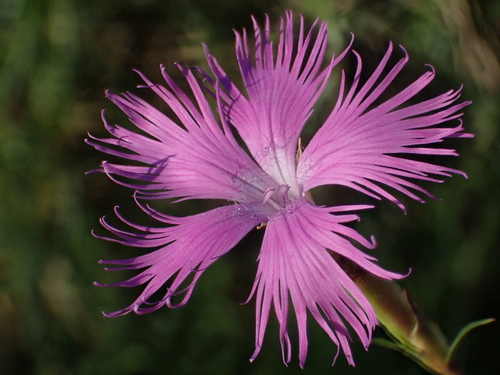
Dianthus superbus, fringed pink, is an herbaceous perennial native to Eurasia, used in gardens and traditional medicine.
Dianthus superbus, commonly known as fringed pink or large pink, is a Dianthus species native to Europe and northern Asia. Its range extends from France north to arctic Norway, and east to Japan. In the southern part of its range, it grows at high altitudes up to 2,400 m. It is a herbaceous perennial plant that grows up to 80 cm tall. It has slender, green to greyish-green leaves that reach up to ...
⚠️ Toxicity: Toxicity risk detected (mainly via ingestion); avoid direct contact and ingestion.
View full details →
Frequently Asked Questions
How many species are in the Caryophyllaceae family?
This guide features 30 representative species from the Caryophyllaceae family. The full family contains many more species worldwide — explore them all on iNature.
How to identify Caryophyllaceae species?
Caryophyllaceae species share common features in their flowers, leaves, and growth patterns. This guide provides photos and descriptions for 30 species. For instant field identification, use the iNature app.
Sources: GBIF, iNaturalist, Wikipedia · Disclaimer
Identify any species instantly — even offline
iNature uses on-device AI to identify plants, animals, fungi and more. No internet needed.
Download iNature — FreeStart Exploring Nature Today
Download iNature for free. 10 identifications on us. No account needed. No credit card required.
Download Free on App Store
