Owls are among the most fascinating birds on Earth, with their silent flight, rotating heads, and exceptional night vision. This guide covers the true owls (Strigidae), the largest owl family.
🦉 Bird Families
Owl Species Guide — Strigidae Family
1
Megascops clarkii (L.Kelso & E.H.Kelso, 1935)
Megascops clarkii (L.Kelso & E.H.Kelso, 1935)
🦋 Animalia Strigidae
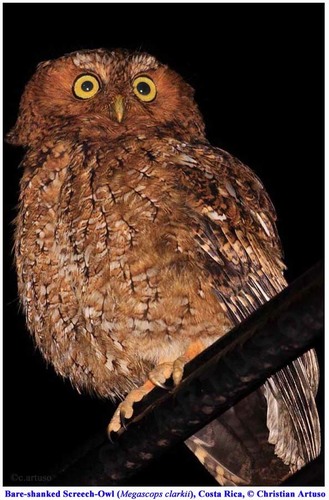
Megascops clarkii is a large screech owl found in mountain forests of Costa Rica, Panama, and far northwestern Colombia.
This species of Megascops owl measures 23 cm (9 in) to 25 cm (10 in) in total length (or 173-190 mm) and weighs between 123 and 190 g. Its upperbody is reddish-brown, with black spotting, mottling, and vermiculation. Its hindneck is yellowish, and the shoulder feathers have a black-edged white band across them. Cinnamon-colored bars mark the flight feathers, while the tail has alternating light an...
View full details → 2
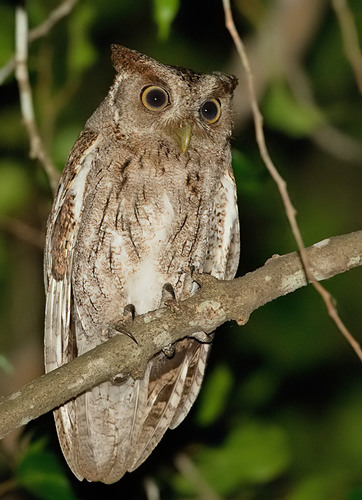
Megascops cooperi, the Pacific screech owl, is a medium-sized owl with two subspecies found in wooded and scrub habitats from Mexico to Costa Rica.
The Pacific screech owl, scientifically named Megascops cooperi (Ridgway, 1878), is a medium-sized species in the Megascops genus. It has prominent "ear" tufts and bright yellow eyes. The nominate subspecies measures 23 to 26 cm (9.1 to 10.2 in) in length and weighs 145 to 175 g (5.1 to 6.2 oz). Its facial disc is pale gray, with a white and blackish border. Its crown and upperparts are pale tawny...
View full details → 3
Megascops kennicottii (D.G.Elliot, 1867)
Megascops kennicottii (D.G.Elliot, 1867)
🦋 Animalia Strigidae
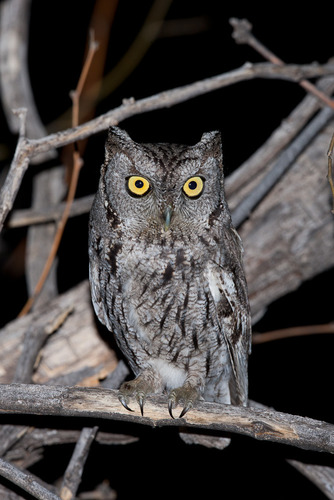
Megascops kennicottii, the western screech owl, is a small North and Central American owl with no red plumage morph.
Megascops kennicottii, commonly known as the western screech owl, averages 22 cm (8.7 in) in length, 55 cm (22 in) in wingspan, and 143 g (5.0 oz) in weight. Its total weight ranges from 88 to 220 g (3.1 to 7.8 oz). Females of this species are larger than males, and populations living in northern regions are notably larger than populations in southern regions. Adult western screech owls are larger...
View full details → 4
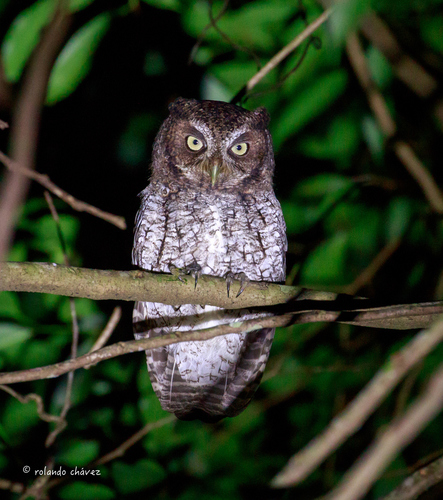
Megascops guatemalae (Middle American screech owl) is a small dimorphic owl found from Mexico to western Panama.
The Middle American screech owl (Megascops guatemalae, first described by Sharpe in 1875) measures 20 to 23 cm (7.9 to 9.1 in) in length and weighs 95 to 150 g (3.4 to 5.3 oz). It is a dimorphic species, with two distinct overall color morphs: one grayish-brown and the other rufous. Unlike other species in the genus Megascops, it has feathered feet. The grayish-brown morph has a light brown facia...
View full details → 5
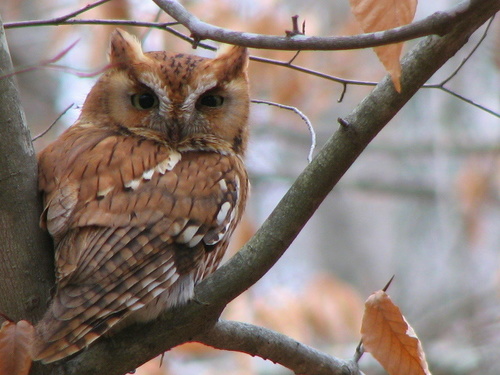
This is a detailed description of the eastern screech owl (Megascops asio), covering its physical traits, plumage morphs, distribution, and habitat.
Megascops asio, the eastern screech owl, has the following physical measurements. Adult individuals measure 16 to 25 cm (6+1⁄2 to 10 in) in total length and weigh 121–244 g (4+1⁄4–8+5⁄8 oz). Across its different sized subspecies, average length ranges from 19.5 to 23.8 cm (7+11⁄16 to 9+3⁄8 in). Wingspan ranges from 46 to 61 cm (18 to 24 in). Regional average weight differs by sex: in Ohio, males a...
View full details → 6
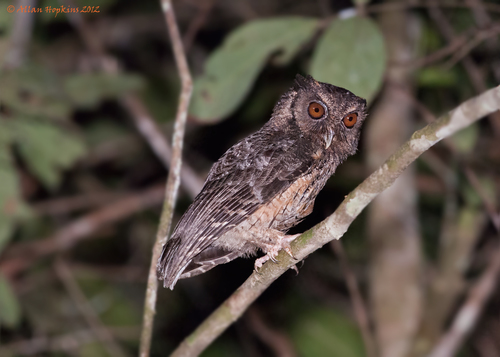
Megascops watsonii, the tawny-bellied screech owl, is a small owl with two subspecies found in Amazonian South American lowland rainforest.
Megascops watsonii, commonly known as the tawny-bellied screech owl, measures 19 to 24 cm (7.5 to 9.4 in) in length. The nominate subspecies weighs 114 to 155 g (4.0 to 5.5 oz), while the subspecies M. w. usta weighs 115 to 141 g (4.1 to 5.0 oz). The nominate subspecies has a dark buff facial disc with a thin darker border, dark buff brows above dark yellow eyes, and relatively long, broad "ear" t...
View full details → 7
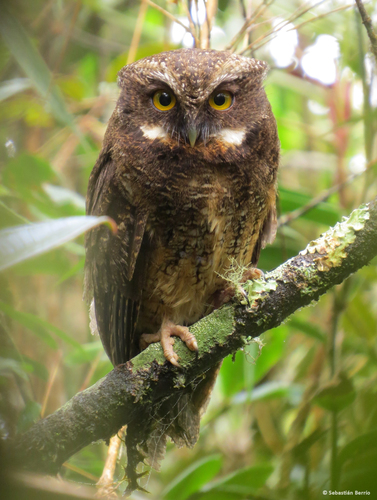
The white-throated screech owl (Megascops albogularis) is a large dark owl with multiple subspecies distributed across Andean South America.
Megascops albogularis, commonly known as the white-throated screech owl, is a large species within its genus. It measures 20 to 26 cm (7.9 to 10.2 in) in length and weighs 130 to 185 g (4.6 to 6.5 oz). It has overall dark plumage, a round head with very small ear tufts, and a somewhat long tail. For adult individuals of the nominate subspecies, the head and upperparts are dark brown, marked with s...
View full details → 8
Megascops sanctaecatarinae (Salvin, 1897)
Megascops sanctaecatarinae (Salvin, 1897)
🦋 Animalia Strigidae
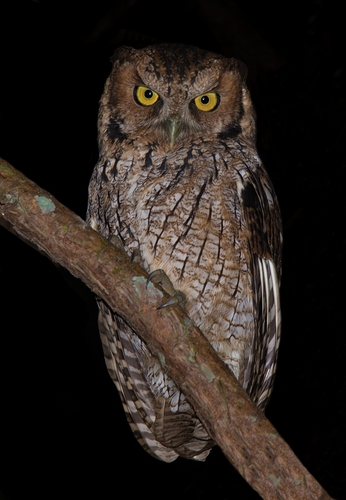
Megascops sanctaecatarinae, the long-tufted screech owl, is a bulky owl species native to parts of southern South America.
Megascops sanctaecatarinae, commonly called the long-tufted screech owl, measures 25 to 28 cm (9.8 to 11 in) in length. Males weigh 155 to 194 g (5.5 to 6.8 oz), while females are heavier, weighing 174 to 211 g (6.1 to 7.4 oz). This species is a fairly large, bulky member of the Megascops genus, with stronger feet than most other Megascops species. It occurs in three distinct color morphs, and the...
View full details → 9
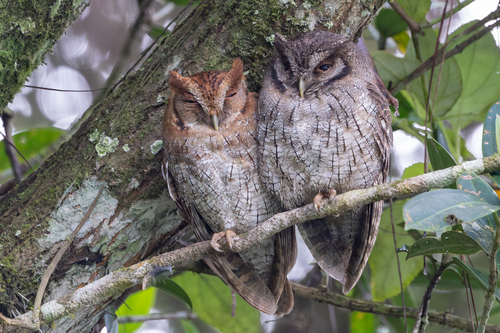
Megascops choliba is the common widespread neotropical tropical screech owl, a small polymorphic owl with multiple subspecies.
Megascops choliba, commonly known as the tropical screech owl, is polymorphic with extensive color variation. Most individuals are overall gray-brown, while brown or rufous morphs occur less commonly. All morphs have a relatively distinct blackish edge to the facial disc and yellow irises. Their undersides are pale, marked with a black herringbone pattern. Subspecies of this owl differ in color in...
View full details → 10
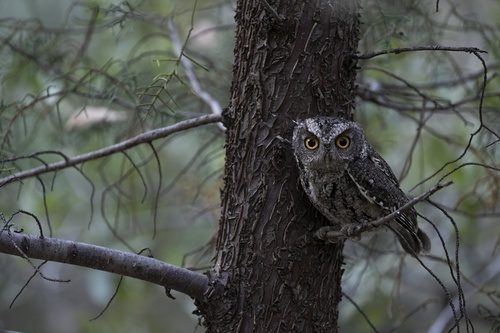
Megascops trichopsis (whiskered screech owl) is a small owl ranging from the southwestern US to north central Nicaragua.
Adults of Megascops trichopsis, commonly called the whiskered screech owl, come in two color morphs: one with brown plumage and one with dark grey plumage. These owls have a round head with ear tufts, yellow eyes, and a yellowish bill. They closely resemble the western screech owl, but can be distinguished by heavier barring on their breasts and a slightly smaller overall size. They measure 6.3 to...
View full details → 11
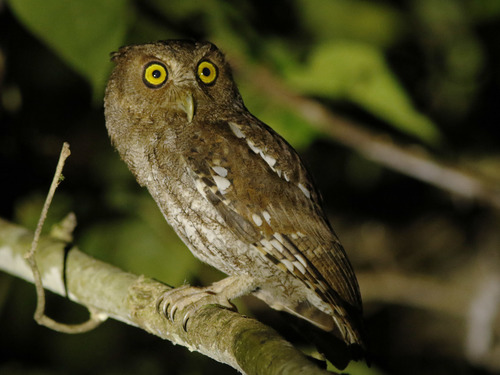
The Chocó screech owl (Megascops centralis) is a small owl with two color morphs found in forested western Central and South America.
Megascops centralis, commonly known as the Chocó screech owl, measures 20.5 to 27 cm (8.1 to 10.6 in) in total length. Two recorded specimens weighed 106.7 g (3.76 oz) and 121.5 g (4.29 oz) respectively. This species occurs in two distinct color morphs: gray and rufous, and many individuals have plumage that is intermediate between these two extremes. The gray morph has a grayish white facial disc...
View full details → 12
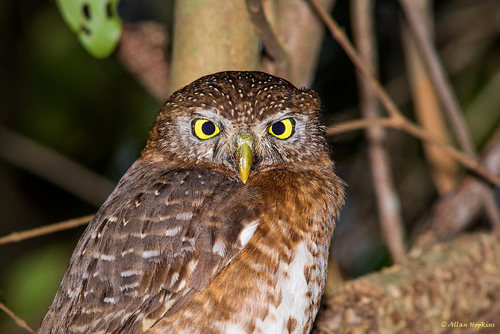
This is a size, plumage, subspecies, distribution and habitat description of the Cuban pygmy owl (Glaucidium siju).
The Cuban pygmy owl (Glaucidium siju) is 16 to 17 cm (6.3 to 6.7 in) long. Males weigh 47 to 68 g (1.7 to 2.4 oz) and females weigh 66 to 102 g (2.3 to 3.6 oz). It has two color morphs, gray-brown and rufous, with the gray-brown morph being more common. Both morphs have a pale grayish face, whitish to cinnamon 'brows' above yellow eyes, and a pair of dark 'false eyes' on the nape. For the nominate...
View full details → 13
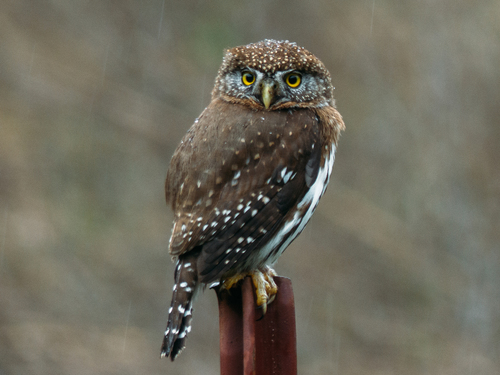
Glaucidium gnoma, the mountain pygmy owl, is a small owl ranging from the southwestern US to southern Mexico that lives in mountain forests.
Adult mountain pygmy owls (Glaucidium gnoma) measure approximately 15–17 cm (5.9–6.7 in) in total length. Males weigh 48 to 54 g (1.7–1.9 oz); this species shows reverse sexual dimorphism, so adult females are heavier, ranging from 60 to 73 g (2.1–2.6 oz). Male wing length falls between 86–89 mm (3.4–3.5 in), while female wing length ranges from 87–98 mm (3.4–3.8 in). Tail length for both sexes me...
View full details → 14
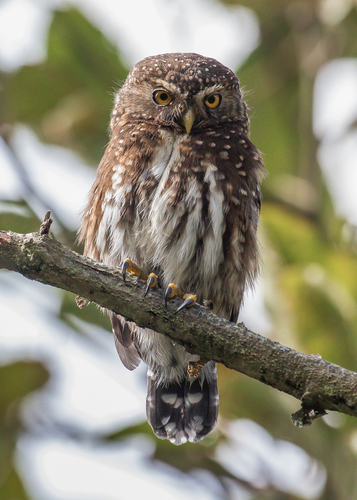
The Andean pygmy owl is a small owl species with two color morphs native to Andean mountain habitats of northwestern to central South America.
The Andean pygmy owl (scientific name Glaucidium jardinii (Bonaparte, 1855)) measures 15 to 16 cm (5.9 to 6.3 in) in total length. Males weigh between 54.9 and 77.4 g (1.9 to 2.7 oz), while females weigh between 54.6 and 75 g (1.9 to 2.6 oz). This species has two distinct color morphs. In the first morph, the head, most of the body, wings, and tail are dull dark brown with white markings. In the s...
View full details → 15
Glaucidium brasilianum (J.F.Gmelin, 1788)
Glaucidium brasilianum (J.F.Gmelin, 1788)
🦋 Animalia Strigidae
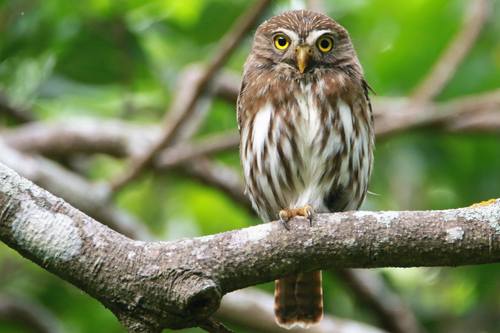
Glaucidium brasilianum, the ferruginous pygmy owl, is a small variable-plumaged owl that often hunts by day.
The ferruginous pygmy owl, with the scientific name Glaucidium brasilianum (J.F.Gmelin, 1788), is a small, stocky owl that typically measures 15 cm (5.9 in) long. It has disproportionately large feet and talons. Its crown features elongated white or buff streaks, its wing coverts bear white spots, and its underparts have heavy white streaking. Prominent white supercilia sit above the facial disc, ...
View full details → 16
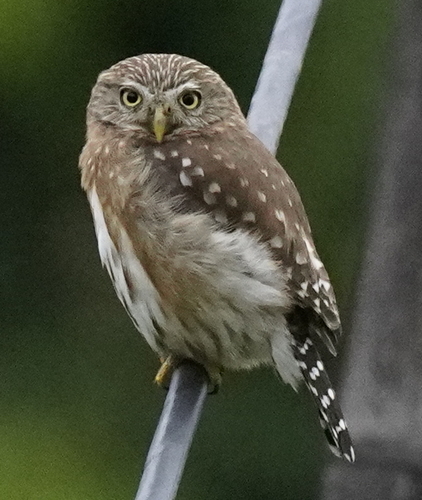
The Pacific pygmy owl is a small Andean owl species with three color morphs found along western South America.
The Pacific pygmy owl (Glaucidium peruanum) measures 15 to 17 cm (5.9 to 6.7 in) in total length. Males weigh approximately 60 g (2.1 oz), while females weigh around 65 g (2.3 oz). Beyond being heavier, females also have slightly longer wings and tails than males, but both sexes share identical plumage patterns. This species has three distinct color morphs: gray, brown, and rufous, with the gray a...
View full details → 17
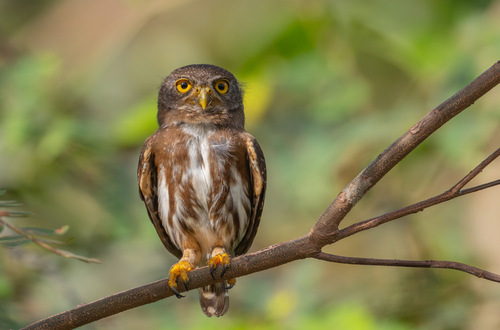
The Amazonian pygmy owl (Glaucidium hardyi) is a tiny owl found across northern South America’s Amazonian forests.
Physical description: The Amazonian pygmy owl is a very small owl, as reflected by its genus name Glaucidium, which means "little owl". Adult individuals have a large, round head marked with black spots that falsely resemble eyes. Their crown is gray-brown and covered with very small white spots. Both the rectrices (tail feathers) and remiges (wing flight feathers) are dark brown, marked with thre...
View full details → 18
Glaucidium sanchezi Lowery & R.J.Newman, 1949
Glaucidium sanchezi Lowery & R.J.Newman, 1949
🦋 Animalia Strigidae
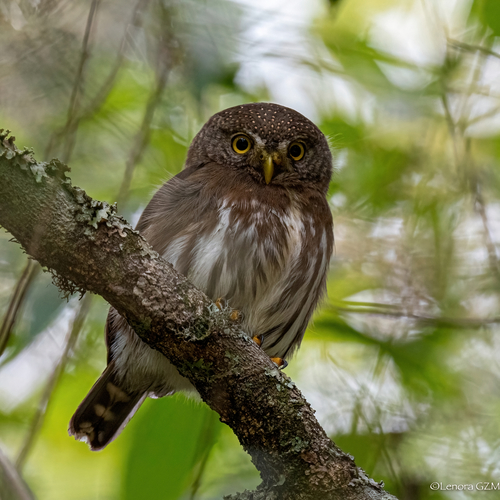
Glaucidium sanchezi (Tamaulipas pygmy owl) is a small endemic owl found only in mountain forests of northeastern Mexico.
Glaucidium sanchezi, commonly known as the Tamaulipas pygmy owl, was formally described by Lowery & R.J. Newman in 1949. Adult Tamaulipas pygmy owls have a total length between 13 and 16 cm (5.1 and 6.3 in), with a relatively long tail measuring 5.1 to 5.7 cm (2.0 and 2.2 in). Their average weight is 53 g (1.9 oz), and males are generally lighter than females. Males have a brownish facial disc fle...
View full details → 19
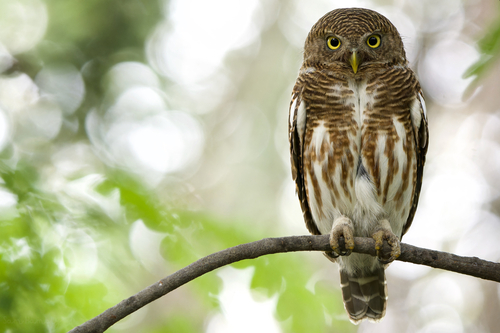
Glaucidium cuculoides, the Asian barred owlet, is a small diurnal true owl widespread in mainland Southeast Asia.
The Asian barred owlet (scientific name Glaucidium cuculoides (Vigors, 1831)) is a small owl, with adult body length measuring 22–25 cm (8.7–9.8 in). Males weigh 150–176 g (0.331–0.388 lb), while females can reach up to 240 g (0.53 lb). Like most species in the true owl family, female Asian barred owlets are typically larger than males. Adult Asian barred owlets have dark brown or olive-brown plu...
View full details → 20
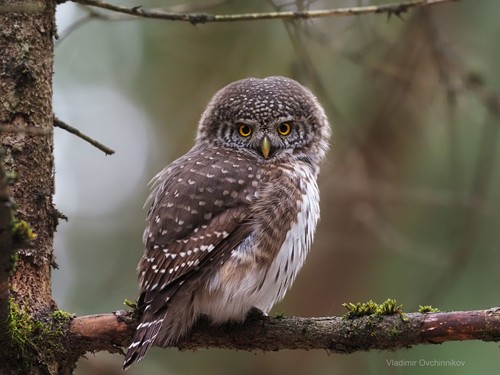
The Eurasian pygmy owl (Glaucidium passerinum) is a small crepuscular owl native to Eurasian boreal and mountain coniferous forests.
The Eurasian pygmy owl (Glaucidium passerinum (Linnaeus, 1758)) typically has plumage ranging from red-tinged to greyish-brown, with spots covering its back. Its tail is usually darker than its body, marked with five narrow whitish bars. It has a small, short head with white to grey eyebrows and yellow eyes, and lacks the ear tufts found in many other owl species. A white half-collar is present on...
View full details → 21
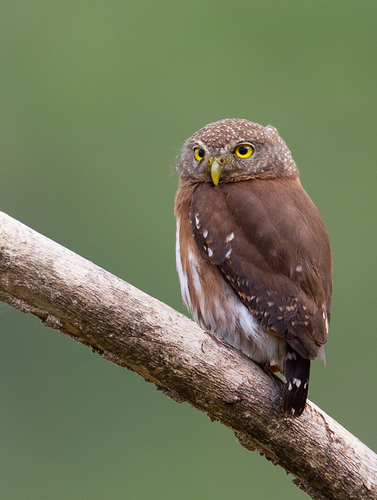
Glaucidium griseiceps, the Central American pygmy owl, is a small owl found across parts of Central and northwestern South America.
The Central American pygmy owl (Glaucidium griseiceps Sharpe, 1875) measures 13 to 18 cm (5.1 to 7.1 in) in total length. Males weigh 50.6 to 58.8 g (1.78 to 2.07 oz), while females weigh approximately 56 g (2.0 oz). Adult individuals have grayish brown crown and nape; the crown bears buff to whitish spots, and the nape has dark "false eyes". Their upperparts and tail are rich brown, with pale bar...
View full details → 22
Glaucidium minutissimum (zu Wied-Neuwied, 1830)
Glaucidium minutissimum (zu Wied-Neuwied, 1830)
🦋 Animalia Strigidae
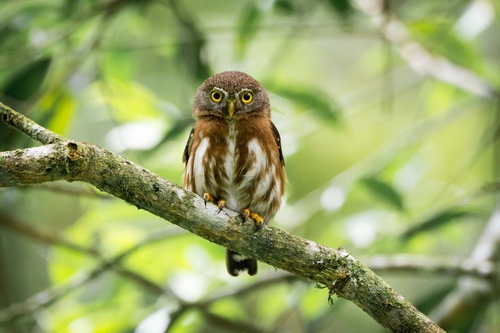
Glaucidium minutissimum is a very small South American owl found in southeastern Brazil and eastern Paraguay.
This is the description of the owl species Glaucidium minutissimum, originally described by zu Wied-Neuwied in 1830. It is one of the smallest owls in South America. On average, individuals weigh 55 g (1.9 oz) and measure 15 cm (5.9 in) in height. Wing length ranges from 85 to 91 mm (3.3 to 3.6 in), while tail length ranges from 49 to 54 mm (1.9 to 2.1 in). It has a rounded head with no ear tufts....
View full details → 23

Glaucidium palmarum, the Colima pygmy owl, is a small owl found in western Mexico across multiple forest and plantation habitats.
The Colima pygmy owl (Glaucidium palmarum Nelson, 1901) measures 13 to 15 cm (5.1 to 5.9 in) in total length. Male individuals weigh 43 to 48 g (1.5 to 1.7 oz), while females are recorded as heavier, though no exact weight range for females has been quantified. The species has brown coloring on its head and back, mostly grayish brown wings, and a darker grayish brown tail. Small dull white spots m...
View full details → 24
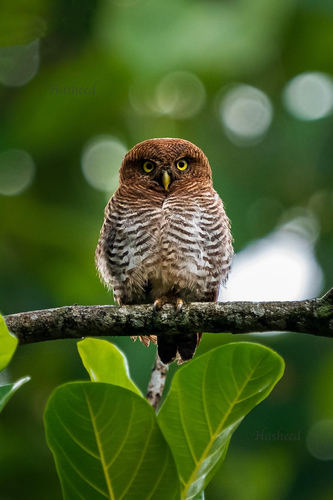
Glaucidium radiatum, the jungle owlet, is a small barred South Asian owl with two recognized subspecies.
This small owlet, Glaucidium radiatum, has a rounded head and fine barring across its entire body. It lacks a distinct facial disk; its wings are brownish, and its tail is marked with narrow white bars. Two subspecies are currently recognized. The nominate subspecies occurs in the plains of India and Sri Lanka, while G. r. malabaricum from the Western Ghats has a shorter tail and more brown colora...
View full details → 25
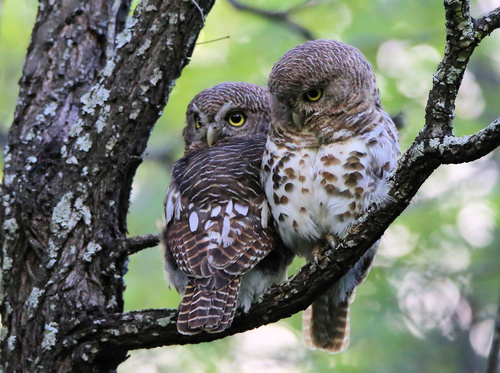
Glaucidium capense, the African barred owlet, is a small owl endemic to open wooded habitats of Southern and Eastern Africa.
The African barred owlet, scientifically named Glaucidium capense (A.Smith, 1834), is a small owlet with noticeable geographic variation across its range. For the nominate subspecies, the upperparts are greyish brown, marked with fine buff bars, and it has a narrow white eyebrow. The outer webs of the scapulars and greater wing coverts are white, with dark brown tips; these feathers form a white s...
View full details → 26
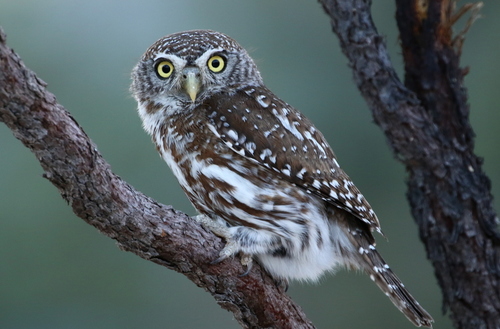
Glaucidium perlatum, the pearl-spotted owlet, is a small African owl classified as Least Concern on the IUCN Red List.
The pearl-spotted owlet, with the scientific name Glaucidium perlatum (Vieillot, 1817), is one of the smallest owls in Africa. It measures 17 to 21 cm in total length. Females are slightly larger and heavier than males, averaging 100g compared to the male average of 65g. Males and females have similar plumage coloration. They have an off-white facial disc and yellow eyes. Two striking false black ...
View full details → 27
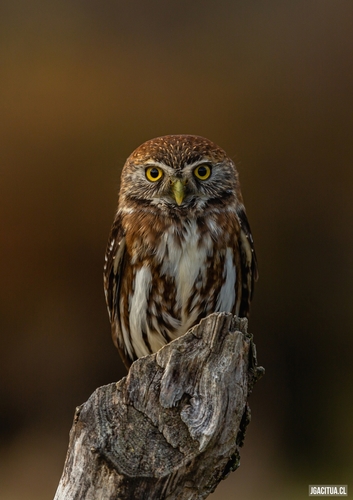
Glaucidium nana, the austral pygmy owl, is a small owl with two color morphs found across southern South America in varied habitats.
This species, commonly known as the austral pygmy owl, has the scientific name Glaucidium nana (P.P.King, 1827). The austral pygmy owl measures 17 to 21 cm (6.7 to 8.3 in) in total length. Males weigh between 56 to 75 g (2.0 to 2.6 oz), while females are heavier, ranging from 70 to 100 g (2.5 to 3.5 oz). This species displays two distinct color morphs: gray-brown and red, as well as intergraded in...
View full details → 28
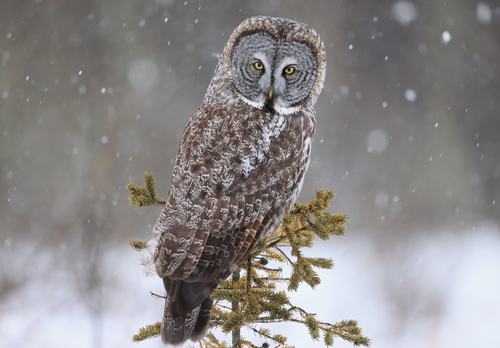
Strix nebulosa, the great grey owl, is a large raptor with described appearance, calls, habitat, and distribution across North America and northern Asia.
Adults of Strix nebulosa, the great grey owl, have large rounded heads with grey faces, yellow eyes surrounded by darker circles, and no ear tufts. They have the largest facial disc of any raptor, with a distinct white collar or "bow-tie" positioned just below the beak. Their underparts are light with dark streaks, while their upper parts are grey with pale bars. Their long tail tapers to a rounde...
View full details → 29
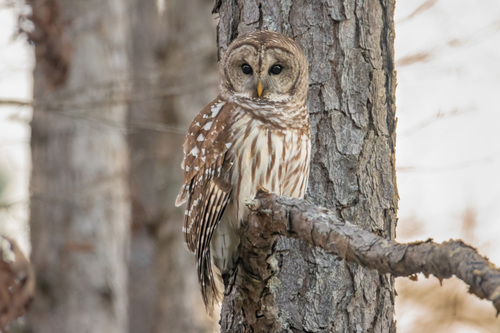
The barred owl (Strix varia) is a large owl with subdued coloration, native to the eastern US and southern Canada, which has expanded its range, prefers old - growth forests, nests in tree hollows, breeds in late winter, and the young gain independence in autumn.
The barred owl (Strix varia Barton, 1799) has a subdued coloration compared to some other sympatric owls. It is overall greyish - brown or brown, with the brown color extending from the head to the back. The mantle and back are scalloped with white bars, and the wing coverts have whitish spotting. The underside has a pale creamy gray - brown base color, with horizontal barring on the throat and up...
View full details → 30
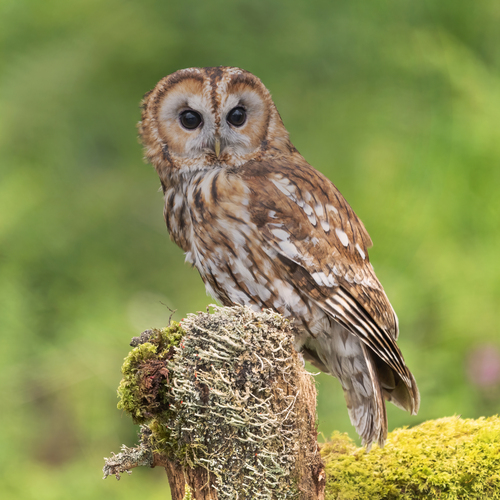
Strix aluco, the tawny owl, is a non-migratory nocturnal Eurasian owl with distinct physical and sensory adaptations.
This is the description of Strix aluco Linnaeus, 1758, commonly known as the tawny owl. The tawny owl is a robust bird, measuring 37–46 cm (15–18 in) in length, with an 81–105 cm (32–41 in) wingspan. Its weight ranges from 385 to 800 g (0.849 to 1.764 lb). It has a large rounded head that lacks ear tufts, and the facial disc surrounding its dark brown eyes is usually quite plain. The nominate race...
View full details →Frequently Asked Questions
How many species are in the Strigidae family?
This guide features 30 representative species from the Strigidae family. The full family contains many more species worldwide — explore them all on iNature.
How to identify Strigidae species?
Strigidae species share common features in their flowers, leaves, and growth patterns. This guide provides photos and descriptions for 30 species. For instant field identification, use the iNature app.
Sources: GBIF, iNaturalist, Wikipedia · Disclaimer
Identify any species instantly — even offline
iNature uses on-device AI to identify plants, animals, fungi and more. No internet needed.
Download iNature — FreeStart Exploring Nature Today
Download iNature for free. 10 identifications on us. No account needed. No credit card required.
Download Free on App Store
