Orchids are one of the largest and most diverse flowering plant families, with over 25,000 species found on every continent except Antarctica. This guide explores the fascinating world of orchids.
🌺 Plant Families
Orchid Species Guide — The Orchidaceae Family
1
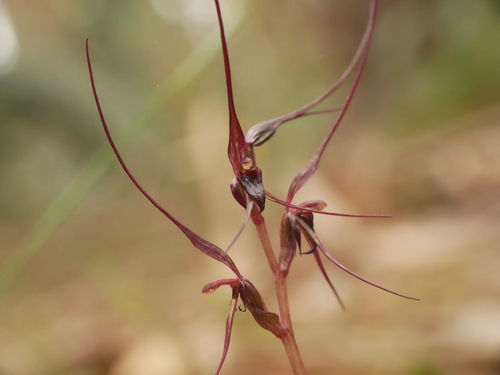
Acianthus caudatus, the mayfly orchid, is a small terrestrial Australian orchid that flowers from August to October.
Acianthus caudatus R.Br. is a terrestrial, perennial, deciduous, sympodial herb, commonly known as mayfly orchid. It produces a single thin, egg-shaped to heart-shaped leaf, which is dark green on the upper surface and reddish-purple on the lower surface. The leaf measures 8–30 mm long and 6–20 mm wide, and has wavy or minutely toothed edges. Up to nine dark purplish flowers grow on a raceme that ...
⚠️ Toxicity: Insufficient toxicity evidence; avoid direct contact and ingestion.
View full details →
2
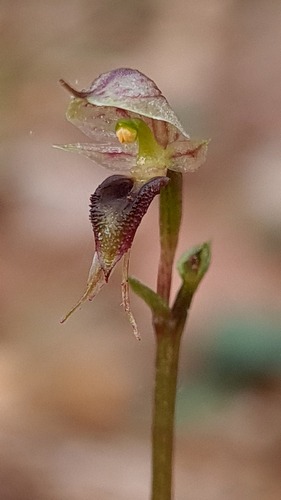
Acianthus fornicatus, the mosquito orchid, is a small terrestrial orchid native to coastal eastern Australia.
Acianthus fornicatus R.Br. is a terrestrial, perennial, deciduous, sympodial herb. It grows a single heart-shaped, glabrous, dark green leaf that is reddish-purple on its lower surface. The leaf itself is 10–40 mm (0.4–2 in) long and 10–20 mm (0.4–0.8 in) wide, and is borne on a stalk 4–9 cm (2–4 in) high. Up to ten well-spaced flowers are arranged on a raceme 100–300 mm (4–10 in) tall. Each indiv...
⚠️ Toxicity: Insufficient toxicity evidence; avoid direct contact and ingestion.
View full details →
3
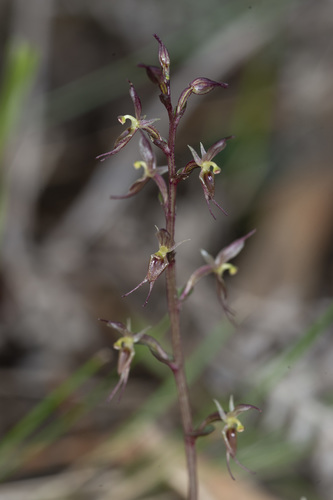
Acianthus pusillus is a small Australian terrestrial orchid that is widespread and locally common across a range of habitats.
Acianthus pusillus is a terrestrial, perennial, deciduous, sympodial herb that grows from a single heart-shaped, hairless, dark green leaf with a reddish-purple lower surface. The leaf itself measures 12–32 mm long and 10–30 mm wide, and is carried on a stalk 30–80 mm tall. Up to 18 translucent green to pinkish flowers with reddish veins and spots are arranged on a thin raceme 30–180 mm tall; each...
⚠️ Toxicity: Insufficient toxicity evidence; avoid direct contact and ingestion.
View full details →
4
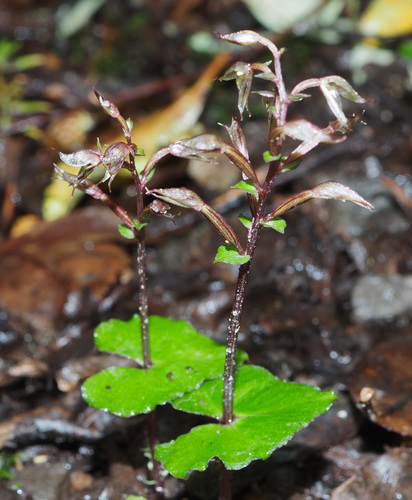
Acianthus sinclairii is a small terrestrial New Zealand orchid with a single heart-shaped leaf and green purple-blotched flowers.
Acianthus sinclairii Hook.f. is a terrestrial, perennial, deciduous, sympodial herb. It grows a single heart-shaped, glabrous, dark green leaf, which often has a maroon tinge or markings. This leaf measures 10–30 mm (0.4–1 in) long, and is positioned between one quarter and halfway up the plant's slender stem. At flowering time, the stem is about 100 mm (4 in) long, and it grows longer after flowe...
⚠️ Toxicity: Insufficient toxicity evidence; avoid direct contact and ingestion.
View full details →
5
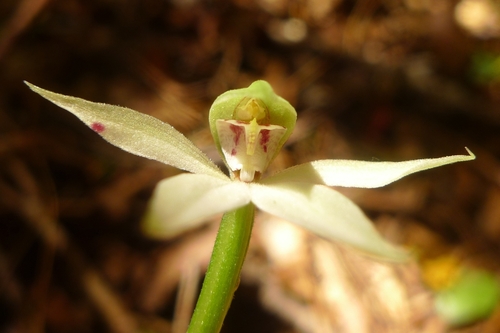
Adenochilus gracilis Hook.f. is a small terrestrial orchid native to New Zealand’s main outlying islands.
Adenochilus gracilis Hook.f. is a terrestrial, perennial, deciduous herb that grows from a long, thin, horizontal rhizome. It produces one egg-shaped to oblong leaf with a heart-shaped base that measures 10–30 mm (0.4–1 in) long, positioned near the base of the flowering stem. A second similar leaf, lacking a petiole, grows about halfway up the flowering stem. A single white flower 10–20 mm (0.4–0...
⚠️ Toxicity: Insufficient toxicity evidence; avoid direct contact and ingestion.
View full details →
6
Anacamptis collina (Banks & Sol. ex Russell) R.M.Bateman, Pridgeon & M.W.Chase
Anacamptis collina (Banks & Sol. ex Russell) R.M.Bateman, Pridgeon & M.W.Chase
🌿 Plantae Orchidaceae
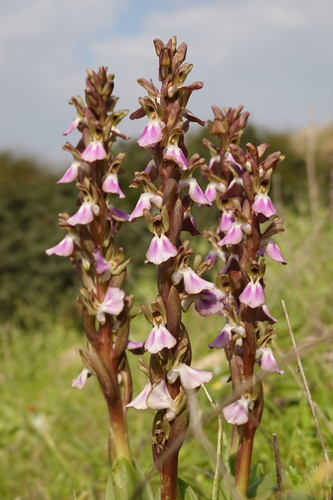
Anacamptis collina, the fan-lipped orchid, is an orchid species native to Mediterranean and Caspian Sea regions.
Anacamptis collina, commonly called the fan-lipped orchid, is a species of orchid. This species is native to the Mediterranean and Caspian Sea regions, ranging from Portugal and Morocco in the west to Iran and Turkmenistan in the east. Its accepted scientific name is Anacamptis collina (Banks & Sol. ex Russell) R.M.Bateman, Pridgeon & M.W.Chase.
⚠️ Toxicity: Insufficient toxicity evidence; avoid direct contact and ingestion.
View full details →
7
Anacamptis coriophora (L.) R.M.Bateman, Pridgeon & M.W.Chase
Anacamptis coriophora (L.) R.M.Bateman, Pridgeon & M.W.Chase
🌿 Plantae Orchidaceae
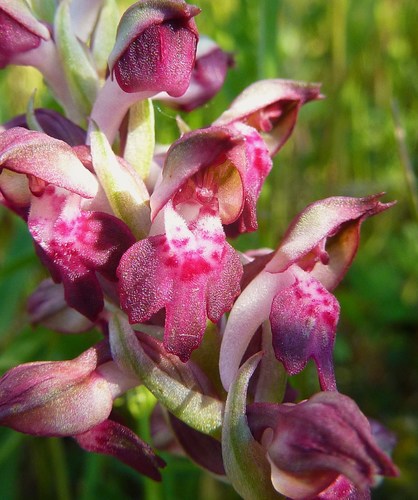
Anacamptis coriophora (bug orchid) is an orchid species native to Europe, the Mediterranean, and the Near East to Iran.
Anacamptis coriophora, commonly known as the bug orchid, is a species of orchid. It can be found in Europe, the Mediterranean region, and the Near East extending as far east as Iran.
⚠️ Toxicity: Insufficient toxicity evidence; avoid direct contact and ingestion.
View full details →
8
Anacamptis laxiflora (Lam.) R.M.Bateman, Pridgeon & M.W.Chase
Anacamptis laxiflora (Lam.) R.M.Bateman, Pridgeon & M.W.Chase
🌿 Plantae Orchidaceae
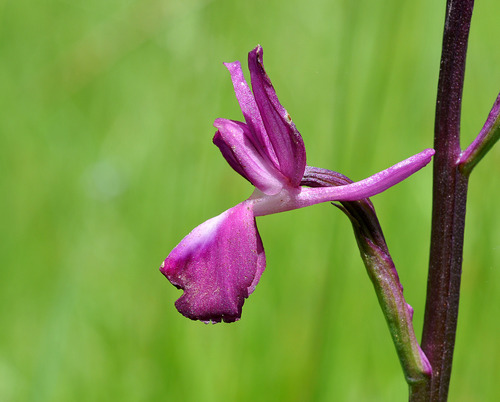
Anacamptis laxiflora is a species of orchid with a broad distribution across Europe and Asia that grows in alkaline wet meadows.
Anacamptis laxiflora, commonly known as the lax-flowered orchid, loose-flowered orchid, or green-winged meadow orchid, is a species of orchid. It has a broad distribution across Europe and Asia, reaching as far north as Germany, and grows in wet meadows with alkaline soil. It can reach up to 60 centimeters in height. This orchid is common in Normandy and Brittany, France. In the United Kingdom, it...
⚠️ Toxicity: Insufficient toxicity evidence; avoid direct contact and ingestion.
View full details →
9
Anacamptis morio (L.) R.M.Bateman, Pridgeon & M.W.Chase
Anacamptis morio (L.) R.M.Bateman, Pridgeon & M.W.Chase
🌿 Plantae Orchidaceae
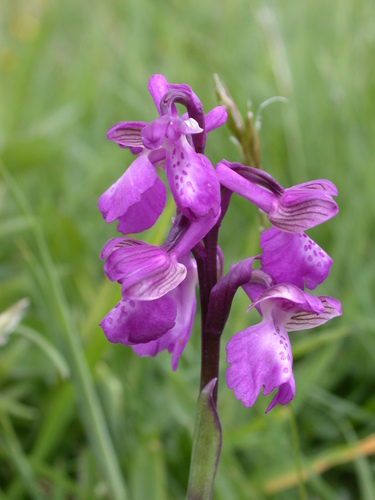
Anacamptis morio, the green-winged orchid, is a western Eurasian orchid that uses nectar deception to attract bee pollinators.
This orchid species, Anacamptis morio, flowers from late April to June in the British Isles, and can flower as early as February in other countries like France. Its inflorescence comes in a range of colors, mainly purple, and spans from white through pink to deep purple. Between 5 and 25 helmet-shaped flowers grow in a loose, linear cluster at the top of a single stalk. A pair of lateral sepals wi...
⚠️ Toxicity: Insufficient toxicity evidence; avoid direct contact and ingestion.
View full details →
10
Anacamptis palustris (Jacq.) R.M.Bateman, Pridgeon & M.W.Chase
Anacamptis palustris (Jacq.) R.M.Bateman, Pridgeon & M.W.Chase
🌿 Plantae Orchidaceae
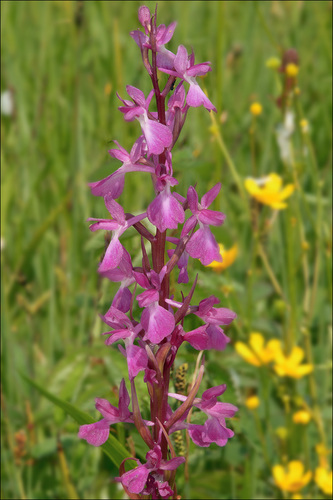
Anacamptis palustris is a perennial herbaceous orchid native to Europe, North Africa, and western Asia that grows in wet, sunny, calcareous habitats.
Anacamptis palustris (Jacq.) R.M.Bateman, Pridgeon & M.W.Chase is a species of orchid. It is native to areas including Western and Central Europe, the Mediterranean region, the Balearic Islands, Turkey, Western Asia, Algeria and Tunisia in North Africa, and Saudi Arabia, with a broader distribution across Europe, North Africa, and western Asia. This orchid is a perennial herbaceous plant. It grows...
⚠️ Toxicity: Insufficient toxicity evidence; avoid direct contact and ingestion.
View full details →
11
Anacamptis papilionacea (L.) R.M.Bateman, Pridgeon & M.W.Chase
Anacamptis papilionacea (L.) R.M.Bateman, Pridgeon & M.W.Chase
🌿 Plantae Orchidaceae
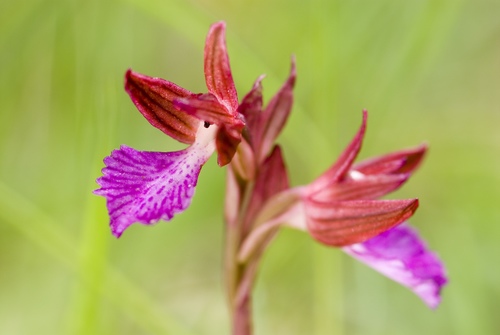
The pink butterfly orchid, Anacamptis papilionacea, is an orchid species found in Southern Europe and Northern Africa on dry stony ground.
Anacamptis papilionacea (L.) R.M.Bateman, Pridgeon & M.W.Chase was formerly classified as Orchis papilionacea. It is commonly called the pink butterfly orchid, and it is a species of flowering plant that belongs to the orchid family, Orchidaceae. This species is distributed across Southern Europe and Northern Africa, including locations such as Spain, Turkey, Serbia, Cyprus, Lebanon, and the Aegea...
⚠️ Toxicity: Insufficient toxicity evidence; avoid direct contact and ingestion.
View full details →
12
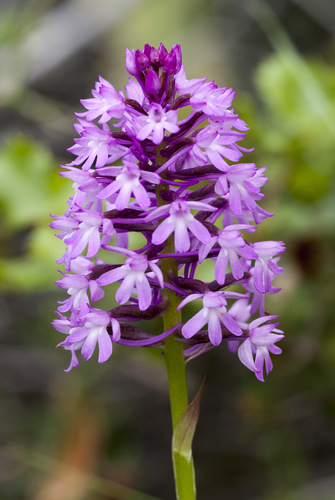
Anacamptis pyramidalis, the pyramidal orchid, is a hardy Eurasian orchid known for its distinctive pyramid-shaped flower spike.
This hardy orchid, Anacamptis pyramidalis, reaches an average height of 10–25 centimetres (3.9–9.8 inches), with a maximum height of 60 centimetres (24 inches). It has an erect, unbranched stem. Its basal leaves are linear-lanceolate with parallel venation, growing up to 25 centimetres (9.8 inches) long, while its cauline leaves are shorter and barely visible along the stem. This orchid produces h...
⚠️ Toxicity: Insufficient toxicity evidence; avoid direct contact and ingestion.
View full details →
13
Anacamptis sancta (L.) R.M.Bateman, Pridgeon & M.W.Chase
Anacamptis sancta (L.) R.M.Bateman, Pridgeon & M.W.Chase
🌿 Plantae Orchidaceae
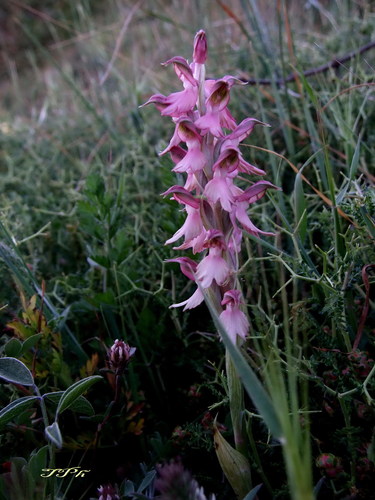
Anacamptis sancta is a rare orchid with larger variable-colored unspotted flowers found across parts of the eastern Mediterranean.
The flowers of Anacamptis sancta look similar to those of Anacamptis coriophora, but they are larger and more variable in color, ranging from pink to red. The flower lips of this species are unspotted, and most of its leaves are already withered by the time the plant blooms. In terms of distribution and habitat, Anacamptis sancta is very local or rare. It occurs in Turkey, Cyprus, Lebanon, Israel,...
⚠️ Toxicity: Insufficient toxicity evidence; avoid direct contact and ingestion.
View full details →
14
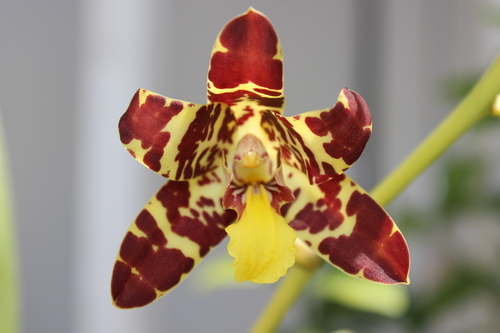
Ansellia africana is a large trash-basket orchid native to tropical and southern Africa, adapted to epiphytic growth with mycorrhizal symbionts.
Ansellia africana Lindl. is a large perennial orchid that is usually epiphytic, though it occasionally grows as a terrestrial plant. It often forms spectacular clumps when attached to the branches of tall trees. This orchid is identifiable by its characteristic white, needle-like aerial roots that grow upward to form a basket-like structure around the plant's tall, many-noded, fusiform, cane-shape...
⚠️ Toxicity: Insufficient toxicity evidence; avoid direct contact and ingestion.
View full details →
15
Aplectrum hyemale (Muhl. ex Willd.) Torr.
Aplectrum hyemale (Muhl. ex Willd.) Torr.
🌿 Plantae Orchidaceae
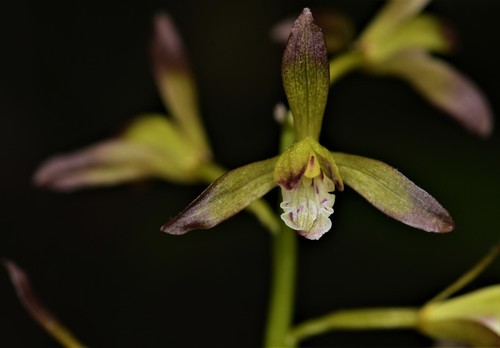
Aplectrum hyemale, or putty root, is a striped-leaf North American orchid, the only species in its genus, that primarily self-pollinates.
Aplectrum hyemale (Muhl. ex Willd.) Torr. is a species of orchid native to eastern Canada and the eastern United States. Its range extends from Oklahoma east to the Carolinas, and north to Minnesota, Ontario, Quebec, and Massachusetts. It is especially common in the Appalachian Mountains, the Great Lakes Region, and the Ohio and Upper Mississippi Valleys. Isolated populations have also been report...
⚠️ Toxicity: Insufficient toxicity evidence; avoid direct contact and ingestion.
View full details →
16
Aporostylis bifolia (Hook.f.) Rupp & Hatch
Aporostylis bifolia (Hook.f.) Rupp & Hatch
🌿 Plantae Orchidaceae
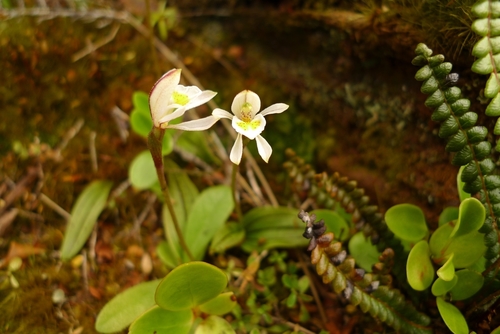
Aporostylis is an orchid genus that contains just one known species, Aporostylis bifolia, native to New Zealand and its outlying islands.
Aporostylis is a genus of flowering plants in the orchid family, Orchidaceae. As of now, only one species in this genus is recognized: Aporostylis bifolia, which is native to New Zealand. This native range includes both the Chatham Islands and the Antipodes Islands.
⚠️ Toxicity: Insufficient toxicity evidence; avoid direct contact and ingestion.
View full details →
17
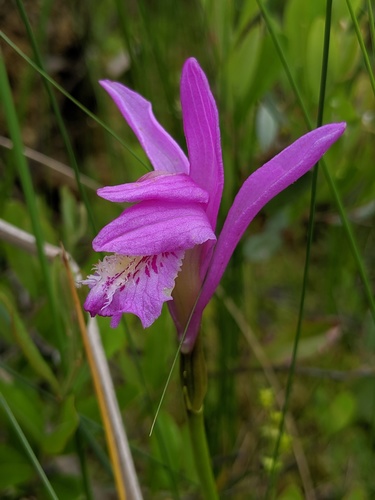
Arethusa bulbosa, dragon's mouth orchid, is the only rare terrestrial orchid species in the monotypic genus Arethusa.
Arethusa bulbosa, commonly known as dragon's mouth orchid, is the only species in the orchid genus Arethusa. The genus takes its name from a naiad from Greek mythology. As a monotypic genus, it is abbreviated Aret in trade journals. This is a rare terrestrial orchid that grows in Eastern North America, ranging from Manitoba east to Newfoundland and St. Pierre & Miquelon, and south to Virginia, wit...
⚠️ Toxicity: Insufficient toxicity evidence; avoid direct contact and ingestion.
View full details →
18
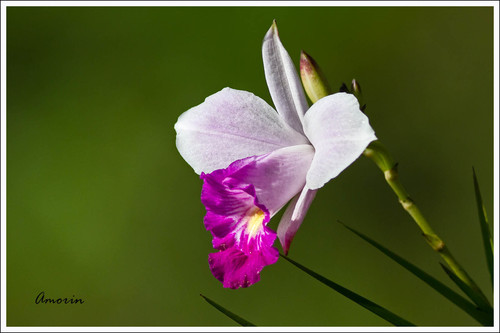
Arundina graminifolia is a terrestrial perennial orchid with distinct growth, flower traits, and varying status across regions.
Arundina graminifolia is a terrestrial, perennial orchid that forms large clumps, with reedy stems that grow between 70 cm and 2 m in height. Its leaves are linear, plaited, and oblong lanceolate, measuring 9 to 19 cm long and 0.8 to 1.5 cm wide, with an acuminate apex. The species also has amplexicaul, or stem-clasping, sheathing stipules. This orchid blooms during summer and autumn, producing op...
⚠️ Toxicity: Insufficient toxicity evidence; avoid direct contact and ingestion.
View full details →
19
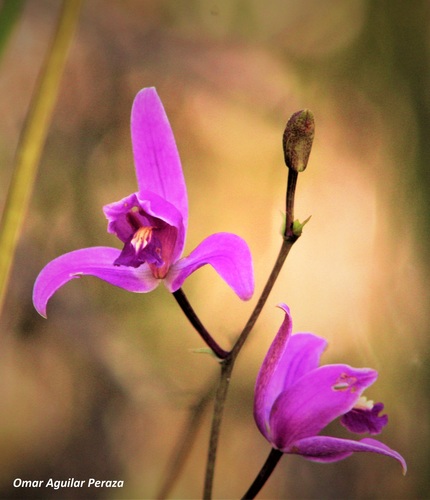
Bletia purpurea, pine-pink, is a large orchid species found in Florida, Latin America, and the West Indies with varied colored flowers.
Bletia purpurea, commonly called pine-pink or sharp-petaled bletia, is an orchid species. It is widespread across most of Latin America and the West Indies, and also occurs in Florida. This species grows as a terrestrial plant in swamps, and sometimes grows on logs or stumps located above the high tide mark. Bletia purpurea can grow up to 180 cm (5 feet) in total length. It produces ovoid, egg-sha...
⚠️ Toxicity: Insufficient toxicity evidence; avoid direct contact and ingestion.
View full details →
20
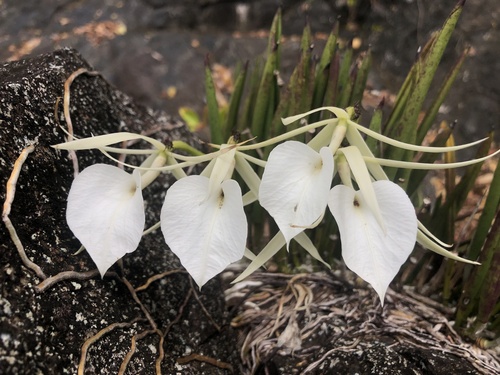
Brassavola nodosa, the lady of the night orchid, is a small hardy orchid widely cultivated for its fragrant evening blooms.
Brassavola nodosa (L.) Lindl. is a small, hardy orchid species. It is native to Mexico, ranging from Tamaulipas south to Chiapas and the Yucatán Peninsula, as well as Central America, the West Indies, and northern South America including Venezuela, Colombia, Guyana, and French Guiana. It is commonly called the "lady of the night" orchid, because it releases a fragrance that resembles a mix of citr...
⚠️ Toxicity: Insufficient toxicity evidence; avoid direct contact and ingestion.
View full details →
21
Bulbophyllum shepherdii (F.Muell.) Rchb.f.
Bulbophyllum shepherdii (F.Muell.) Rchb.f.
🌿 Plantae Orchidaceae
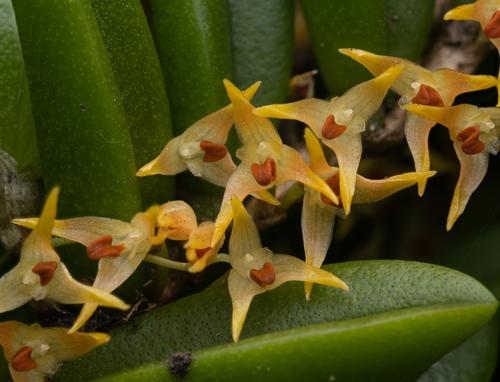
Bulbophyllum shepherdii is a small Australian epiphytic/lithophytic orchid that bears single, mostly closed flowers from March to August.
Bulbophyllum shepherdii is an epiphytic or lithophytic herb that has branching rhizomes, which form a dense mat over its growing substrate. Its pseudobulbs are roughly spherical but flattened, measuring 2–3 mm (0.08–0.1 in) in diameter, and are spaced 2–9 mm (0.08–0.4 in) apart from each other. Each pseudobulb produces one grooved, stalkless leaf that is elliptic to egg-shaped, 20–40 mm (0.8–2 in)...
⚠️ Toxicity: Insufficient toxicity evidence; avoid direct contact and ingestion.
View full details →
22
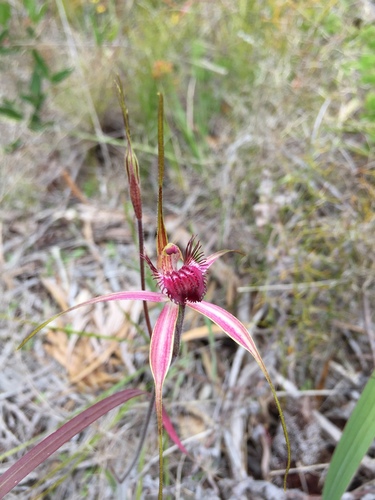
Caladenia arenicola is a terrestrial orchid that grows in sandy woodlands of south-west Western Australia, bearing up to three scented flowers between August and October.
Caladenia arenicola Hopper & A.P.Br. is a terrestrial, perennial, deciduous herb. It grows from an underground tuber and produces a single erect, hairy leaf that is 15–25 cm (6–10 in) long and 5–12 mm (0.2–0.5 in) wide. Its inflorescence is a raceme that stands 30–60 cm (10–20 in) high and bears up to three flowers. Each individual flower is 8–10 cm (3–4 in) long and 6–8 cm (2–3 in) wide. The dors...
⚠️ Toxicity: Insufficient toxicity evidence; avoid direct contact and ingestion.
View full details →
23
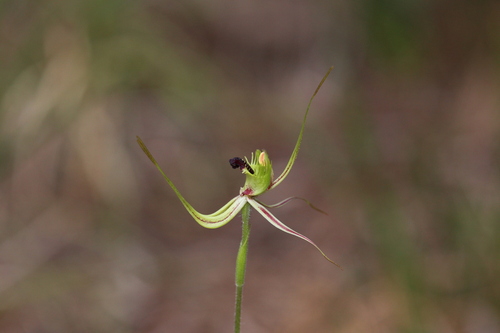
Caladenia attingens is a tuberous terrestrial Australian orchid with hairy leaves and multicolored flowers flowering from August to November.
Caladenia attingens is a terrestrial, perennial, deciduous herb that grows from an underground tuber. It produces a single erect, hairy leaf that measures 5–20 cm (2–8 in) long and 5–12 mm (0.2–0.5 in) wide, and the lower section of the leaf often has reddish blotches. One or two flowers grow from a hairy spike that reaches 12–45 cm (5–20 in) high. Each individual flower is 4–8 cm (2–3 in) long an...
⚠️ Toxicity: Insufficient toxicity evidence; avoid direct contact and ingestion.
View full details →
24
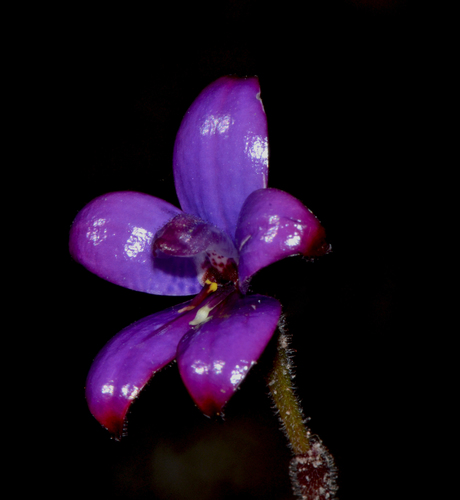
Caladenia brunonis is a common terrestrial orchid from Western Australia that grows in forests, woodlands and heath, with purple flowers and hairy green leaves.
Caladenia brunonis, also referred to as Elythranthera brunonis, is a terrestrial, perennial, deciduous, sympodial herb. It grows from a tuber that is partly surrounded by a fibrous, multi-layered protective sheath, and has a few inconspicuous fine roots. This species produces a single flattened, dark green, hairy leaf. The leaf is 20–80 mm (0.8–3 in) long, about 7 mm (0.3 in) wide, and has a reddi...
⚠️ Toxicity: Insufficient toxicity evidence; avoid direct contact and ingestion.
View full details →
25
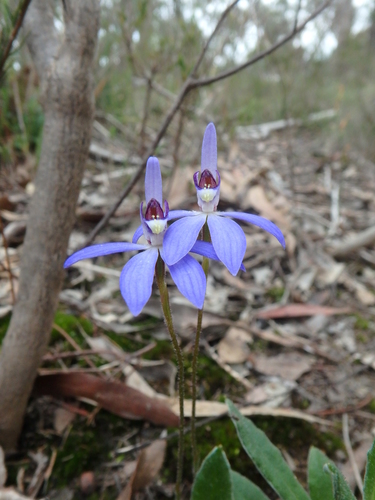
Caladenia caerulea is a small terrestrial orchid from south-eastern Australia with a single blue flower and hairy leaf.
Caladenia caerulea (also referred to as Cyanicula caerulea) is a terrestrial, perennial, deciduous herb that grows from an underground tuber. It produces a single sparsely hairy leaf, 20–70 mm (0.8–3 in) long and 2–5 mm (0.08–0.2 in) wide, that usually lies flat on the ground. One flower, most often pale to dark blue, rarely white, 20–30 mm (0.8–1 in) in both length and width, grows on a stalk 50–...
⚠️ Toxicity: Insufficient toxicity evidence; avoid direct contact and ingestion.
View full details →
26
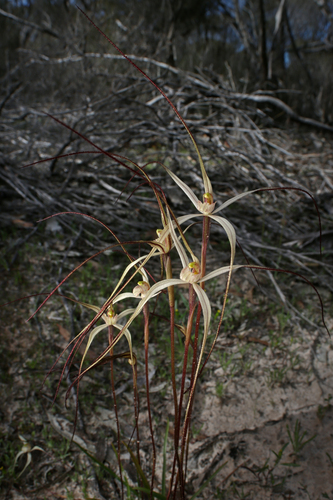
Caladenia capillata is a clumping, hairy-flowered terrestrial orchid found in mallee and rocky scrub habitats of southeastern Australia.
Caladenia capillata D.L.Jones is a terrestrial, perennial, deciduous herb that often grows in clumps. It has an underground tuber and a single, very hairy, narrow linear leaf, measuring 10–20 cm (4–8 in) long and 3–6 mm (0.1–0.2 in) wide. Up to three, or sometimes four, flowers grow on a slender, very hairy spike that stands 5–15 cm (2–6 in) high. The dorsal sepal, lateral sepals, and petals are g...
⚠️ Toxicity: Insufficient toxicity evidence; avoid direct contact and ingestion.
View full details →
27
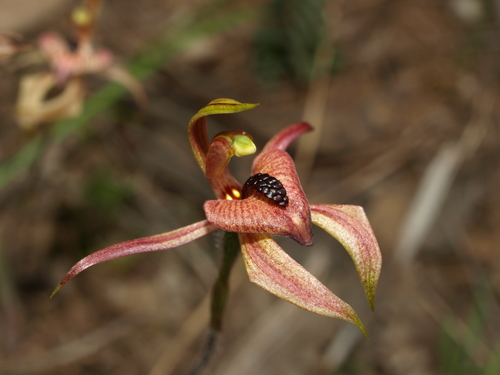
Caladenia cardiochila is a terrestrial orchid species native to south-eastern Australia, with distinct heart-shaped labellum and seasonal flowering.
Caladenia cardiochila Tate is a terrestrial, perennial, deciduous herb that grows from an underground tuber. It produces a single, sparsely hairy leaf that is linear to lance-shaped, measuring 4–11 cm (2–4 in) long and 3–10 mm (0.1–0.4 in) wide. One or two flowers are borne on a slender, wiry, sparsely hairy spike that reaches 10–30 cm (4–10 in) in height. The sepals and petals are yellowish to gr...
⚠️ Toxicity: Insufficient toxicity evidence; avoid direct contact and ingestion.
View full details →
28
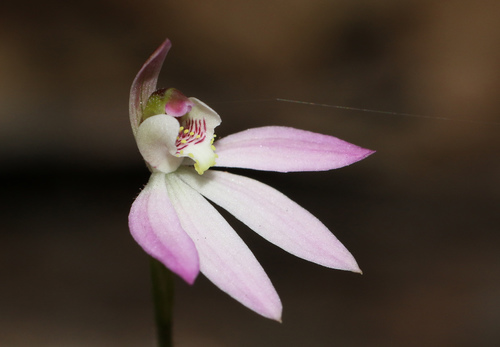
Caladenia carnea, the pink fingers orchid, is a pink-flowered terrestrial orchid native to southeastern Australia.
Caladenia carnea R.Br. is a terrestrial, perennial, deciduous herb that grows from an underground tuber. It produces a single, sparsely hairy, narrow linear leaf, which measures 90–150 mm (4–6 in) long and 3–4 mm (0.1–0.2 in) wide. Its inflorescence is a raceme that grows 120–250 mm (5–10 in) tall, and bears between one and three, and sometimes up to five flowers. The flowers may sometimes be swee...
⚠️ Toxicity: Insufficient toxicity evidence; avoid direct contact and ingestion.
View full details →
29
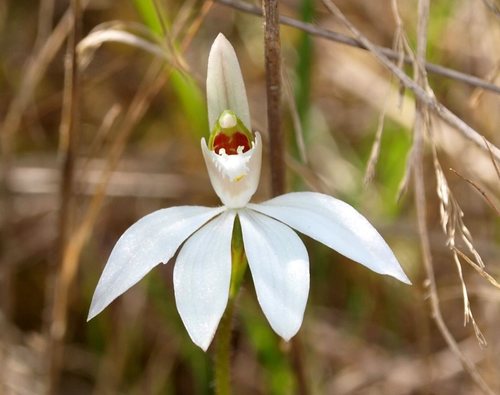
Caladenia catenata is a species of terrestrial orchid found in south-eastern Australia, growing in forest and shrubland habitats.
Caladenia catenata is a terrestrial, perennial, deciduous herb that grows from an underground tuber. It produces a single, sparsely hairy linear leaf, which is 6 to 14 centimetres (2 to 6 inches) long and 3 to 4 millimetres (0.1 to 0.2 inches) wide. One or two flowers are held on a slender, sparsely hairy flowering spike that reaches 10 to 30 centimetres (4 to 10 inches) in height. The sepals and ...
⚠️ Toxicity: Insufficient toxicity evidence; avoid direct contact and ingestion.
View full details →
30
Caladenia chlorostyla D.L.Jones, Molloy & M.A.Clem.
Caladenia chlorostyla D.L.Jones, Molloy & M.A.Clem.
🌿 Plantae Orchidaceae
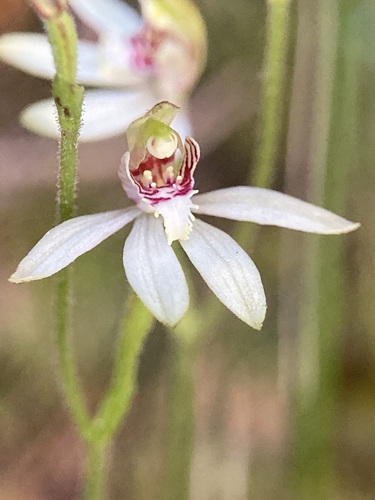
Caladenia chlorostyla is a terrestrial perennial deciduous orchid native to New Zealand that grows in multiple sunny habitats.
Caladenia chlorostyla D.L.Jones, Molloy & M.A.Clem. is a terrestrial, perennial, deciduous herb that usually grows as a solitary individual. It has an underground tuber, and a single, sparsely hairy, bright green, narrow linear leaf that reaches up to 5–15 cm (2–6 in) long and 1–3 mm (0.04–0.1 in) wide. One, or sometimes up to five, unscented flowers up to 11–16 mm (0.4–0.6 in) in diameter are bor...
⚠️ Toxicity: Insufficient toxicity evidence; avoid direct contact and ingestion.
View full details →
Frequently Asked Questions
How many species are in the Orchidaceae family?
This guide features 30 representative species from the Orchidaceae family. The full family contains many more species worldwide — explore them all on iNature.
How to identify Orchidaceae species?
Orchidaceae species share common features in their flowers, leaves, and growth patterns. This guide provides photos and descriptions for 30 species. For instant field identification, use the iNature app.
Sources: GBIF, iNaturalist, Wikipedia · Disclaimer
Identify any species instantly — even offline
iNature uses on-device AI to identify plants, animals, fungi and more. No internet needed.
Download iNature — FreeStart Exploring Nature Today
Download iNature for free. 10 identifications on us. No account needed. No credit card required.
Download Free on App Store
