The Liliaceae (lily family) has been refined by modern taxonomy to include the "true lilies" — lilies, tulips, and fritillaries — some of the most elegant flowering plants in cultivation. Tulips alone have driven economic booms and busts through history. This guide covers the most notable species in this iconic plant family.
🌱 Plant Families
Lily Family (Liliaceae) — Complete Species Guide
1
Calochortus albus (Benth.) Douglas ex Benth.
Calochortus albus (Benth.) Douglas ex Benth.
🌿 Plantae Liliaceae
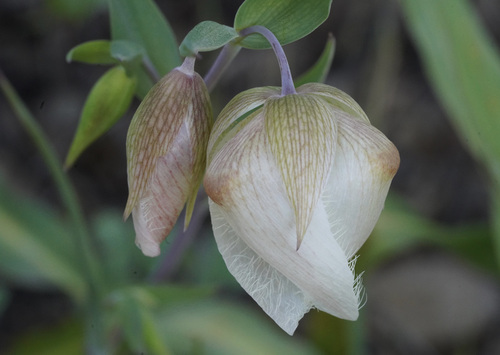
Calochortus albus is a variable flowering bulb widespread across most of California, commonly grown in cultivation.
Calochortus albus (Benth.) Douglas ex Benth. is a widespread and variable species that blooms during winter and spring, then goes dormant after flowering until autumn rains begin. At maturity, the plant reaches a height of 20 to 80 cm; its stems, which reach 7.5 to 80 cm, are erect to arching, slender, glaucous, and can be simple or branching. It produces two types of leaves: basal (radical) and c...
⚠️ Toxicity: Insufficient toxicity evidence; avoid direct contact and ingestion.
View full details →
2
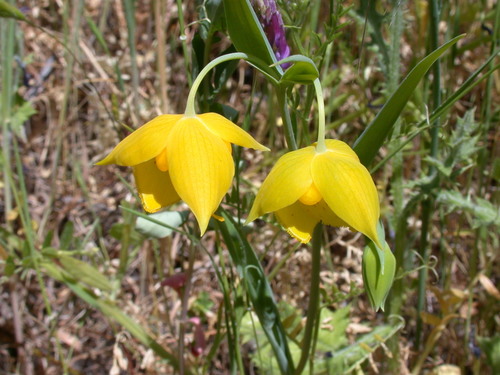
Calochortus amabilis is a bulbous perennial herb endemic to northern California, cultivated ornamentally and used traditionally for food.
Calochortus amabilis Purdy is a bulbous perennial herb. It grows an upright, somewhat waxy branching stem that reaches 10 to 50 centimeters in height. At maturity, it reaches 10 to 50 centimeters (4–20 inches) tall, with a spread of 5 centimeters (2 inches). Stems are glaucous, stout, flexuous, and generally branching. It produces two types of leaves: basal (radical) and cauline. The basal leaf is...
⚠️ Toxicity: Insufficient toxicity evidence; avoid direct contact and ingestion.
View full details →
3
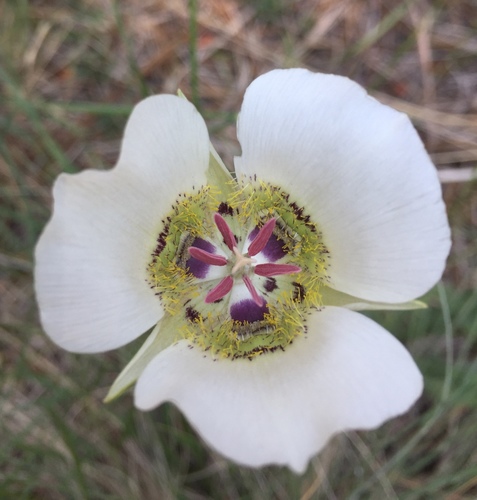
Calochortus ambiguus is a perennial bulb-forming lily herb native to higher elevation Sonoran Desert regions of the southwestern US and northern Mexico.
Calochortus ambiguus, commonly called the Arizona mariposa lily or doubting mariposa lily, is a perennial bulb-forming herb belonging to the lily family Liliaceae. This species grows at higher elevations in the Sonoran Desert regions of Arizona, western New Mexico, southern Utah, and Sonora. Its flowers are white or very pale lavender, with a green center and reddish-purple anthers.
⚠️ Toxicity: Insufficient toxicity evidence; avoid direct contact and ingestion.
View full details →
4
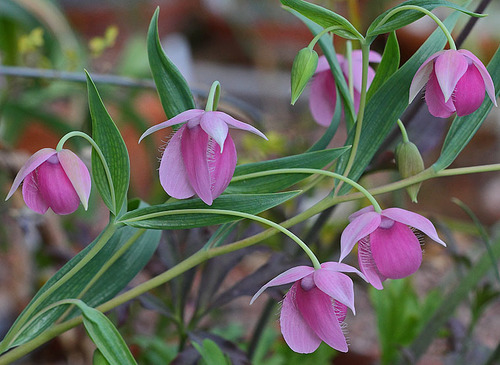
Calochortus amoenus is a perennial herb endemic to California’s Central Sierra Nevada foothills, with rose-colored spherical nodding flowers.
Calochortus amoenus is a perennial herb that forms a branching stem reaching heights between 20 and 50 centimeters. A single narrow leaf grows at the base of the stem; it can reach up to 50 centimeters in length and does not wither away when the plant flowers. Two to three smaller leaves develop along the stem. The inflorescence holds two or more nodding flowers, each with petals curved closed to ...
⚠️ Toxicity: Insufficient toxicity evidence; avoid direct contact and ingestion.
View full details →
5
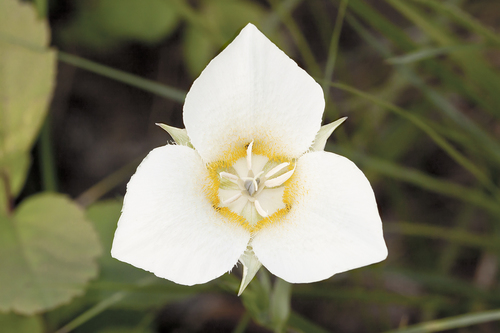
Calochortus apiculatus is a bulb-forming perennial herb native to western North America with pale yellow streaked flowers.
Calochortus apiculatus Baker is a bulb-forming perennial herb that grows a single stalk reaching up to 30 cm in height. Its flowers are pale yellow, with purple streaks and yellow hairs on the petals. This species is native to western Canada (specifically Alberta and British Columbia) and the northwestern United States. In the United States, most recorded specimens come from the northern Rocky Mou...
⚠️ Toxicity: Insufficient toxicity evidence; avoid direct contact and ingestion.
View full details →
6
Calochortus argillosus (Hoover) Zebzll & Fielder
Calochortus argillosus (Hoover) Zebzll & Fielder
🌿 Plantae Liliaceae

Calochortus argillosus is a perennial herb with bell-shaped flowers, native to described morphological traits.
Calochortus argillosus is a perennial herb that grows an unbranched stem 40 to 60 centimeters (16 to 24 inches) tall. A single narrow basal leaf grows up to 30 centimeters (12 inches) long, and this leaf withers away by the time the plant flowers. Its inflorescence holds 1 to 4 erect, bell-shaped flowers. Each flower has three sepals and three petals that measure up to 4 centimeters long. The peta...
⚠️ Toxicity: Insufficient toxicity evidence; avoid direct contact and ingestion.
View full details →
7
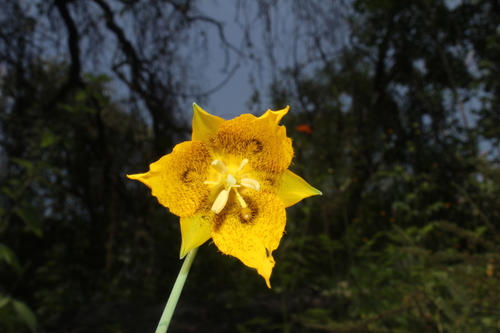
Calochortus barbatus is a bulb-forming Mexican perennial herb with nodding yellow hermaphrodite flowers pollinated by insects.
Calochortus barbatus (Kunth) Painter is a bulb-forming perennial herb. It produces branching stems that reach up to 50 cm in height. Its flowers are nodding, meaning they hang downward; they are yellow, and covered in either yellow or purple hairs. All flowers of this species are hermaphrodite, and they are pollinated by insects. This plant is widespread across most of montane Mexico, growing from...
⚠️ Toxicity: Insufficient toxicity evidence; avoid direct contact and ingestion.
View full details →
8
Calochortus bruneaunis A.Nelson & J.F.Macbr.
Calochortus bruneaunis A.Nelson & J.F.Macbr.
🌿 Plantae Liliaceae
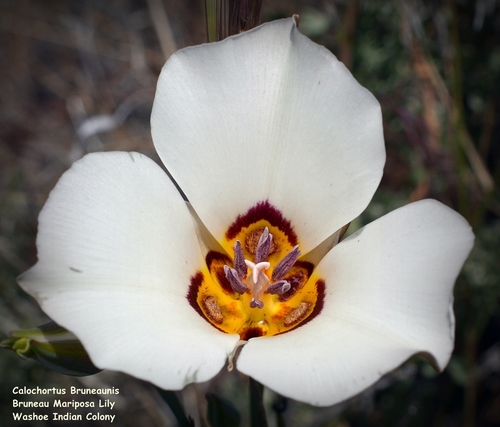
Calochortus bruneaunis is a perennial flowering herb native to dry sagebrush steppe habitats of the western U.S. Great Basin region.
Calochortus bruneaunis A.Nelson & J.F.Macbr. is a perennial herb that grows a mostly unbranched stem reaching up to 40 centimeters tall. The basal leaf is narrow, measuring 10 to 20 centimeters long, and it withers away when the plant flowers. The inflorescence holds 1 to 4 erect, bell-shaped flowers. Both the pointed sepals and larger, rounded petals have a base color ranging from white to lilac-...
⚠️ Toxicity: Insufficient toxicity evidence; avoid direct contact and ingestion.
View full details →
9
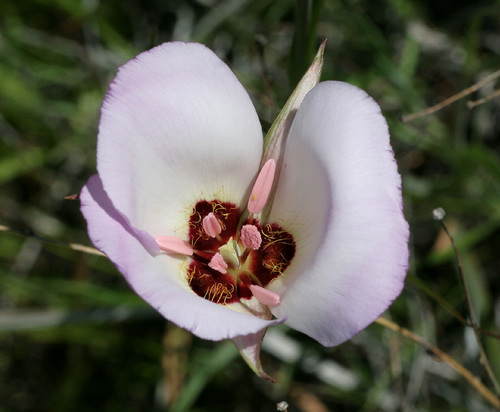
Calochortus catalinae is a perennial bulb plant endemic to coastal Southern California, with pale petals marked by dark basal blotches.
Calochortus catalinae S.Watson is a perennial plant. It produces long basal leaves and tall, branching stems that can grow up to 60 centimeters high. Its purple-tinted sepals reach up to 3 centimeters long, and its petals are longer than the sepals. Petals are usually white or very pale pink, with a purple or deep red blotch at their bases. The inner bowl-shaped portion of the petals may have spar...
⚠️ Toxicity: Insufficient toxicity evidence; avoid direct contact and ingestion.
View full details →
10
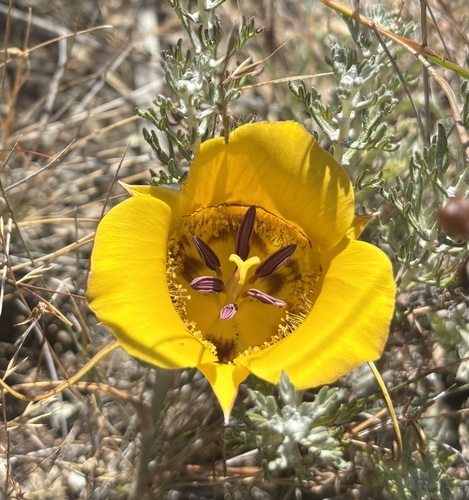
Calochortus clavatus is a lily species with several described varieties native to parts of California.
Calochortus clavatus, a species of lily, produces tall stems that can reach up to 1 metre (3.3 ft) in height, and bears only basal leaves. A single lily flower forms at the top of the stem. Its sepals can grow up to 4 centimeters long, while its petals reach up to 5 centimeters long. The petals are yellow, with a darker line or series of often red bands near their base. The inner cup of the flower...
⚠️ Toxicity: Insufficient toxicity evidence; avoid direct contact and ingestion.
View full details →
11
Calochortus concolor (Baker) Purdy & L.H.Bailey
Calochortus concolor (Baker) Purdy & L.H.Bailey
🌿 Plantae Liliaceae
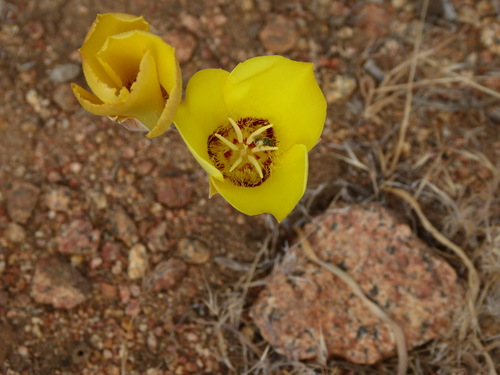
Calochortus concolor is a North American perennial herb with bell-shaped yellow flowers that form long narrow seed capsules.
Calochortus concolor is a perennial herb that produces an erect stem measuring 30 to 60 centimeters tall. Its waxy basal leaf grows 10 to 20 centimeters long, and withers when the plant flowers. The inflorescence holds 1 to 7 erect, bell-shaped flowers. Each flower has three sepals and three yellow petals, with reddish coloring near the petal bases. The fruit it produces is a narrow, angled capsul...
⚠️ Toxicity: Insufficient toxicity evidence; avoid direct contact and ingestion.
View full details →
12
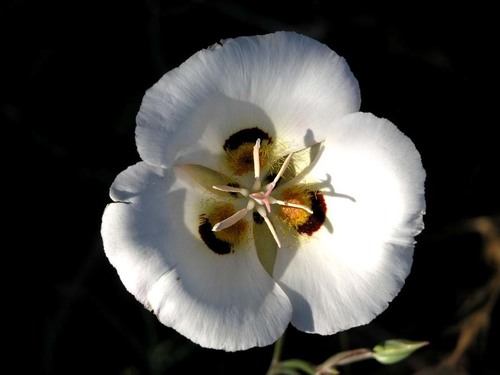
Calochortus dunnii is an endemic perennial herb from the Peninsular Ranges of southern California and northern Baja California with distinctive bell-shaped flowers.
Calochortus dunnii is a perennial herb that produces a slender, branching stem that can reach up to 60 centimeters in height. Its waxy, channeled basal leaf grows 10 to 20 centimeters long, and it withers when the plant flowers. The inflorescence holds 2 to 6 upright bell-shaped flowers. Each flower has three sepals and three white or pinkish petals. The petals can be up to 3 centimeters long; the...
⚠️ Toxicity: Insufficient toxicity evidence; avoid direct contact and ingestion.
View full details →
13
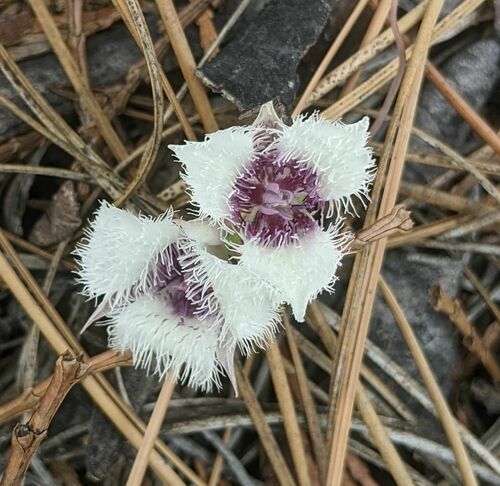
Calochortus elegans is a lily-family flowering perennial native to the western US, with edible bulbs.
Calochortus elegans Pursh is a species of flowering plant in the lily family, with common names including elegant Mariposa lily, cat's ear, elegant cat's ears, and star tulip. It is native to the western United States, ranging from northern California to Montana. This perennial herb grows a slender, generally unbranched stem that reaches up to 15 centimeters tall. Its single basal leaf is 10 to 20...
⚠️ Toxicity: Toxicity risk detected (mainly via ingestion); avoid direct contact and ingestion.
View full details →
14
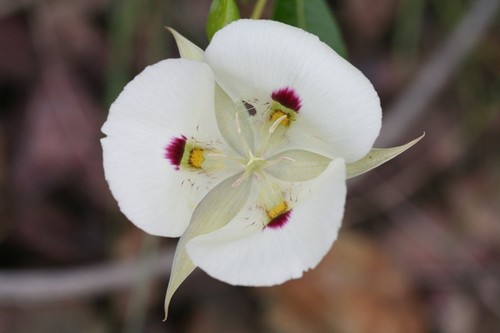
Calochortus eurycarpus, the white mariposa lily, is a bulb-forming perennial lily native to the western United States.
Calochortus eurycarpus, commonly called white mariposa lily, is a North American flowering plant species belonging to the lily family. It is native to the western United States, where it occurs in Montana, Idaho, eastern Oregon, western Wyoming, northeastern Nevada's Box Elder County, and southeastern Washington's Asotin and Garfield counties. This species is a bulb-forming perennial herb that pro...
⚠️ Toxicity: Insufficient toxicity evidence; avoid direct contact and ingestion.
View full details →
15
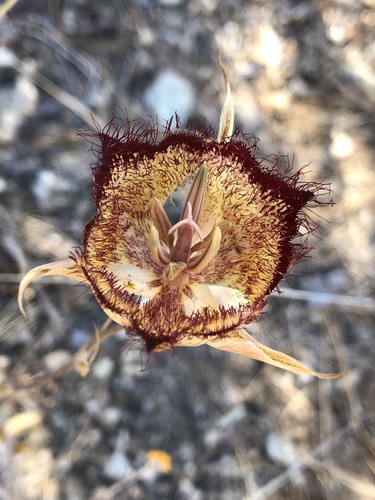
Calochortus fimbriatus is a bulb-forming perennial herb that blooms more vigorously the year after wildfire.
Calochortus fimbriatus is a perennial herb that grows from a bulb, producing a slender, branching stem that reaches 30 to 110 centimeters in height. It has a single basal leaf that grows up to 40 centimeters long; this leaf emerges in January and withers long before the plant begins blooming in late June or early July. Its blooming period continues until mid-August. The inflorescence holds 2 to 6 ...
⚠️ Toxicity: Insufficient toxicity evidence; avoid direct contact and ingestion.
View full details →
16
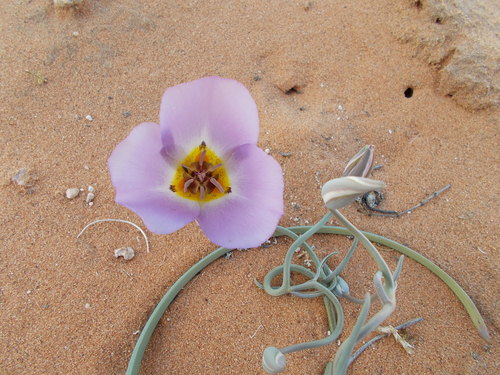
Calochortus flexuosus is a flowering plant with a winding branched stem, showy pink/lavender/white petals with yellow spotted bases.
Calochortus flexuosus produces one long, bare stem, with only one or two small leaves located near its base. The stem may branch, and it is typically winding, bent, or curved. A showy flower grows at the tip of the stem. The flower has coloration ranging from pink or lavender shades to white. The base of each of its petals is solid yellow, marked with white and red stripes or spots.
⚠️ Toxicity: Insufficient toxicity evidence; avoid direct contact and ingestion.
View full details →
17
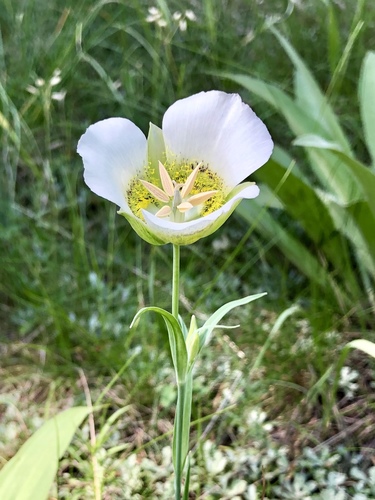
Calochortus gunnisonii is a lily-family flowering bulb native to the western US, grown in dry-climate cultivation.
Calochortus gunnisonii S.Watson, commonly called the Rocky Mountain mariposa or Gunnison mariposa lily, is a North American flowering plant species belonging to the lily family. It is native to the western United States, found primarily in the Rocky Mountains and Black Hills, with documented populations in Arizona, New Mexico, Utah, Colorado, Wyoming, Montana, South Dakota, Grant County in Washing...
⚠️ Toxicity: Insufficient toxicity evidence; avoid direct contact and ingestion.
View full details →
18
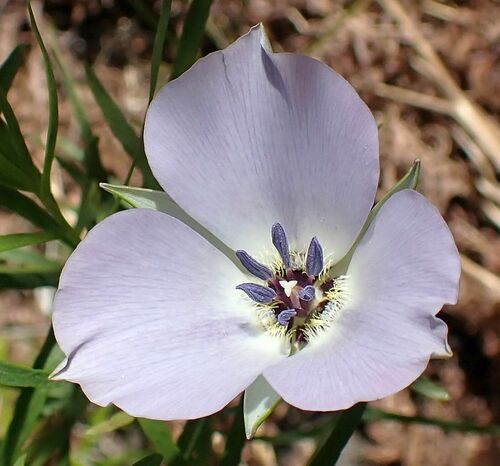
Calochortus invenustus is a North American perennial herb with bell-shaped white to light purple flowers, growing up to 50 cm tall.
Calochortus invenustus Greene is a perennial herb. It grows a slender, mostly unbranched stem that reaches up to 50 centimeters in height. It produces one basal leaf 10 to 20 centimeters long, which withers when the plant flowers. The inflorescence holds 1 to 6 erect bell-shaped flowers arranged in a loose cluster. Each flower has three sepals and three petals; the petals are usually white to ligh...
⚠️ Toxicity: Insufficient toxicity evidence; avoid direct contact and ingestion.
View full details →
19
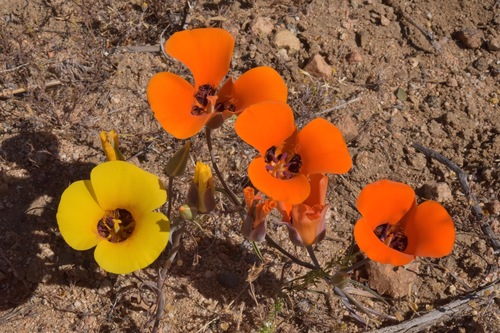
Calochortus kennedyi is a perennial herb with colorful bell flowers, with two recognized varieties across western North America.
Calochortus kennedyi Porter is a perennial herb. It produces a slender, unbranching stem that sometimes twists, reaching up to 50 centimeters tall, though it is typically shorter. It has one basal leaf 10 to 20 centimeters long with a waxy texture, and this leaf withers when the plant flowers. The inflorescence is a loose cluster holding 1 to 6 erect, bell-shaped flowers. Each flower has three sep...
⚠️ Toxicity: Insufficient toxicity evidence; avoid direct contact and ingestion.
View full details →
20
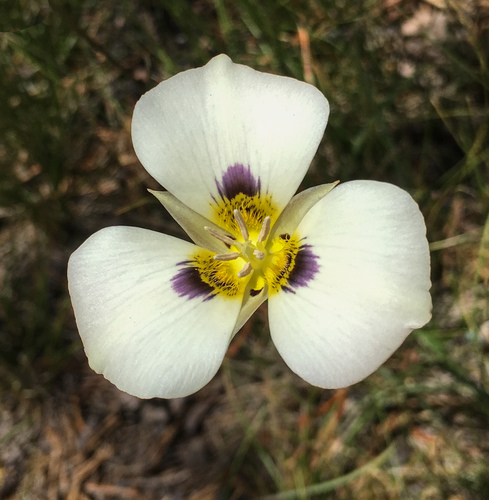
Calochortus leichtlinii is a perennial herb with varying flower colors that produces a narrow capsule fruit.
Calochortus leichtlinii is a perennial herb that grows an erect, unbranched stem reaching up to 60 centimeters in height. Its single basal leaf is 10 to 15 centimeters long, and it withers by the time the plant begins flowering. The inflorescence forms a loose cluster holding 1 to 5 erect, bell-shaped flowers. Each flower has three petals that measure 1 to 4 centimeters long. Petal color ranges fr...
⚠️ Toxicity: Insufficient toxicity evidence; avoid direct contact and ingestion.
View full details →
21
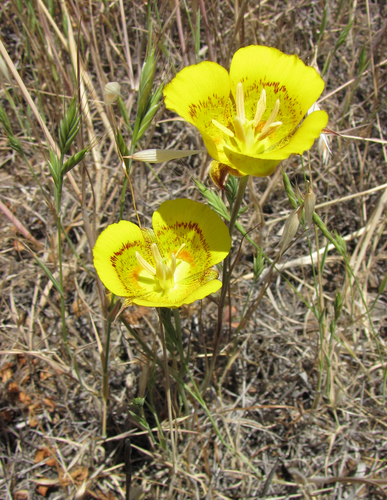
Calochortus luteus is a yellow-flowered perennial herb native to California, grown as an ornamental and for restoration projects.
Calochortus luteus Douglas ex Lindl. is a perennial herb. Its flowers are primarily bright deep yellow, 3–5 cm across, with a bulb-shaped perianth that is red-brown on the inner lining. Flowers often have a central red-brown blotch and sparse hairs inside the perianth. This species grows in coastal prairie, grasslands, and some open forest floors. Its range covers coastal ranges extending from th...
⚠️ Toxicity: Insufficient toxicity evidence; avoid direct contact and ingestion.
View full details →
22
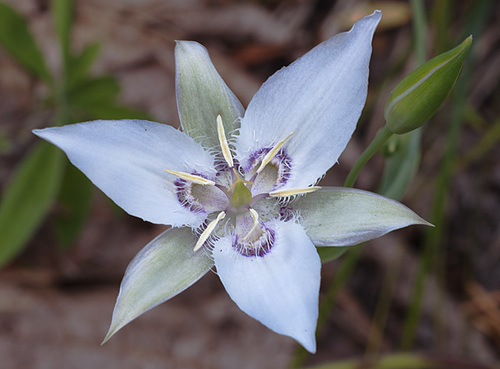
Calochortus lyallii is a bulb-producing perennial herb with upright, bell-shaped white to pale violet flowers.
Calochortus lyallii Baker, also known as Calochortus lyallii, is a bulb-forming perennial herb. It typically reaches a height of around 50 centimeters. Its flowers grow upright, have a bell shape, and range in color from white to pale violet, with darker markings visible on the petals.
⚠️ Toxicity: Insufficient toxicity evidence; avoid direct contact and ingestion.
View full details →
23
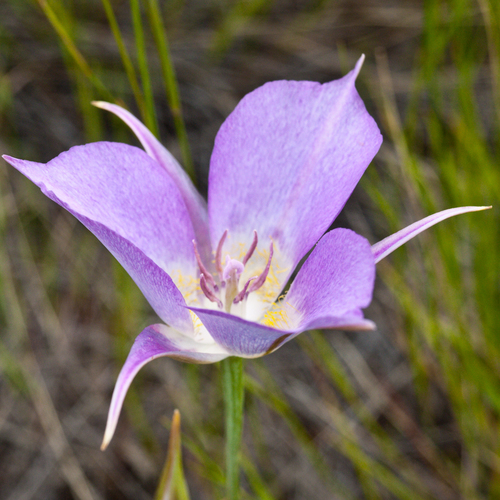
Calochortus macrocarpus is a North American bulbous plant whose edible bulbs were harvested by First peoples of southern British Columbia.
Calochortus macrocarpus Douglas has blue-green, grass-like leaves. Its bulbs are carrot-shaped and taper toward the end. This species produces large, three-petaled flowers that range in color from pink to purple, and are occasionally white; each flower has a greenish stripe on the underside of its petals. The plant’s sepals are roughly 2 inches long, much narrower than the petals, and slightly lon...
⚠️ Toxicity: Insufficient toxicity evidence; avoid direct contact and ingestion.
View full details →
24
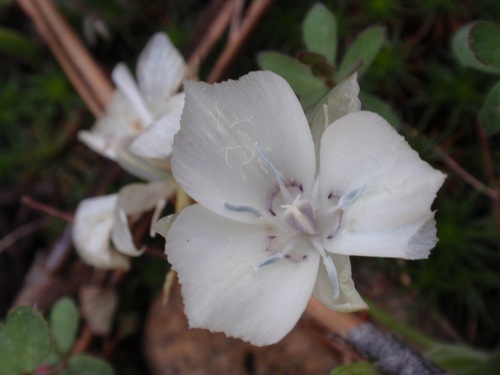
Calochortus minimus is a small perennial lily relative endemic to California’s Sierra Nevada, growing along mountain lakesides.
Calochortus minimus Ownbey is a perennial herb that grows an unbranching stem not exceeding 10 centimeters in height. Its single basal leaf measures 10 to 20 centimeters long and remains intact, not withering when the plant flowers. The inflorescence can hold up to 10 erect, bell-shaped flowers. Each individual flower has three pointed sepals and three small white petals. After flowering, it produ...
⚠️ Toxicity: Insufficient toxicity evidence; avoid direct contact and ingestion.
View full details →
25
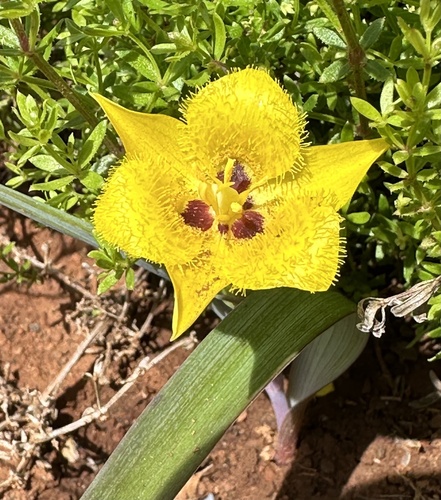
Calochortus monophyllus is a yellow-flowered perennial herb with upright bell-shaped blooms and a winged capsule fruit.
Calochortus monophyllus is a perennial herb that grows a slender stem, which is sometimes branched, reaching up to around 20 centimeters tall. Its single basal leaf measures 10 to 30 centimeters in length and does not wither when the plant flowers. Smaller leaves may grow along the length of the stem. The inflorescence holds 1 to 6 erect, bell-shaped flowers. Each flower has three pointed sepals a...
⚠️ Toxicity: Insufficient toxicity evidence; avoid direct contact and ingestion.
View full details →
26
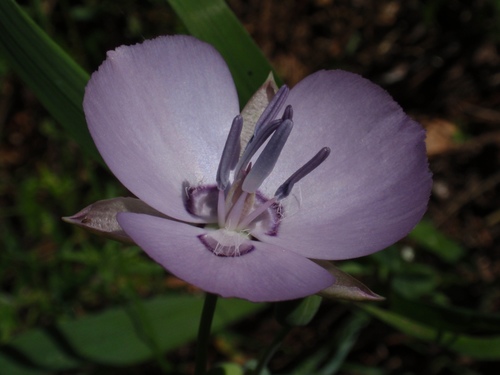
Calochortus nudus is a hairless-petaled perennial bulb plant native to western US mountain regions.
Calochortus nudus S.Watson is a perennial herb that grows an unbranched stem reaching up to around 25 centimeters tall. It has one basal leaf that measures 5 to 15 centimeters long, and this leaf does not wither when the plant flowers. The inflorescence holds one or more erect, bell-shaped flowers. Each flower has three small, pointed sepals and three wider petals, all of which are pinkish or lave...
⚠️ Toxicity: Insufficient toxicity evidence; avoid direct contact and ingestion.
View full details →
27
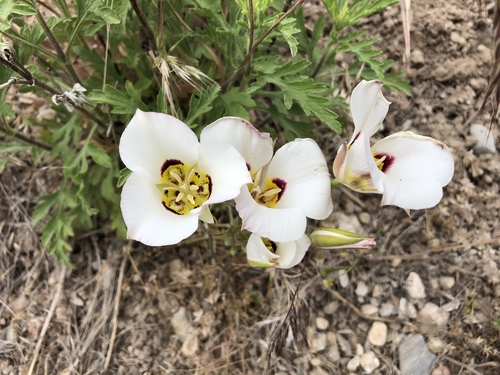
Calochortus nuttallii is a western North American wild lily cultivated as an ornamental for pollinator gardens.
Calochortus nuttallii Torr. typically grows between 15–45 cm (6–18 inches) tall and produces linear leaves. Each plant bears 1 to 4 flowers; every flower has 3 white petals and 3 sepals. The petals are usually tinged with lilac, and occasionally magenta, with a purplish band that radiates out from the flower's yellow base. A distinct form with yellow petals and deep purple bands has been recorded ...
⚠️ Toxicity: Insufficient toxicity evidence; avoid direct contact and ingestion.
View full details →
28
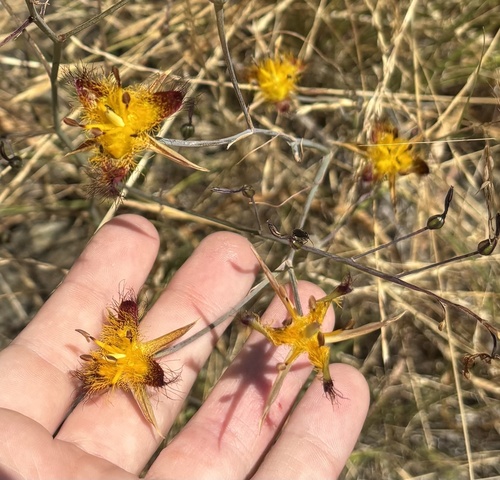
Calochortus obispoensis is a perennial herb with distinct flowers and angled capsules holding translucent yellow seeds.
Calochortus obispoensis is a perennial herb that grows a slender, branched stem reaching up to 60 centimeters in height. Its single basal leaf measures 20 to 30 centimeters long and withers when the plant blooms. Smaller leaves may grow along the length of the stem. The inflorescence holds 2 to 6 upright flowers. Each open flower has three reflexed sepals that can grow up to 3 centimeters long, pl...
⚠️ Toxicity: Insufficient toxicity evidence; avoid direct contact and ingestion.
View full details →
29
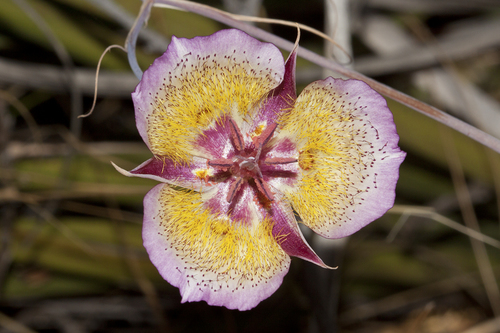
Calochortus plummerae is a lily species with colored banded petals, flowering May to July and producing long fruit capsules.
Calochortus plummerae Greene produces thin, branching stems and a small number of long, curling leaves. A lily-like flower grows at the top of the stem, with long, pointed sepals and petals that can reach up to 4 centimeters in length. The petals are pink, lavender, or white, with a wide yellow band across their middle section. The inner surface of the petals is hairy, and the edges are sometimes ...
⚠️ Toxicity: Insufficient toxicity evidence; avoid direct contact and ingestion.
View full details →
30
Calochortus pulchellus (Benth.) Alph.Wood
Calochortus pulchellus (Benth.) Alph.Wood
🌿 Plantae Liliaceae
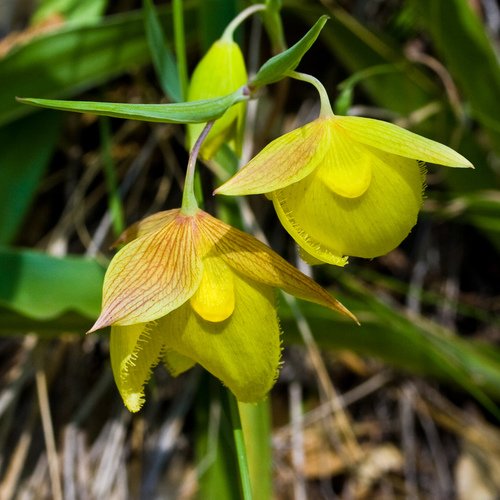
Calochortus pulchellus is a yellow-flowered North American perennial herb with reclassified former varieties.
Calochortus pulchellus is a perennial herb that produces a branching stem reaching up to around 30 centimeters in height. Its basal leaf can grow up to 40 centimeters long and does not wilt when the plant flowers. There are an additional 2 or 3 smaller leaves positioned higher along the stem. The inflorescence may hold either a single solitary flower or a cluster of multiple flowers. These flowers...
⚠️ Toxicity: Insufficient toxicity evidence; avoid direct contact and ingestion.
View full details →
Frequently Asked Questions
How many species are in the Liliaceae family?
This guide features 30 representative species from the Liliaceae family. The full family contains many more species worldwide — explore them all on iNature.
How to identify Liliaceae species?
Liliaceae species share common features in their flowers, leaves, and growth patterns. This guide provides photos and descriptions for 30 species. For instant field identification, use the iNature app.
Sources: GBIF, iNaturalist, Wikipedia · Disclaimer
Identify any species instantly — even offline
iNature uses on-device AI to identify plants, animals, fungi and more. No internet needed.
Download iNature — FreeStart Exploring Nature Today
Download iNature for free. 10 identifications on us. No account needed. No credit card required.
Download Free on App Store
