The Fabaceae (legume or pea family) is the third-largest family of flowering plants, encompassing beans, peas, clovers, acacias, and lupins. These plants are ecologically vital because they fix atmospheric nitrogen through symbiotic root bacteria. This guide covers the most commonly encountered legume species worldwide.
🌱 Plant Families
Legume Family (Fabaceae): Species, Photos & Identification
1
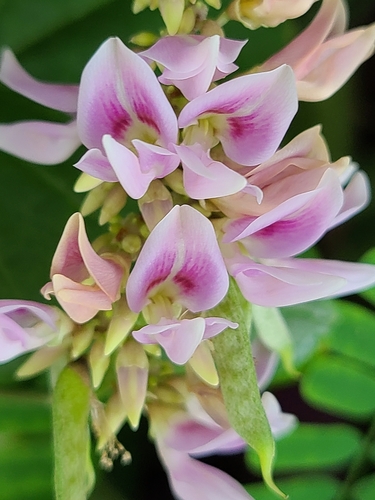
Abrus precatorius (jequirity bean/rosary pea) is a toxic, invasive pantropical climber with a history of traditional medicinal use.
Scientific name: Abrus precatorius L. Introduction Abrus precatorius, commonly known as jequirity bean or rosary pea, is a herbaceous flowering plant in the bean family Fabaceae. It is a slender, perennial climbing vine with long, pinnately leafleted leaves that twines around trees, shrubs, and hedges. The plant is most widely recognized for its seeds: these seeds are used to make beads and for c...
⚠️ Toxicity: Toxicity risk detected (mainly via ingestion); avoid direct contact and ingestion.
View full details →
2
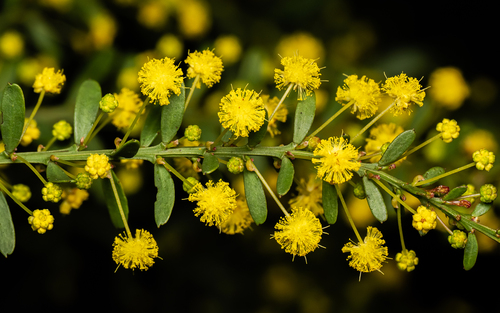
Acacia acinacea (gold dust wattle) is an open bushy shrub native to southeastern Australia that bears golden-yellow flowers between July and November.
Scientific name: Acacia acinacea Lindl. Description: Acacia acinacea, commonly called gold dust wattle, is an open, bushy or straggling shrub that usually reaches around 2.5 m (8 ft 2 in) in height. Its phyllodes are asymmetric, shaped narrowly oblong, lance-shaped, or egg-shaped with the narrower end toward the base. They measure 4–15 mm (0.16–0.59 in) long and 2–8 mm (0.079–0.315 in) wide, with...
⚠️ Toxicity: Insufficient toxicity evidence; avoid direct contact and ingestion.
View full details →
3
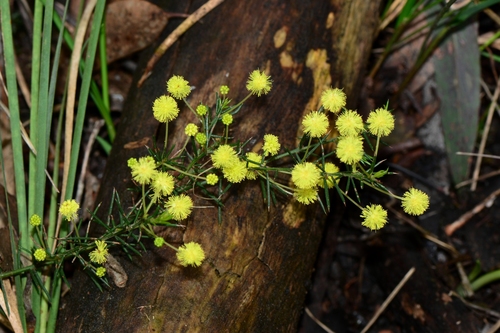
Acacia aculeatissima is a small prostrate wattle found in south-eastern Australian rocky woodland, forest and heath.
Scientific name: Acacia aculeatissima J.F.Macbr. Description: Acacia aculeatissima is an open, prostrate shrub. It typically grows to a maximum height of 50 cm (20 in), and rarely reaches 1 m (3 ft 3 in). It has finely ribbed, hairy branchlets. Its phyllodes are needle-shaped, curved backwards, 5–12 mm (0.20–0.47 in) long, 0.5–1 mm (0.020–0.039 in) wide, and sharply pointed. Up to 3 usually spher...
⚠️ Toxicity: Insufficient toxicity evidence; avoid direct contact and ingestion.
View full details →
4
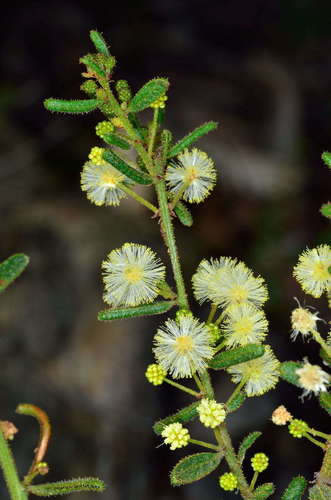
Acacia aspera Lindl. is a spreading Australian shrub that produces cream to golden spherical flower heads from August to October.
Scientific name: Acacia aspera Lindl. Description: Acacia aspera is a spreading shrub that typically reaches 0.5–2 m (1 ft 8 in – 6 ft 7 in) in height. It has hairy, ribbed branchlets. Its phyllodes range in shape from oblong to narrowly oblong or elliptic, are 6–30 mm (0.24–1.18 in) long and mostly 2–4 mm (0.079–0.157 in) wide, and have a prominent midrib. Flowers are arranged in one or two sphe...
⚠️ Toxicity: Insufficient toxicity evidence; avoid direct contact and ingestion.
View full details →
5
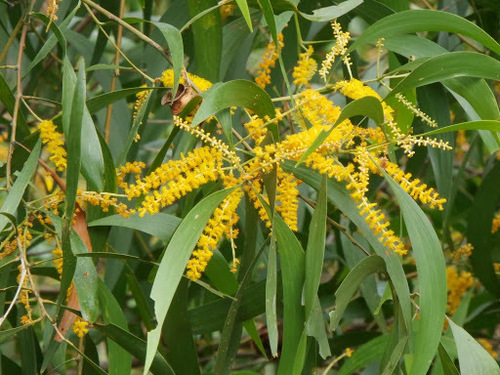
Acacia auriculiformis is an Australian-native wattle tree with yellow flower spikes and coiled pods, with recorded bioactive properties.
Scientific name: Acacia auriculiformis A.Cunn. ex Benth. Description: Acacia auriculiformis, also commonly called ear-pod wattle, is a mostly glabrous tree. It typically grows 8–10 m (26–33 ft) tall, and rarely reaches up to 35 m (115 ft). It has thin branchlets, with smooth bark; older individuals develop fissured bark. Its phyllodes are very narrowly elliptic, and sometimes curved. Most phyllo...
⚠️ Toxicity: Insufficient toxicity evidence; avoid direct contact and ingestion.
View full details →
6
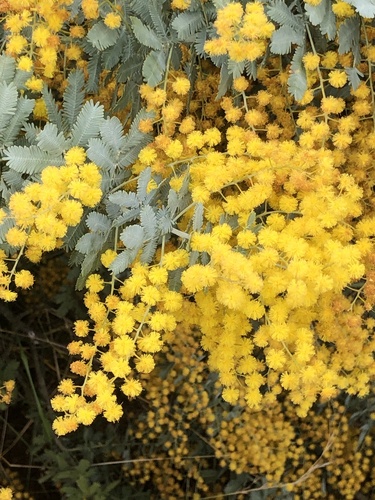
Acacia baileyana (Cootamundra wattle) is an Australian wattle widely used in horticulture, sometimes an environmental weed.
Scientific name: Acacia baileyana F.Muell. Description: Acacia baileyana (commonly known as Cootamundra wattle) is a shrub or tree that typically grows 3–10 m (9.8–32.8 ft) tall, and has smooth, grey or brown bark. Its leaves are more or less sessile, somewhat leathery, and glaucous, with mostly two to four pairs of pinnae that are oblong to narrowly oblong, 5–8 mm (0.20–0.31 in) long and 0.7–1....
⚠️ Toxicity: Insufficient toxicity evidence; avoid direct contact and ingestion.
View full details →
7
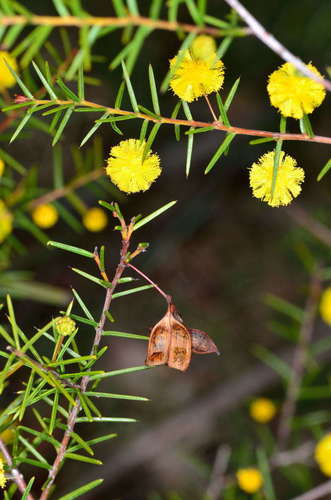
Acacia brownii (heath wattle) is a small Australian shrub that grows in forest, woodland, and heath habitats along the Great Dividing Range.
Acacia brownii, commonly called heath wattle, is an erect or spreading shrub that typically reaches a height of 0.3 to 1 m (1 ft 0 in to 3 ft 3 in). It has branchlets that range from glabrous to sparsely hairy. Its phyllodes are more or less rigid, straight, and round or four-angled in cross-section, ending in a sharp point. The phyllodes measure 8–20 mm (0.31–0.79 in) long and up to approximately...
⚠️ Toxicity: Insufficient toxicity evidence; avoid direct contact and ingestion.
View full details →
8
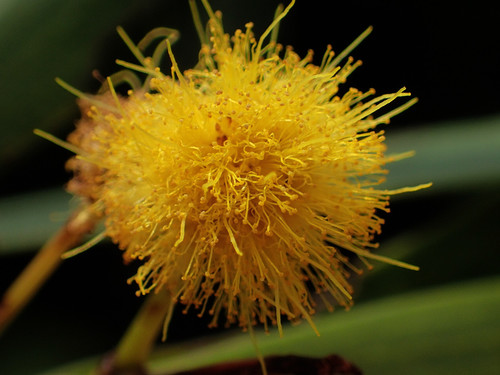
Acacia confusa is a perennial Southeast Asian tree, invasive in Hawaii, with various wood uses and traditional medicinal applications in Taiwan.
Scientific name: Acacia confusa Merr. Introduction Acacia confusa is a perennial tree native to Southeast Asia. Its common names include ayangile, small Philippine acacia, Formosa acacia (Taiwan acacia), Philippine Wattle, and Formosan koa. It reaches a maximum height of 15 m. This tree has become very widespread across many tropical Pacific regions, including Hawaii, where it is classified as an...
⚠️ Toxicity: Insufficient toxicity evidence; avoid direct contact and ingestion.
View full details →
9
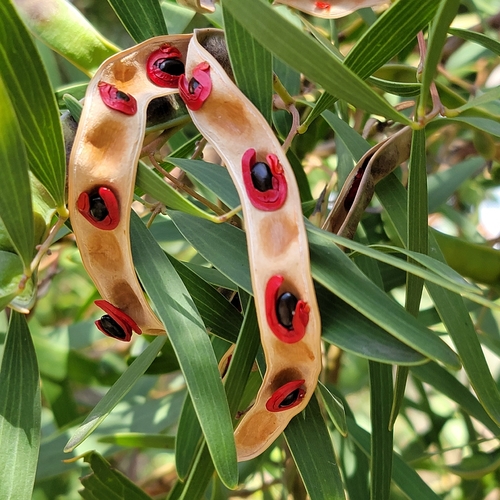
Acacia cyclops, an Australian shrub or tree, is an invasive alien outside its native range, and has various traditional human uses.
Scientific name: Acacia cyclops A.Cunn. ex G.Don Description: Acacia cyclops is a shrub or small tree that typically reaches 1–6 m (3 ft 3 in – 19 ft 8 in) in height, and has glabrous branchlets. Its phyllodes are ascending, and shaped from narrowly oblong to elliptic or egg-shaped with the narrower end at the base. Most phyllodes are 40–95 mm (1.6–3.7 in) long and 6–15 mm (0.24–0.59 in) wide, le...
⚠️ Toxicity: Insufficient toxicity evidence; avoid direct contact and ingestion.
View full details →
10
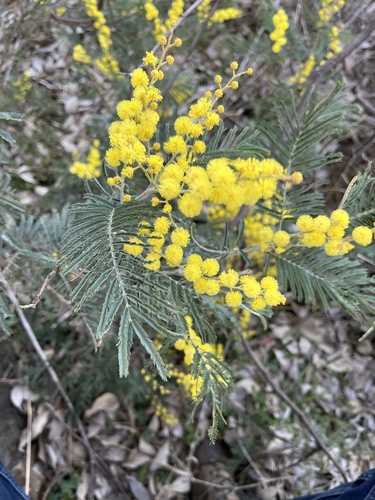
Acacia dealbata is an Australian tree/shrub widely cultivated for ornament, cut flowers, perfume, and timber.
Scientific name: Acacia dealbata Link Description Acacia dealbata is an erect, bushy shrub or spreading tree that typically grows up to 30 m (98 ft) tall. It has smooth grey, brown or dark brown bark that becomes deeply corrugated with age. Its leaves are bipinnate, borne on a petiole up to 15 mm (0.59 in) long, with 6 to 30 pairs of pinnae. Each pinna holds 10 to 68 pairs of narrowly oblong to l...
⚠️ Toxicity: Insufficient toxicity evidence; avoid direct contact and ingestion.
View full details →
11
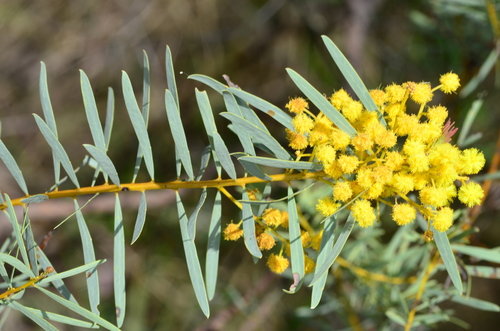
Acacia decora (western silver wattle) is an Australian hardy shrub commonly cultivated in horticulture.
Scientific name: Acacia decora Rchb. Description: Acacia decora is a shrub that typically grows 1–3 m (3 ft 3 in – 9 ft 10 in) tall, with ribbed, usually glabrous branchlets. Its phyllodes grow on raised stem projections, and are lance-shaped or narrowly lance-shaped with the narrower end toward the base, or narrowly elliptic to more or less linear. They are usually 20–60 mm (0.79–2.36 in) long a...
⚠️ Toxicity: Insufficient toxicity evidence; avoid direct contact and ingestion.
View full details →
12
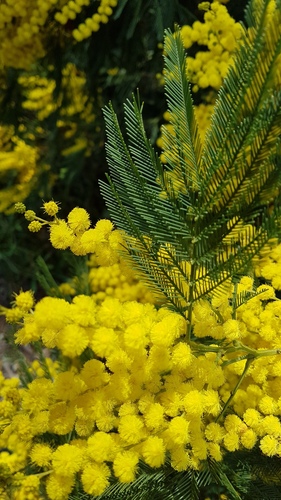
Acacia decurrens is an Australian wattle species with multiple uses that is cultivated and naturalised globally.
Scientific name: Acacia decurrens Willd. Description Acacia decurrens is a tall shrub or tree that typically grows up to 10 to 25 m (33 to 82 ft) in height, and has smooth or fissured greyish-black or black bark. Its more or less glabrous branchlets bear winged ridges 0.5–2 mm (0.020–0.079 in) wide. Young foliage tips are light green or yellowish. The dark green leaves are alternately arranged, b...
⚠️ Toxicity: Insufficient toxicity evidence; avoid direct contact and ingestion.
View full details →
13
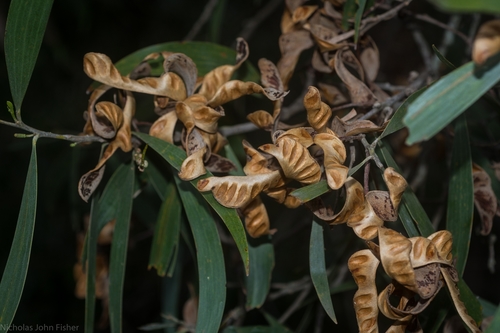
Acacia disparrima (southern salwood) is an Australian wattle with two subspecies differing in range and flowering time.
Scientific name: Acacia disparrima M.W.McDonald & Maslin Description: Acacia disparrima grows as a tree-like shrub reaching 3 to 5 m (9.8 to 16.4 ft) in height, or a small tree reaching 3 to 9 m (9.8 to 29.5 ft) tall, and may occasionally grow to 12 m (39 ft). It has slender branchlets that are angled at their tips. Its phyllodes are dimidiate, roughly sickle-shaped, and measure 50–140 mm (2.0–5....
⚠️ Toxicity: Insufficient toxicity evidence; avoid direct contact and ingestion.
View full details →
14
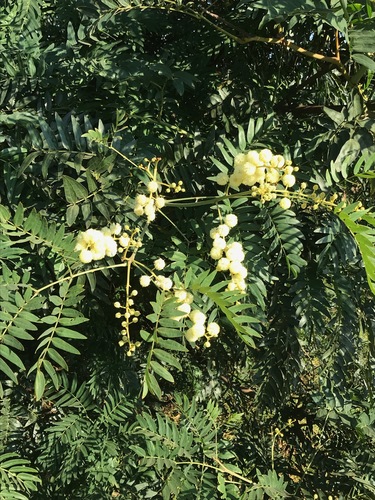
Acacia elata (cedar wattle) is an Australian tree endemic to NSW, naturalised elsewhere, grown ornamentally and used for wood.
Scientific name: Acacia elata A.Cunn. ex Benth. Description: Acacia elata, commonly known as cedar wattle, is a tree that typically grows to a height of 7–20 m (23–66 ft), with a diameter at breast height of up to 0.6 m (2 ft 0 in). Its bark is dark brown to black and deeply fissured at the base of the tree. Branchlets are terete, and covered in soft hairs when young. The leaves are bipinnate, wi...
⚠️ Toxicity: Insufficient toxicity evidence; avoid direct contact and ingestion.
View full details →
15
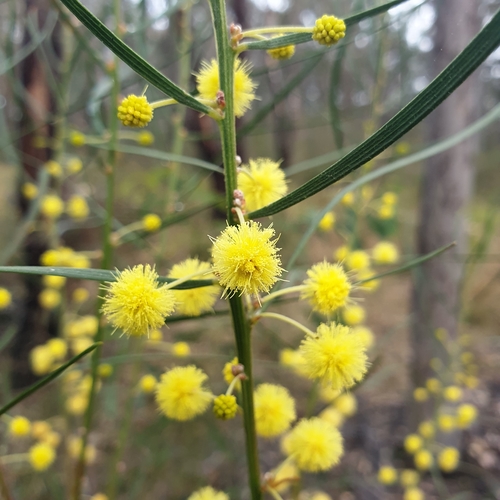
Acacia elongata (swamp wattle) is an Australian shrub with yellow flower heads, sometimes cultivated in gardens.
Scientific name: Acacia elongata Sieber ex DC. Description: Acacia elongata (common name swamp wattle) is an erect or spreading shrub that usually grows up to 5 m (16 ft) tall. It has yellow-ribbed branchlets, sometimes with tiny pressed hairs against the surface. Its phyllodes are rigid, linear to narrowly lance-shaped (with the narrower end at the base), straight to slightly curved. They are ty...
⚠️ Toxicity: Insufficient toxicity evidence; avoid direct contact and ingestion.
View full details →
16
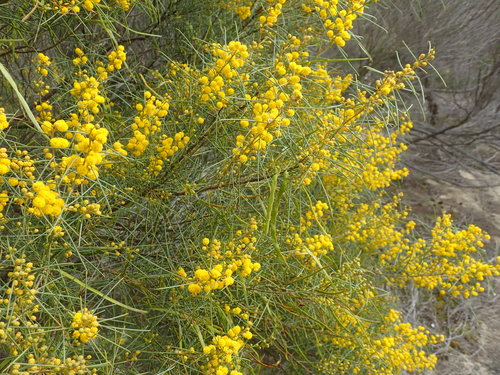
Acacia euthycarpa is a shrub or occasional tree with two subspecies native to south-eastern Australia, eaten by Icilius blue butterfly larvae.
Acacia euthycarpa (J.M.Black) J.M.Black is most often a shrub that typically reaches 2–4 m (6 ft 7 in – 13 ft 1 in) in height, and occasionally grows as a tree up to 10 m (33 ft) tall. Its new shoots and branchlets are glabrous. The phyllodes are linear to lance-shaped, with the narrower end oriented toward the base, and are mostly 20–100 mm (0.79–3.94 in) long and 1–6 mm (0.039–0.236 in) wide. Fl...
⚠️ Toxicity: Insufficient toxicity evidence; avoid direct contact and ingestion.
View full details →
17
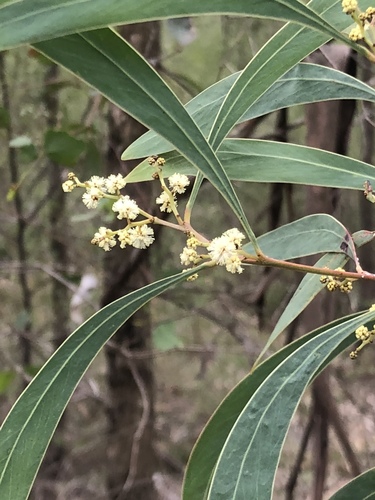
Acacia falcata is an Australian wattle species that has horticultural, indigenous and commercial uses, and supports local insect and butterfly populations.
Scientific name: Acacia falcata Willd. Description: Acacia falcata is an erect, slender shrub or tree that typically reaches a height of 2–5 m (6 ft 7 in – 16 ft 5 in). It has smooth or finely fissured bark, and red-brown, glabrous branchlets that are often covered with a whitish bloom. Its phyllodes are sickle-shaped, broadest above the middle and narrowed at the base; they measure 70–190 mm (2....
⚠️ Toxicity: Insufficient toxicity evidence; avoid direct contact and ingestion.
View full details →
18
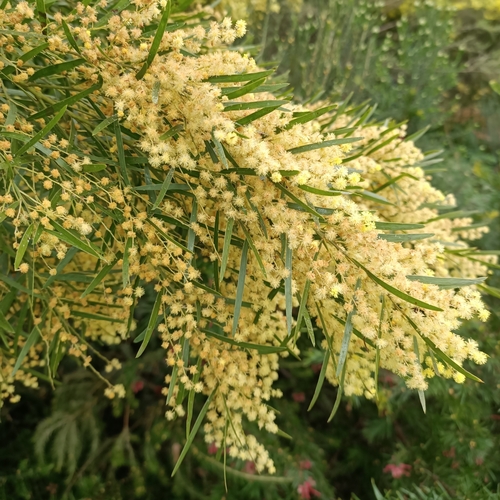
Acacia fimbriata, or fringed wattle, is an Australian shrub/tree grown as a hardy hedge and screening plant in horticulture.
### Description Acacia fimbriata A.Cunn. ex G.Don, commonly called fringed wattle, is a shrub or tree that usually reaches up to 6–7 m (20–23 ft) in height and 6 m (20 ft) in width. It has slender branchlets covered in short hairs, with linear to narrowly oblong or narrowly lance-shaped phyllodes. Phyllodes are typically 20–50 mm (0.79–1.97 in) long and 2–5 mm (0.079–0.197 in) wide, with thin edge...
⚠️ Toxicity: Insufficient toxicity evidence; avoid direct contact and ingestion.
View full details →
19
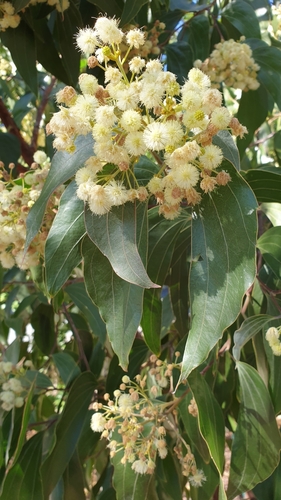
Acacia flavescens is an Australian eastern Queensland wattle tree with multiple cultivation and medicinal uses.
### Description Acacia flavescens A.Cunn. ex Benth. is a tree that typically reaches a height of 4–20 m (13–66 ft). It has rough, furrowed, somewhat shaggy bark. Its branchlets are covered with star-shaped hairs, while new shoots bear golden hairs. The phyllodes are narrowly elliptic to lance-shaped, measuring 90–300 mm (3.5–11.8 in) long and 20–70 mm (0.79–2.76 in) wide. They are more or less gla...
⚠️ Toxicity: Insufficient toxicity evidence; avoid direct contact and ingestion.
View full details →
20
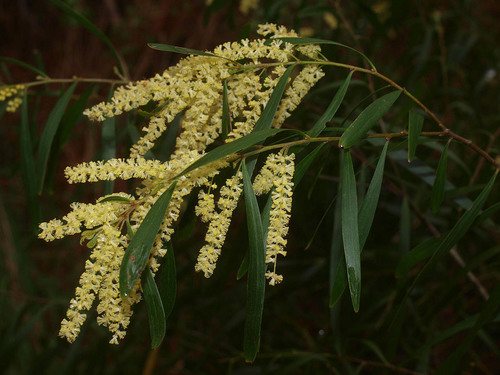
Acacia floribunda (white sally wattle) is an Australian wattle widely used in horticulture for erosion control and hedging.
Scientific name: Acacia floribunda (Vent.) Willd. Description: Acacia floribunda is a spreading shrub or tree that typically reaches a height of 2–8 m (6 ft 7 in – 26 ft 3 in). It has smooth grey bark that sometimes becomes rough with age, and pendulous branches that are often covered in soft hairs. Its phyllodes are linear to narrowly lance-shaped, 50–190 mm (2.0–7.5 in) long and 1.5–12 mm (0.05...
⚠️ Toxicity: Insufficient toxicity evidence; avoid direct contact and ingestion.
View full details →
21

Acacia genistifolia is a spreading Australian shrub that grows in sclerophyll forest and heathland across south-eastern parts of the continent.
Scientific name: Acacia genistifolia Link Description: Acacia genistifolia is an open, erect, straggly, or spreading shrub that typically grows to 0.6–3 m (2 ft 0 in – 9 ft 10 in) in height, and has ribbed branchlets. Its phyllodes are sessile, straight to slightly curved, flat, and sharply pointed, measuring 10–40 mm (0.39–1.57 in) long and 1–3 mm (0.039–0.118 in) wide, with a gland located 2–4 ...
⚠️ Toxicity: Insufficient toxicity evidence; avoid direct contact and ingestion.
View full details →
22
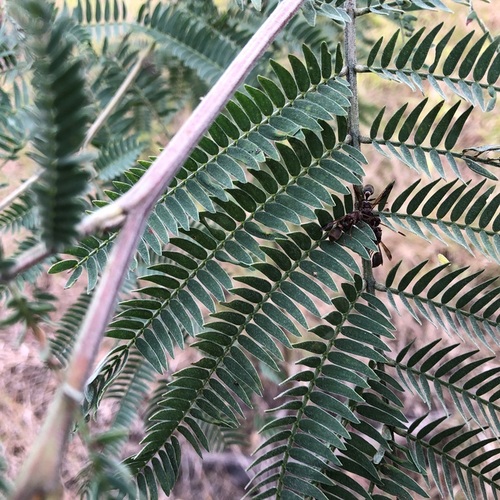
Acacia glaucocarpa (hickory wattle) is a Queensland Australian shrub/tree growing in open woodland on sandstone/sedimentary rock.
Scientific name: Acacia glaucocarpa Maiden & Blakely Description: Acacia glaucocarpa (common name hickory wattle) is a shrub or tree that typically grows to a height of 2.5–10 m (8 ft 2 in – 32 ft 10 in). It has slightly fissured grey or grey-brown bark, and terete, faintly ridged branchlets that bear woolly hairs near their tips. Its leaves are bipinnate and bluish green, with 3 to 8 pairs of pi...
⚠️ Toxicity: Insufficient toxicity evidence; avoid direct contact and ingestion.
View full details →
23
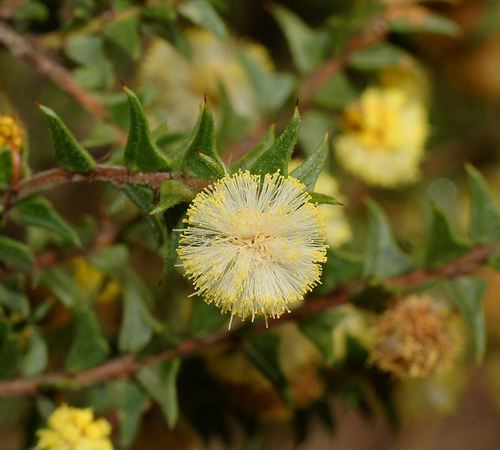
Acacia gunnii Benth., or ploughshare wattle, is a small shrub native to eastern Australia that grows in open forest and coastal heath.
Acacia gunnii Benth. (common name ploughshare wattle) is a diffuse shrub that grows prostrate or erect, typically reaching a maximum height of 1 m (3 ft 3 in). It usually has hairy branchlets. Its phyllodes are more or less sessile and variable in shape, measuring 4–15 mm (0.16–0.59 in) long and 1.5–4 mm (0.059–0.157 in) wide. Most phyllodes have a sharply pointed, rigid projection that forms a ro...
⚠️ Toxicity: Insufficient toxicity evidence; avoid direct contact and ingestion.
View full details →
24
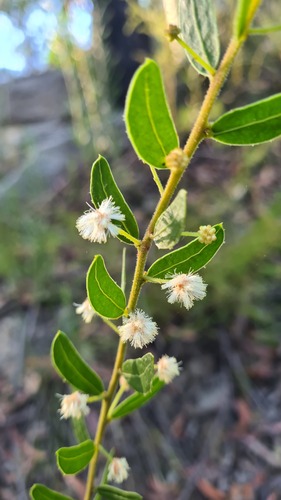
Acacia hispidula is a 2-meter tall shrub with evergreen phyllodes, pale yellow/white flowers, and disjunct distribution in eastern Australian Eucalyptus woodlands.
Scientific name: Acacia hispidula (Sm.) Willd. Description: This shrub typically grows to a height of 2 m (6 ft 7 in), and has a spreading, open growth habit. Its branchlets are scabrous, tuberculate, and covered with minute hairs. It bears evergreen phyllodes that are asymmetric, narrowly oblong-elliptic in shape, and often shallowly incurved. The phyllodes range from sub-glabrous to glabrous, m...
⚠️ Toxicity: Insufficient toxicity evidence; avoid direct contact and ingestion.
View full details →
25
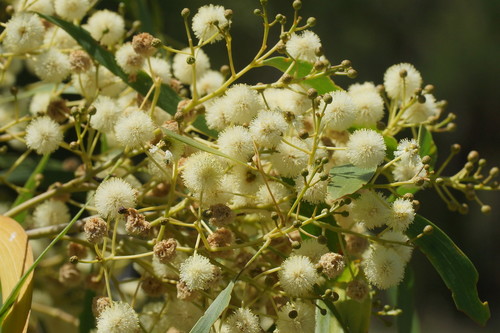
Acacia implexa is a hardy Australian acacia with documented Aboriginal uses and cultivation requirements.
Scientific name: Acacia implexa Benth. Description: Acacia implexa is a long-lived small to medium-sized tree with an upright growth habit and an open crown. It typically reaches 5–15 m (16–49 ft) in height and 4–10 m (13–33 ft) in width. The tree can grow with either a single stem or multiple stems, and has rough greyish bark. Branchlets are commonly lightly covered in a waxy bloom, and do not h...
⚠️ Toxicity: Toxicity risk detected (mainly via contact); avoid direct contact and ingestion.
View full details →
26
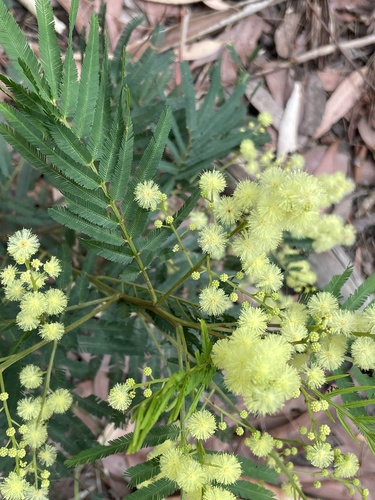
Acacia irrorata (common names green wattle, blueskin) is a Fabaceae Acacia species native to eastern Australia.
Scientific name: Acacia irrorata Sieber ex Spreng. Acacia irrorata, commonly called green wattle or blueskin, is a species of the genus Acacia belonging to the plant family Fabaceae. This species is native to eastern Australia.
⚠️ Toxicity: Insufficient toxicity evidence; avoid direct contact and ingestion.
View full details →
27
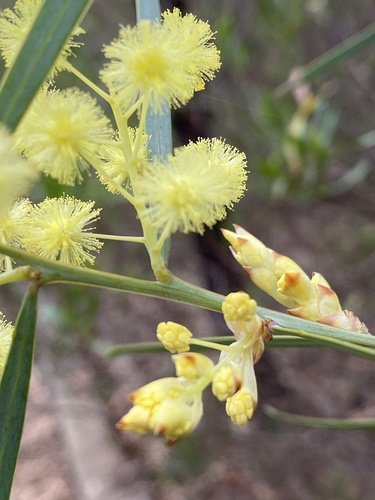
Acacia iteaphylla is a weeping Australian shrub, invasive outside its native range, cultivated ornamentally for screens and windbreaks.
Scientific name: Acacia iteaphylla F.Muell. ex Benth. Description: This shrub has a weeping growth habit, typically reaching 2 to 5 metres (6.6 to 16.4 ft) in height, with a crown width of 2 to 5 m (6.6 to 16.4 ft). Young plants are glabrous, with greenish bark that turns brown as the plant matures. Its slender grey-green foliage has pink-red new growth tips. The long, slender phyllodes are arran...
⚠️ Toxicity: Insufficient toxicity evidence; avoid direct contact and ingestion.
View full details →
28
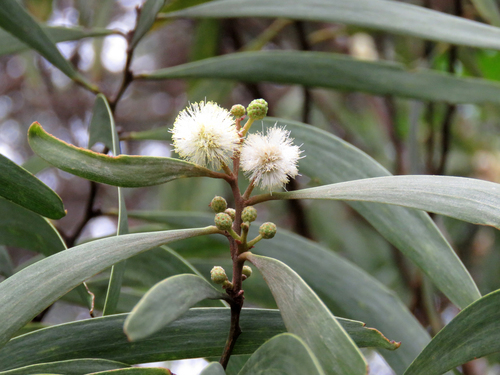
Acacia koa (koa) is a large fast-growing Hawaiian endemic tree with valued wood for construction, crafts, and instruments.
Scientific name: Acacia koa A.Gray Description: Koa is a large tree, typically reaching 15–25 metres (49–82 feet) in height and 6–12 m (20–39 ft) in spread. When growing in deep volcanic ash, koa can reach up to 30 m (98 ft) in height, 6 m (20 ft) in trunk circumference, and 38 m (125 ft) in spread. It is one of the fastest-growing Hawaiian trees, and can reach 6–9 m (20–30 ft) in five years when...
⚠️ Toxicity: Insufficient toxicity evidence; avoid direct contact and ingestion.
View full details →
29
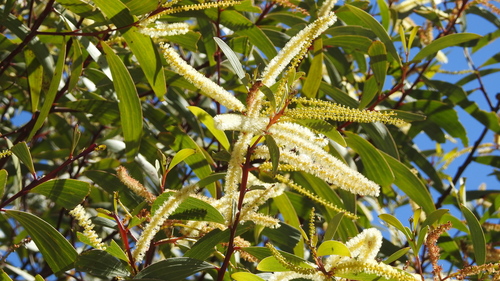
Acacia leiocalyx is a small Australian acacia tree with yellow flowers, found widely in Queensland.
Acacia leiocalyx (Domin) Pedley is a small Acacia tree that has furrowed bark. It bears sickle-shaped green leaves with prominent veins, and the lower two veins are joined near the leaf base. Its flowers are yellow and arranged in narrow spikes. The seed pods of this species are narrow, distinctly curved, and grow in loose clusters. It typically flowers between June and October. This species cont...
⚠️ Toxicity: Insufficient toxicity evidence; avoid direct contact and ingestion.
View full details →
30
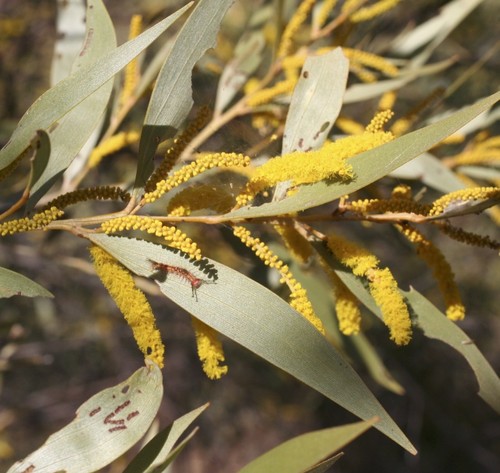
Acacia leptostachya Benth. is a shrub or tree endemic to central-eastern Cape York Peninsula, adapted to cultivation in full sun dry well-drained soils.
Scientific name: Acacia leptostachya Benth. Description: This species typically grows as a shrub or tree reaching a maximum height of 0.5 to 6 m (1 ft 8 in to 19 ft 8 in). It has hairy, ribbed branchlets and resinous young shoots. Like most Acacia species, it has phyllodes rather than true leaves. The evergreen phyllodes are covered in silvery hairs, have a narrowly elliptic to lanceolate shape, ...
⚠️ Toxicity: Insufficient toxicity evidence; avoid direct contact and ingestion.
View full details →
Frequently Asked Questions
How many species are in the Fabaceae family?
This guide features 30 representative species from the Fabaceae family. The full family contains many more species worldwide — explore them all on iNature.
How to identify Fabaceae species?
Fabaceae species share common features in their flowers, leaves, and growth patterns. This guide provides photos and descriptions for 30 species. For instant field identification, use the iNature app.
Sources: GBIF, iNaturalist, Wikipedia · Disclaimer
Identify any species instantly — even offline
iNature uses on-device AI to identify plants, animals, fungi and more. No internet needed.
Download iNature — FreeStart Exploring Nature Today
Download iNature for free. 10 identifications on us. No account needed. No credit card required.
Download Free on App Store
