The Iridaceae (iris family) is celebrated for some of the most spectacular garden flowers on Earth, including irises, crocuses, gladioli, and freesias. Most species grow from corms or rhizomes and display intricate flower structures. This guide covers the most notable species from wild meadows to cultivated gardens.
🌱 Plant Families
Iris Family (Iridaceae): Species & Identification Guide
1
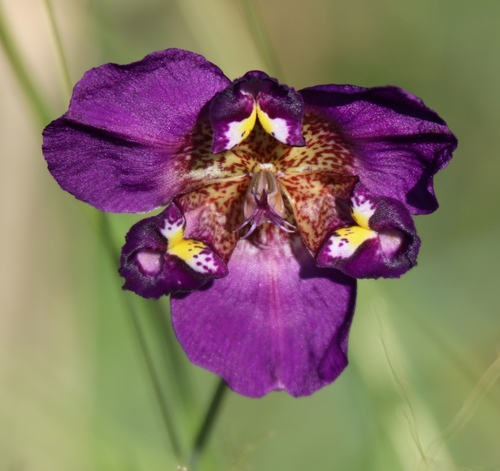
Alophia drummondii, the propeller flower, is a bulbous herbaceous perennial in the Iridaceae family native to parts of the Americas.
Alophia drummondii, commonly known as the propeller flower, is a flowering plant species belonging to the Iridaceae family. It is native to the Americas, ranging from the U.S. states of Arkansas and Oklahoma south into Mexico, with an apparent disjunct population located in Paraguay. Its natural habitat consists of sandy soils in open prairies and woodlands, and it often grows along partially shad...
⚠️ Toxicity: Insufficient toxicity evidence; avoid direct contact and ingestion.
View full details →
2
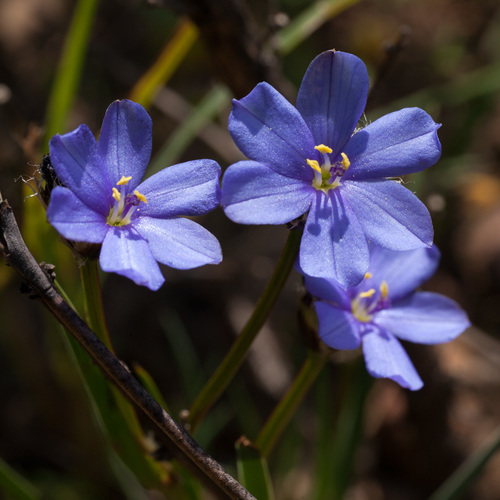
The lectotype of Aristea africana (L.) Hoffmanns, as designated by Goldblatt in 1993, is an illustration in Burman's Rar. Afric. Pl from 1739.
Lectotype (Goldblatt in Jarvis et al., Regnum Veg. 127: 57. 1993): [Illustration] "Ixia foliis ad radicem nervosis, gramineis, floribus ac fructu & c." in Burman, Rar. Afric. Pl: 191, t. 70, f. 2. 1739.
View full details → 3
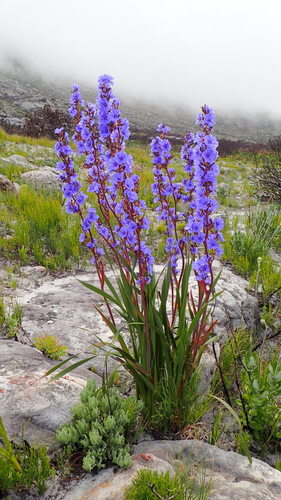
The neotype of Aristea capitata (L.) Ker Gawl. was collected in South Africa's Western Cape at Du Toit's Kloof on 15 Oct 1949 by W.F. Barker 6075, with the main specimen at NBG and isotypes at K, MO, PRE.
Neotype (Goldblatt et al. in Novon 12: 191, 2002): Collected in South Africa, Western Cape, at the foot of Du Toit's Kloof on 15 October 1949 by W.F. Barker (specimen number 6075). The neotype is deposited at NBG, with isotypes at K, MO, and PRE.
View full details → 4
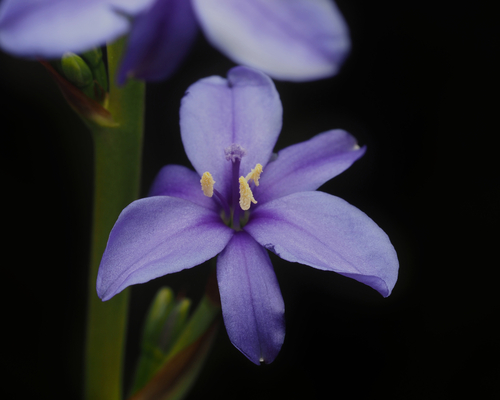
Aristea ecklonii is an evergreen perennial Iridaceae native to southern and central Africa, and invasive in several regions outside its range.
Aristea ecklonii Baker, commonly known as blue flies, blue stars, blue-eyed iris, and blue corn-lily, is a plant species belonging to the Iridaceae family. It was first formally described in 1866. This species is native to central and southern Africa, ranging from South Africa northward to Cameroon and Tanzania. Aristea ecklonii is an evergreen perennial plant that bears small blue flowers. It gr...
⚠️ Toxicity: Insufficient toxicity evidence; avoid direct contact and ingestion.
View full details →
5
Babiana ambigua (Roem. & Schult.) G.J.Lewis
Babiana ambigua (Roem. & Schult.) G.J.Lewis
🌿 Plantae Iridaceae
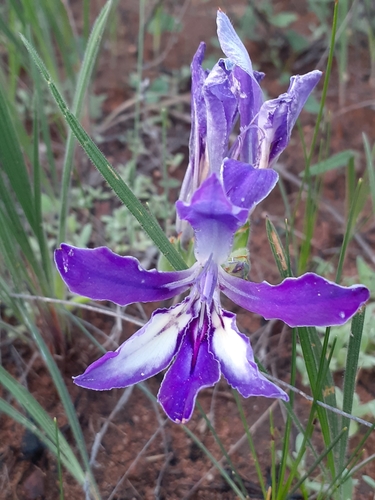
Babiana ambigua is a small perennial corm-bearing plant from South Africa’s Western Cape, currently listed as least concern.
Babiana ambigua is a perennial plant that emerges from an underground globular corm at the start of its growing season. It is usually 5–8 cm (2.0–3.1 in) tall, and occasionally reaches up to 16 cm (6.3 in). Unlike most other Babiana species, the netted, fibrous tunic surrounding the corm does not enclose the stem all the way to the surface and does not form a fibrous collar. The sparsely hairy ste...
⚠️ Toxicity: Insufficient toxicity evidence; avoid direct contact and ingestion.
View full details →
6
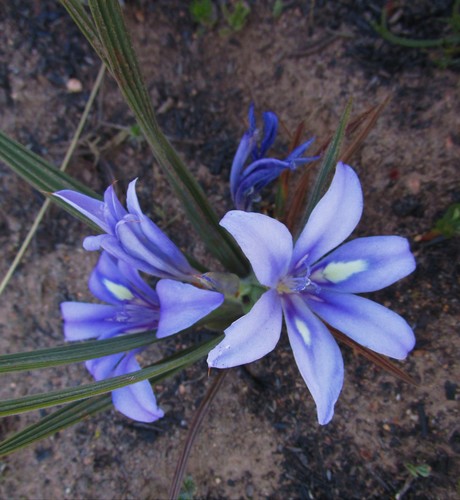
Babiana sambucina is a corm-growing geophyte from South Africa with two subspecies of differing conservation statuses.
Babiana sambucina (Jacq.) Ker Gawl. is a perennial geophyte that grows from a globose corm covered in a fibrous outer layer, reaching a height of 8–30 cm (3.1–11.8 in). Each growing season, it produces up to six leaf blades that are lance-shaped to linear, variably pleated, and variably hairy, with at least a silky texture at their base. Leaf blades are angled relative to their petioles, and grow ...
⚠️ Toxicity: Insufficient toxicity evidence; avoid direct contact and ingestion.
View full details →
7
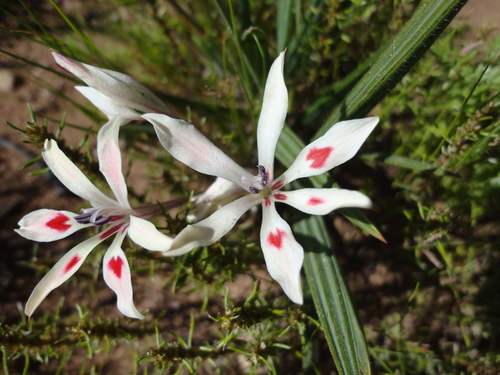
Babiana tubiflora is a small cormous perennial flowering plant native to coastal and inland Western Cape, South Africa.
Babiana tubiflora is a perennial species that grows 7–15 cm (2.8–5.9 in) tall, emerging from an underground globular corm at the start of its growing season. Its stem is covered in dense white velvety hairs, and unlike almost all other Babiana species, it lacks the fibrous collar at the point where it emerges from the ground. It often produces slender runners to carry out vegetative reproduction. ...
⚠️ Toxicity: Insufficient toxicity evidence; avoid direct contact and ingestion.
View full details →
8
Babiana villosula (J.F.Gmel.) Ker Gawl. ex Steud.
Babiana villosula (J.F.Gmel.) Ker Gawl. ex Steud.
🌿 Plantae Iridaceae
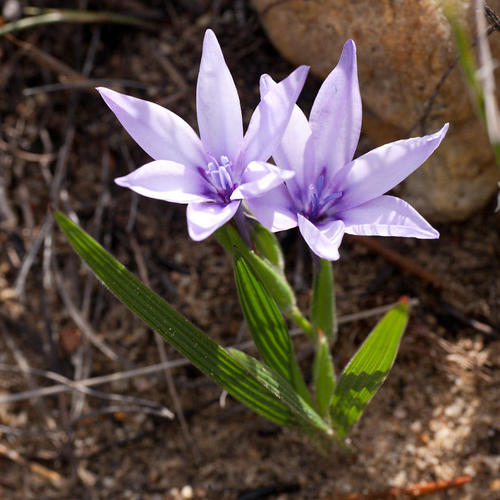
Babiana villosula is an endemic threatened perennial geophyte of the Western Cape fynbos and renosterveld.
Babiana villosula is a perennial flowering geophyte that belongs to the genus Babiana. This species is endemic to the Western Cape of South Africa, where its distribution spans from Malmesbury to Gordon's Bay. It grows as part of the local fynbos and renosterveld vegetation types. The species' total range covers an area smaller than 2000 km². It has already lost 80% of its original habitat to huma...
⚠️ Toxicity: Insufficient toxicity evidence; avoid direct contact and ingestion.
View full details →
9
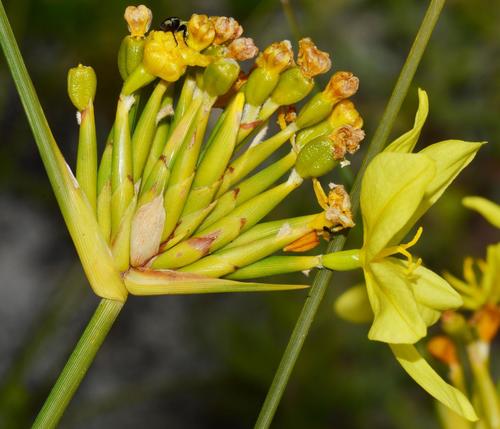
Bobartia indica L. is described with capitate spikes and a foliaceous involucre in Fl. zeyl. 41, and was also called Scirpus maderaspatanus with a sub - round scaly capitulum in Scheuch. gram. 369.
Bobartia indica L. is described as Bobartia with capitate spikes and a foliaceous involucre, as mentioned in Fl. zeyl. 41 and * Amoen. acad. 1. p. 388. It was also referred to as Scirpus maderaspatanus with a sub - round scaly capitulum in Scheuch. gram. 369.
View full details → 10
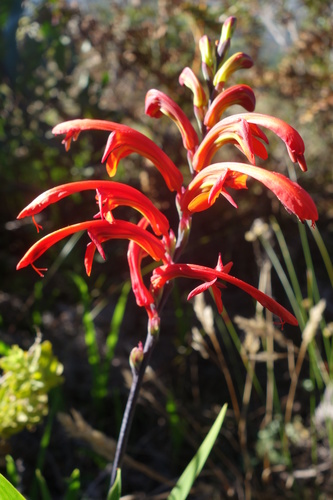
Chasmanthe aethiopica, the cobra lily, is an endemic Cape fynbos perennial geophyte with red-purple flowers growing 40–65 cm tall.
Chasmanthe aethiopica, commonly known as the cobra lily, is a perennial geophyte. It is a member of the genus Chasmanthe, and forms part of the fynbos vegetation community. This plant is endemic to the Eastern Cape and Western Cape regions. It reaches a height between 40 and 65 cm, produces red-purple flowers, and blooms from April to July each year.
⚠️ Toxicity: Insufficient toxicity evidence; avoid direct contact and ingestion.
View full details →
11
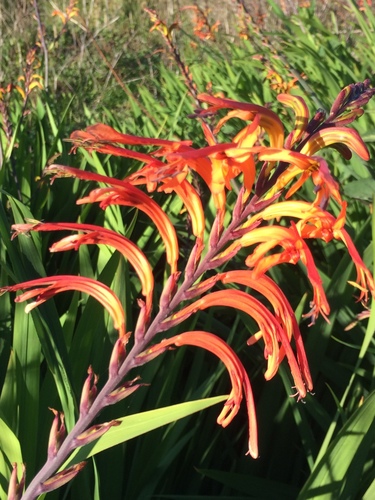
Chasmanthe floribunda is a South African endemic corm-growing perennial herb that is naturalized in several other regions worldwide.
Chasmanthe floribunda (Salisb.) N.E.Br. is a deciduous geophyte, a perennial herbaceous plant that grows from a corm. It forms clumps of long, narrow leaves, and produces one thin, tall erect stem; the entire plant reaches a height of 50 to 120 cm. Its underground tubers are 6 to 7 cm in diameter. This species puts on new vegetative growth in winter, flowers in spring, and stays dormant through th...
⚠️ Toxicity: Insufficient toxicity evidence; avoid direct contact and ingestion.
View full details →
12
Crocosmia aurea (Pappe ex Hook.) Planch.
Crocosmia aurea (Pappe ex Hook.) Planch.
🌿 Plantae Iridaceae
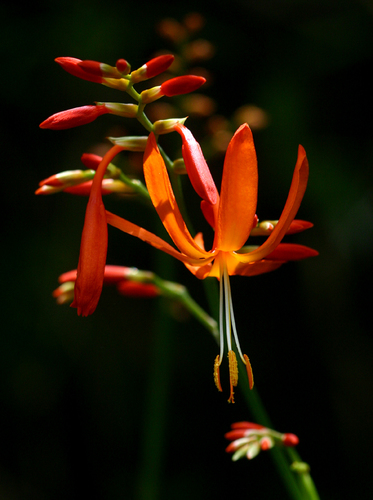
Crocosmia aurea is a cormous flowering plant native to eastern and southern Africa, with bright orange to red summer blooms.
Crocosmia aurea (Pappe ex Hook.) Planch. reaches an average height of 120 centimetres (47 inches). It grows from basal underground corms that produce long stolons. Its basal, alternate leaves are cauline and linear, with a distinct midvein and entire margins, and measure about 20–30 millimetres (0.79–1.18 inches) wide. The end of the flower stalk holds colourful branched inflorescences made up of ...
⚠️ Toxicity: Insufficient toxicity evidence; avoid direct contact and ingestion.
View full details →
13
Crocosmia ×crocosmiiflora (Lemoine) N.E.Br.
Crocosmia ×crocosmiiflora (Lemoine) N.E.Br.
🌿 Plantae Iridaceae
Crocosmia ×crocosmiiflora is found in various protected areas like SFF Isla de la Corota and PNN Tinigua, and near many other locations including SF Plantas Medicinales Orito Ingi and multiple páramos and river basins.
The plant Crocosmia ×crocosmiiflora is found in SFF Isla de la Corota, Otún Quimbaya, and PNN Tinigua. It is near SF Plantas Medicinales Orito Ingi, PNN Cueva de los Guacharos, SFF Galeras, PNN Sumapaz, PNN Sierra de la Macarena, PNN Tatamá, PNN Cordillera de los Picachos, SFF Iguaque, PNN Sierra Nevada de Santa Marta, PNN Tayrona, PNN Chingaza, PNN Los Nevados, PNN Farallones de Cali, PNN Serraní...
View full details → 14
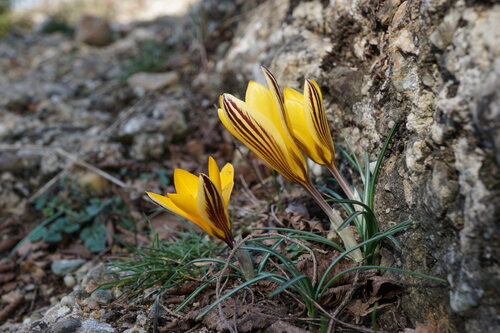
Crocus angustifolius is a corm-growing flowering species from Crimea, widely cultivated with an RHS Award of Garden Merit.
Crocus angustifolius Weston is a herbaceous perennial geophyte that grows from a corm. The corm is globose, meaning it is round with a slight bulge in the middle, and covered in a coarsely reticulated tunic. This species produces narrow flowers that open into either a funnelform or radiate shape. The flowers are golden yellow, and their outer surfaces have glossy red-brown mottling and streaks. Fl...
⚠️ Toxicity: Insufficient toxicity evidence; avoid direct contact and ingestion.
View full details →
15
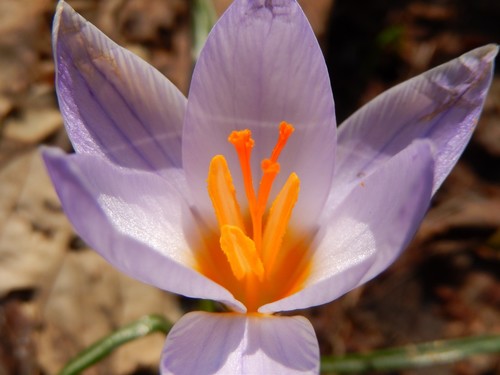
Crocus biflorus Mill. is a corm-growing herbaceous perennial geophyte that usually produces two flowers per blooming corm.
Crocus biflorus Mill. is a herbaceous perennial geophyte that grows from a corm. Its corm is globe-shaped with flattened ends, and is covered by a smooth tunic that has two or three rings. The species produces white-lilac flowers that have yellow throats and purple-blue striped outer surfaces. Each blooming corm typically produces two flowers, which is the reason for the species epithet "biflorus"...
⚠️ Toxicity: Insufficient toxicity evidence; avoid direct contact and ingestion.
View full details →
16
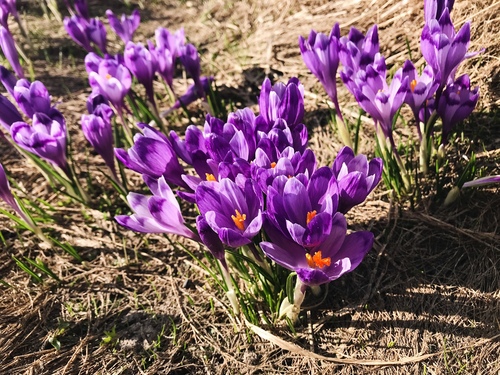
Herbarium specimens of Crocus heuffelianus from Italy, mainly in Friuli Venezia Giulia and Veneto, are presented; it's a new record for Italian flora, marking a new western range limit, and was previously mis - identified in regional literature.
Herbarium specimens examined: In ITALY - Friuli Venezia Giulia: In the Alpi Giulie, on Caporetto M. Matajur, a specimen was collected on 29 May 1889 by Marchesetti (FI!, original label lacks identification). Near San Pietro, multiple specimens were collected by Minio between January 1897 and March 1903, initially mis - identified as C. vernus. In Leonacco, Buttrio, Moruzzo, and Travagnacco - Leona...
View full details → 17
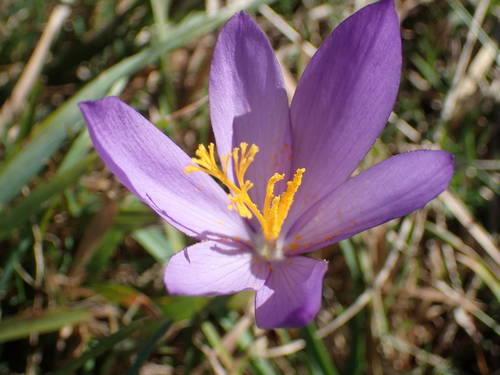
Crocus nudiflorus Sm. is an autumn-flowering crocus native to southwest Europe, used historically in folk medicine.
Crocus nudiflorus Sm. grows from corms, which spread to form clumps of plants via stolons. Each corm typically produces one long-tubed flower, shaped like either a goblet or a bell. Flowers bloom in autumn or at the end of summer. Flower color ranges from deep purple to lilac-purple, with a paler throat and a bright orange or yellow stigma. Linear basal leaves, which usually have a silvery central...
⚠️ Toxicity: Insufficient toxicity evidence; avoid direct contact and ingestion.
View full details →
18
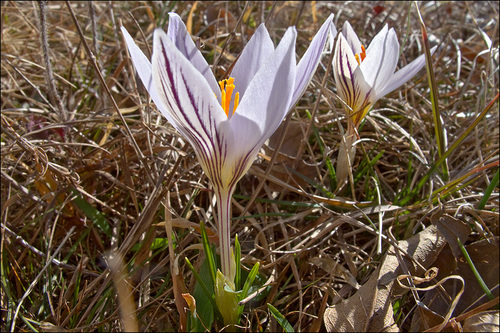
Crocus reticulatus is a cormous perennial flowering plant in Iridaceae native to parts of Eastern Europe and the Caucasus.
Crocus reticulatus Steven ex Adams is a species of flowering plant in the family Iridaceae. It is a cormous perennial plant. Its native range covers central and southern European Russia, the northern Caucasus, the Transcaucasus, and Ukraine. This species grows in woods and meadows at elevations up to 2,000 meters, and its flowering period runs from February through April.
⚠️ Toxicity: Insufficient toxicity evidence; avoid direct contact and ingestion.
View full details →
19
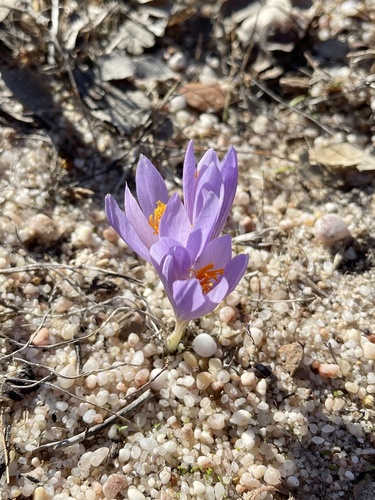
Crocus serotinus, the late crocus, is an iridaceae flowering plant found in the Iberian Peninsula and North Africa.
Crocus serotinus, commonly called the late crocus, is a species of flowering plant. It belongs to the genus Crocus within the plant family Iridaceae, and is native to the Iberian Peninsula and North Africa.
⚠️ Toxicity: Insufficient toxicity evidence; avoid direct contact and ingestion.
View full details →
20
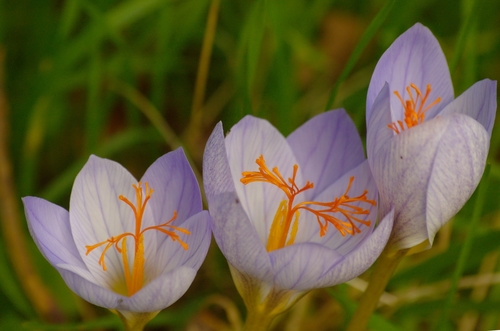
Bieberstein's crocus (Crocus speciosus) is a showy autumn-blooming cormous perennial, widely grown as an ornamental plant.
Crocus speciosus M.Bieb., commonly known as Bieberstein's crocus, is a flowering plant species in the genus Crocus, which belongs to the family Iridaceae. It is native to northern and central Turkey, the Caucasus, northern Iran, Crimea, and Bulgaria. This species is a cormous perennial that grows 10–15 cm (3.9–5.9 in) tall. Its lilac flowers, which have pale throats and dark veins, bloom in autumn...
⚠️ Toxicity: Insufficient toxicity evidence; avoid direct contact and ingestion.
View full details →
21
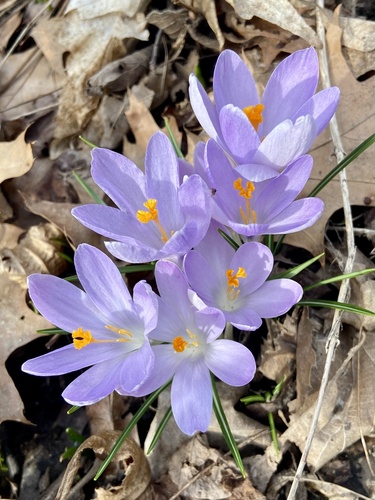
Crocus tommasinianus is a small early-flowering cormous perennial, widely cultivated as an ornamental garden plant.
Crocus tommasinianus Herb. is a cormous perennial species in the genus Crocus, family Iridaceae. It is one of the smaller cultivated crocus species, with an overall height of 3 inches (76 mm). It produces slender lilac-colored flowers that measure about 2–4 cm (1–2 inches) long. Flowers have white perianth tubes and six petals, which range in color from pale silvery lilac to reddish purple; outer ...
⚠️ Toxicity: Insufficient toxicity evidence; avoid direct contact and ingestion.
View full details →
22
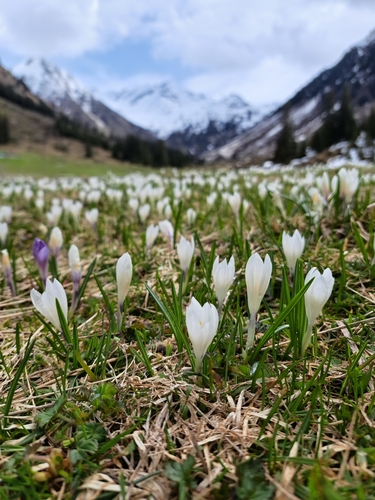
Crocus vernus, or spring giant crocus, is an iridaceae flowering plant native to Europe, widely cultivated as an ornamental.
Crocus vernus (L.) Hill, commonly called spring crocus or giant crocus, is a flowering plant species in the Iridaceae family. It is native to the Alps, the Pyrenees, and the Balkans. Its cultivars, along with the cultivars of Crocus flavus known as Dutch crocus, are grown as ornamental plants. Dutch crocuses are larger than other cultivated crocus species, such as Crocus chrysanthus. Depending on ...
⚠️ Toxicity: Insufficient toxicity evidence; avoid direct contact and ingestion.
View full details →
23
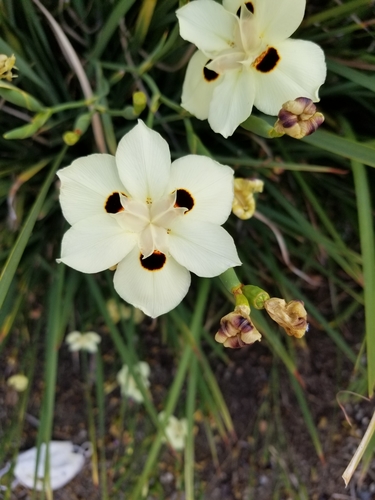
Dietes bicolor is an evergreen perennial iris native to South Africa, widely cultivated for its attractive spotted yellow blooms.
Dietes bicolor, commonly known as the African iris, butterfly flag, fortnight lily, or peacock flower, is a clump-forming rhizomatous evergreen perennial plant in the iris family Iridaceae. It produces long, sword-like pale green leaves that grow from multiple fans at the base of the clump. If left undisturbed for years, this plant can form large clumps. It is commonly cultivated in its native Sou...
⚠️ Toxicity: Insufficient toxicity evidence; avoid direct contact and ingestion.
View full details →
24
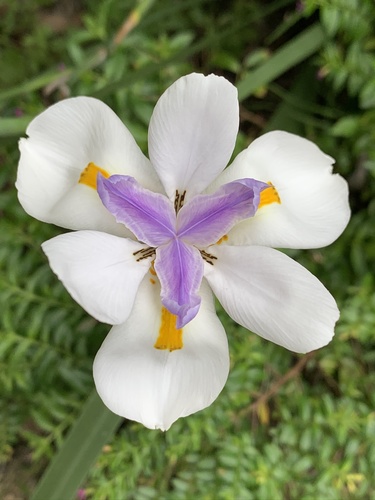
Dietes grandiflora is a rhizomatous perennial iris from South Africa, widely grown as an ornamental, with white marked flowers.
Dietes grandiflora N.E.Br., commonly known as the fortnight lily, large wild iris, African iris, or fairy iris, is a rhizomatous perennial plant in the iris family (Iridaceae). It produces long, rigid, sword-shaped green leaves. In its native South Africa, this species is very common in horticulture, where it is often used for public gardens, commercial landscaping, and roadside plantings. Its flo...
⚠️ Toxicity: Insufficient toxicity evidence; avoid direct contact and ingestion.
View full details →
25
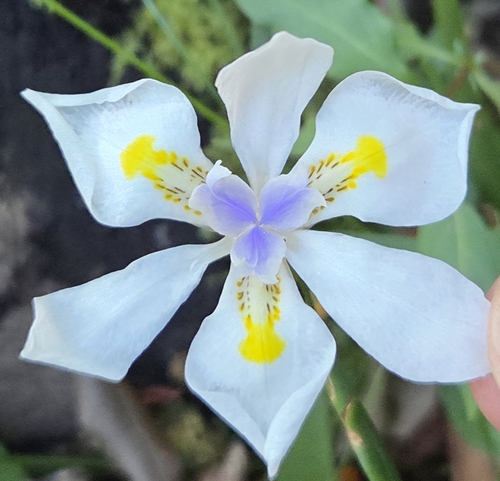
Dietes iridioides is an African flowering plant that forms dense basal fan-shaped tufts and prefers semi-shaded habitat.
Description: Dietes iridioides has sarmentous stems, whose branches bear lily-like flowers that are 6–8 centimetres (2.4–3.1 in) wide. The flowers are white with yellow central markings, and also marked with violet, with six free tepals that are not joined into a tube at their bases. Each of these flowers only lasts for a few days. This plant grows up to 60 centimetres (24 in) in height, and reach...
⚠️ Toxicity: Insufficient toxicity evidence; avoid direct contact and ingestion.
View full details →
26
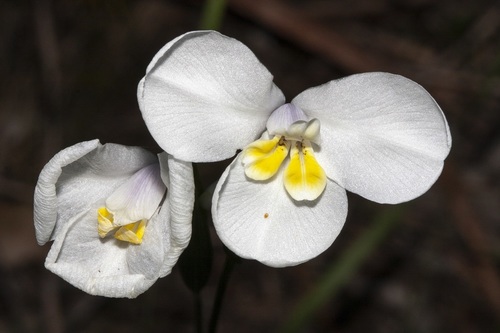
Diplarrena moraea is an Australian low flammability iris family plant found in New South Wales, Victoria, and Tasmania.
Diplarrena moraea Labill. is a plant in the iris family Iridaceae. Its common names include white iris, and butterfly flag in the United Kingdom. This species grows in heathland and forest in the Australian states of New South Wales, Victoria, and Tasmania. It was first formally described in 1800 by French naturalist Jacques Labillardière, in the publication Relation du Voyage à la Recherche de la...
⚠️ Toxicity: Insufficient toxicity evidence; avoid direct contact and ingestion.
View full details →
27
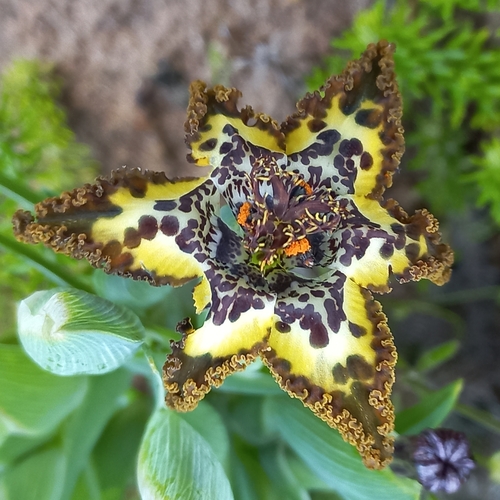
Ferraria crispa Burm. is a South African native flowering plant in the Iridaceae family, known as black flag in Australia and starfish lily.
Ferraria crispa Burm. is a monocotyledonous flowering plant species that belongs to the Iridaceae plant family. It is native to South Africa. In Australia, it is commonly called black flag, and it also has the alternative common name starfish lily.
⚠️ Toxicity: Insufficient toxicity evidence; avoid direct contact and ingestion.
View full details →
28
Freesia laxa (Thunb.) Goldblatt & J.C.Manning
Freesia laxa (Thunb.) Goldblatt & J.C.Manning
🌿 Plantae Iridaceae
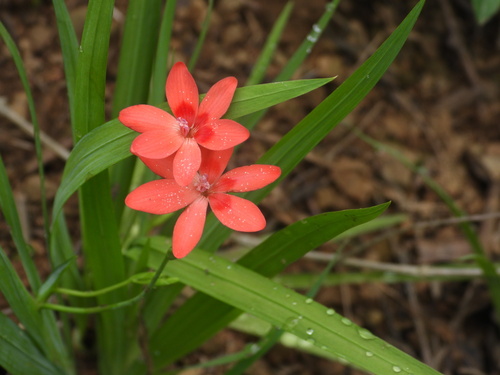
Freesia laxa is a southern African corm-growing flowering plant widely grown in cultivation.
Freesia laxa grows from corms and reaches a height of 15–30 cm (6–12 in). Its green leaves are arranged in a flat "fan", with the flower stalk emerging from this fan. The flowers are flattened, measuring around 2 cm (0.8 in) across. Flower colour varies a great deal: the base colour may be red, white, or pale blue. The bases of the lowest three tepals usually have a darker marking in red or purple...
⚠️ Toxicity: Insufficient toxicity evidence; avoid direct contact and ingestion.
View full details →
29
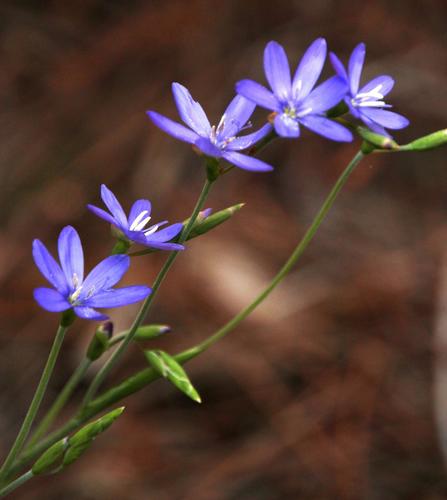
Geissorhiza aspera Goldblatt is a South African endemic geophyte with star-shaped flowers that bloom in late winter.
Geissorhiza aspera Goldblatt is a velvety-stemmed geophyte that typically grows 10–35 cm (3.9–13.8 in) tall. Soil conditions and moisture affect plant height, so individual plants may be larger or smaller than this typical range. Each plant may branch up to three times, though branching does not always occur. Its corm is covered in woody tunics. It produces sword-shaped leaves with thickened margi...
⚠️ Toxicity: Insufficient toxicity evidence; avoid direct contact and ingestion.
View full details →
30
Geissorhiza ovata (Burm.f.) Asch. & Graebn.
Geissorhiza ovata (Burm.f.) Asch. & Graebn.
🌿 Plantae Iridaceae
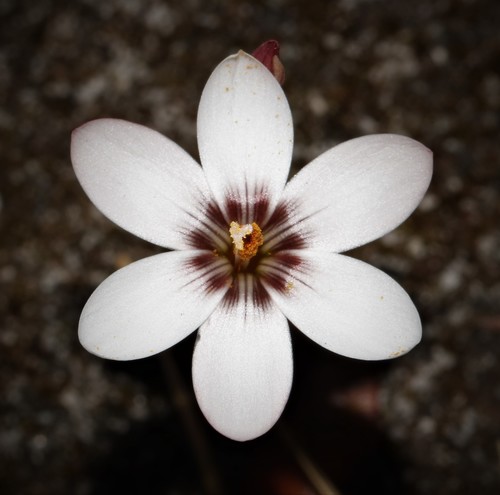
Geissorhiza ovata is a flowering Iridaceae species found on rocky habitats in South Africa's Northern Cape.
Geissorhiza ovata (Burm.f.) Asch. & Graebn. is a species of flowering plant that belongs to the family Iridaceae. This species grows on stone ridges and rock outcrops in the Northern Cape Province of South Africa.
⚠️ Toxicity: Insufficient toxicity evidence; avoid direct contact and ingestion.
View full details →
Frequently Asked Questions
How many species are in the Iridaceae family?
This guide features 30 representative species from the Iridaceae family. The full family contains many more species worldwide — explore them all on iNature.
How to identify Iridaceae species?
Iridaceae species share common features in their flowers, leaves, and growth patterns. This guide provides photos and descriptions for 30 species. For instant field identification, use the iNature app.
Sources: GBIF, iNaturalist, Wikipedia · Disclaimer
Identify any species instantly — even offline
iNature uses on-device AI to identify plants, animals, fungi and more. No internet needed.
Download iNature — FreeStart Exploring Nature Today
Download iNature for free. 10 identifications on us. No account needed. No credit card required.
Download Free on App Store
