The Fungi kingdom is a vast and fascinating group of organisms that includes mushrooms, molds, yeasts, and lichens. Neither plants nor animals, fungi play crucial roles in ecosystems as decomposers, symbionts, and food sources.
🍄 Kingdom Guide
Introduction to Fungi — Mushrooms, Molds & More
1
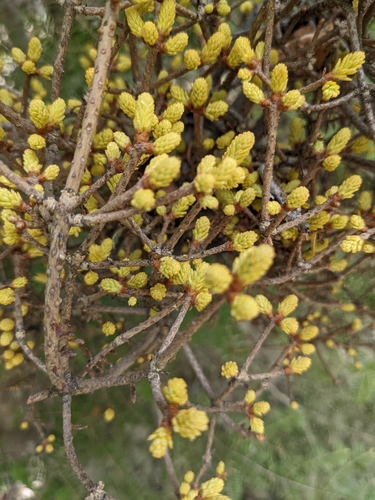
Chrysomyxa arctostaphyli is a North American basidiomycete fungus that causes spruce broom rust disease on spruce trees.
Spruce broom rust (also called yellow witches' broom rust) is a fungal plant disease caused by the basidiomycete fungus Chrysomyxa arctostaphyli. This disease occurs exclusively in North America. Its most concentrated outbreaks are on blue and Engelmann spruce in northern Arizona and southern Colorado, and on black and white spruce in Alaska. The disease has a heteroecious life cycle that alternat...
View full details → 2
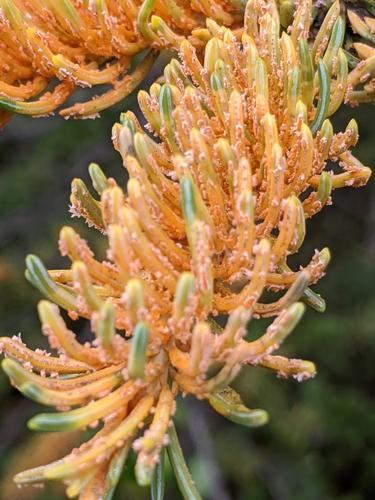
Chrysomyxa ledicola is a plant pathogen that causes spruce-Labrador tea rust and was behind 2011's Alaska orange goo event.
Chrysomyxa ledicola Lagerh. is a plant pathogen that causes the plant disease known as large-spored spruce-Labrador tea rust. This pathogen infects five plant species: white spruce, black spruce, Sitka spruce, Engelmann spruce, and Labrador-tea. It was also the source of the orange organic material, nicknamed "orange goo", that covered the Iñupiat village of Kivalina, Alaska during the summer of 2...
View full details → 3
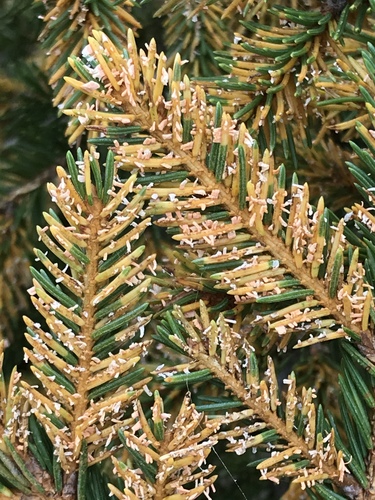
Chrysomyxa rhododendri is a pathogenic fungus that causes spruce needle rust, found in European mountain regions.
This plant pathogen, currently classified as Chrysomyxa rhododendri (DC.) de Bary, was previously known as Chrysomyxa ledi var. rhododendri. It causes the plant disease spruce needle rust. The fungus occurs in European mountains, particularly in the Grisons and Ticino cantons of Switzerland, at elevations between 1,000 and 2,000 metres. Fungal spores hibernate on Rhododendron species each year. Du...
View full details → 4
Coleosporium asterum (Dietel) Syd. & P.Syd.
Coleosporium asterum (Dietel) Syd. & P.Syd.
🍄 Fungi Coleosporiaceae
Coleosporium asterum is a rust fungus that infects Asteraceae plants and two North American pines, first found in 1898 in Japan.
Coleosporium asterum (Dietel) Syd. & P.Syd. is a rust fungus species belonging to the Coleosporiaceae family. It infects plants from the Asteraceae family, including genera Aster and Solidago, as well as two species of needle pines: Pinus contorta and Pinus banksiana. It has been documented growing on a number of specific Asteraceae species, including Canadanthus modestus, Eurybia conspicua, Solid...
View full details → 5
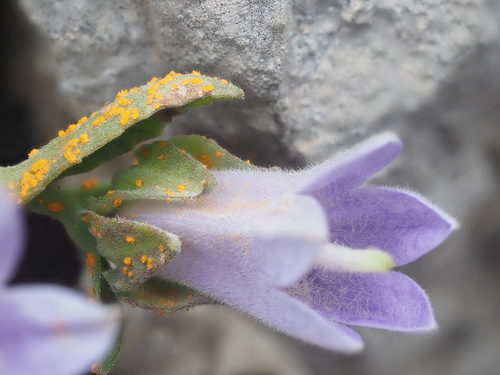
Coleosporium tussilaginis is a plant pathogenic rust fungus in Coleosporiaceae that infects Campanula rotundifolia.
Coleosporium tussilaginis is a rust fungus species that belongs to the family Coleosporiaceae. This organism is classified as a plant pathogen. It has been recorded infecting Campanula rotundifolia, where it produces both urediniospores and teliospores.
View full details → 6
Coleosporium tussilaginis (Pers.) Lév.
Coleosporium tussilaginis (Pers.) Lév.
🍄 Fungi Coleosporiaceae
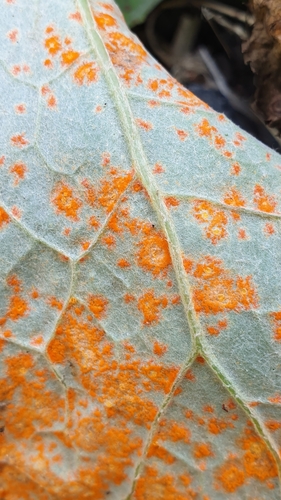
Coleosporium tussilaginis is a pathogenic rust fungus in Coleosporiaceae that infects Campanula rotundifolia and produces two spore types.
Coleosporium tussilaginis (Pers.) Lév. is a rust fungus species belonging to the family Coleosporiaceae. This organism is classified as a plant pathogen. It has been recorded infecting Campanula rotundifolia, and produces both urediniospores and teliospores when growing on this host plant.
View full details → 7
Coleosporium euphrasiae (Schumach.) G.Winter
Coleosporium euphrasiae (Schumach.) G.Winter
🍄 Fungi Coleosporiaceae
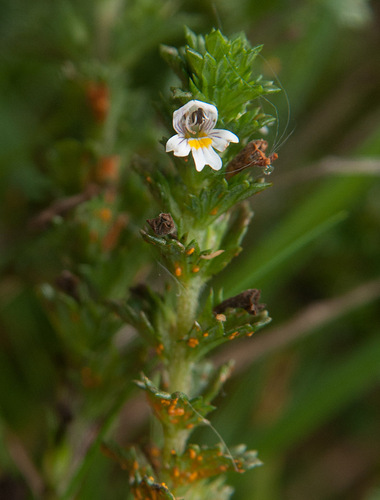
Coleosporium euphrasiae is a rust fungus plant pathogen that infects Campanula rotundifolia and produces two spore types.
Coleosporium euphrasiae (Schumach.) G.Winter, also referred to as Coleosporium tussilaginis, is a species of rust fungus belonging to the family Coleosporiaceae. This organism is a plant pathogen, and it is documented to infect Campanula rotundifolia. On its host Campanula rotundifolia, it produces both urediniospores and teliospores.
View full details → 8
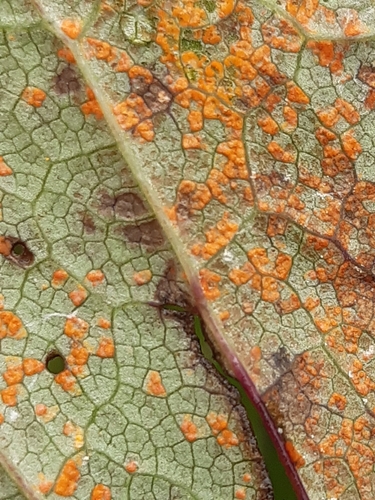
Coleosporium tussilaginis is a pathogenic rust fungus from Coleosporiaceae that infects Campanula rotundifolia.
Coleosporium tussilaginis is a species of rust fungus that belongs to the family Coleosporiaceae. It is classified as a plant pathogen. It has been recorded infecting Campanula rotundifolia, where it produces both urediniospores and teliospores.
View full details → 9
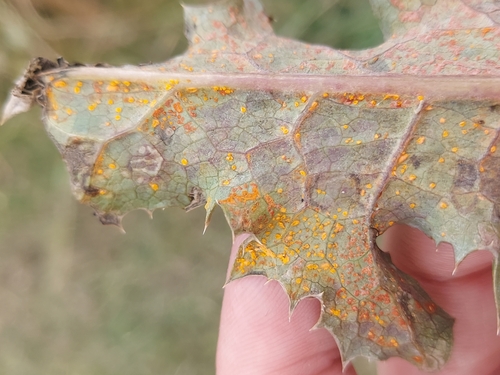
Coleosporium sonchi is a plant-pathogenic rust fungus in Coleosporiaceae that infects Campanula rotundifolia and produces two spore types.
Coleosporium sonchi (published as (F.Strauss) Lév.) is a species of rust fungus that belongs to the family Coleosporiaceae. It is classified as a plant pathogen. This fungus is documented to infect Campanula rotundifolia, where it produces both urediniospores and teliospores.
View full details → 10
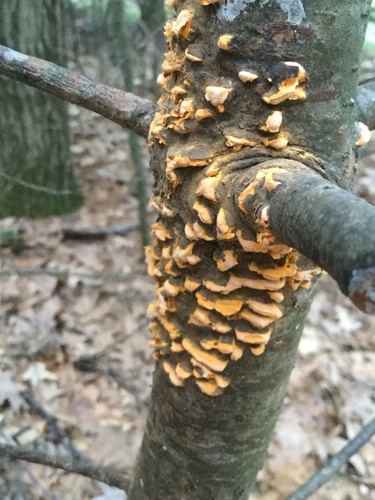
Cronartium ribicola J.C.Fisch. is a rust fungus that causes white pine blister rust, favoring cool, moist conditions.
Cronartium ribicola J.C.Fisch. is a species of rust fungus in the family Cronartiaceae that causes the plant disease white pine blister rust. It has other common names in different languages: Rouille vésiculeuse du pin blanc in French, white pine Blasenrost in German, and moho ampolla del pino blanco in Spanish. Environmentally, Cronartium ribicola prefers cooler temperatures and moist conditions ...
View full details → 11
Cronartium quercuum (Berk.) Miyabe ex Shirai
Cronartium quercuum (Berk.) Miyabe ex Shirai
🍄 Fungi Cronartiaceae
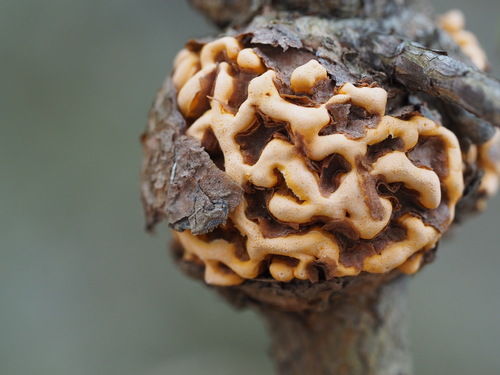
Cronartium quercuum, or pine-oak gall rust, is a fungus that causes disease in pines and oaks across the Americas, Caribbean, and Asia.
Cronartium quercuum, commonly called pine-oak gall rust, is a fungal disease that affects pine (Pinus spp.) and oak (Quercus spp.) trees. It is similar to pine-pine gall rust in that it infects pine trees, but its second host is an oak tree rather than another pine. This fungus is distributed across North, Central, and South America, the Caribbean, and Asia. In North America, it occurs in Canada, ...
View full details → 12
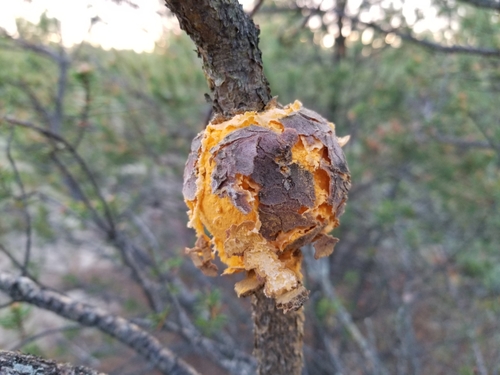
Western gall rust (pine-pine gall rust) is a pine fungal disease caused by Cronartium harknessii, forming galls that can kill young saplings.
Western gall rust, also called pine-pine gall rust, is a fungal disease of pine trees. It is caused by Cronartium harknessii E.Meinecke, which was formerly named Endocronartium harknessii or Peridermium harknessii. The older name Peridermium harknessii described the fungus's aecial phase under the now-superseded system of dual nomenclature. This causal agent is an autoecious, endocyclic rust fungu...
View full details → 13
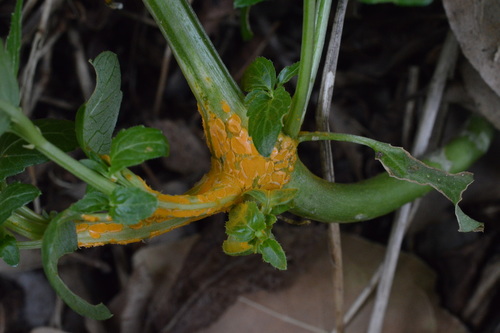
Melampsora pulcherrima Maire is a Mediterranean rust plant pathogen that infects two host species at different times of year.
Melampsora pulcherrima Maire is a Mediterranean plant pathogenic rust fungus. It infects two host plants: it infects Mercurialis annua during winter, producing galls, pycnia, and aecia across the leaves and stem. These infections appear as golden yellow swellings that can reach several centimeters in size. It also infects Populus alba, causing uredia and telia to form on the leaves from spring thr...
View full details → 14
Naohidemyces vaccinii (Jørst.) S.Sato, Katsuya & Y.Hirats. ex Vanderweyen & Fraiture
Naohidemyces vaccinii (Jørst.) S.Sato, Katsuya & Y.Hirats. ex Vanderweyen & Fraiture
🍄 Fungi Pucciniastraceae
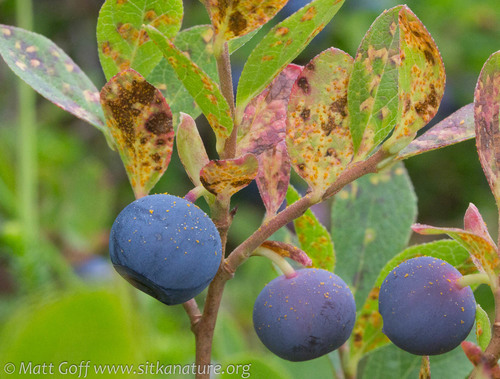
Naohidemyces vaccinii is a plant pathogen causing leaf rust on Vaccinium and early needle cast on Tsuga, with a multi-stage wind-borne life cycle.
Naohidemyces vaccinii is a plant pathogen that infects plants belonging to the Vaccinium and Tsuga genera. It causes leaf rust on lingonberries, blueberries, and cranberries, and early needle cast on hemlocks. This species has been recorded on members of the Vaccinium genus in Canada, the United States (Alaska, Maine, New Hampshire), the United Kingdom, Europe, Russia, China, Korea, and Japan. It ...
View full details → 15
Gymnoconia nitens (Schwein.) F.Kern & Thurst.
Gymnoconia nitens (Schwein.) F.Kern & Thurst.
🍄 Fungi Phragmidiaceae
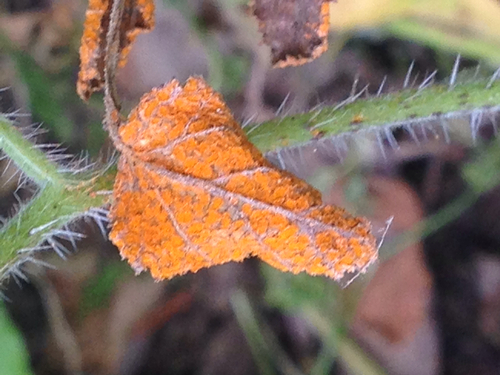
Gymnoconia nitens is a Phragmidiaceae rust fungus pathogen that causes orange rust on berries, first described in 1822.
Gymnoconia nitens (Schwein.) F.Kern & Thurst. is a species of rust fungus that belongs to the Phragmidiaceae family. It acts as a plant pathogen, and is responsible for causing orange rust disease on a variety of berry plants. This species was first formally described in 1822 by mycologist Lewis David de Schweinitz, under the original name Aecidium luminatum.
View full details → 16
Arthuriomyces peckianus (Howe) Cummins & Y.Hirats.
Arthuriomyces peckianus (Howe) Cummins & Y.Hirats.
🍄 Fungi Phragmidiaceae
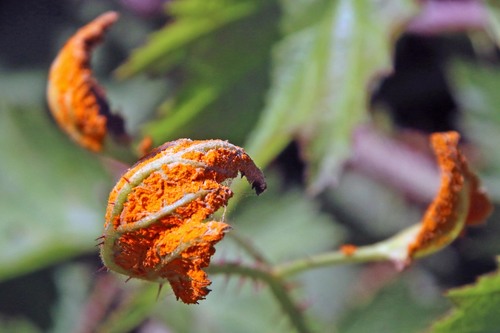
Arthuriomyces peckianus is a fungal plant pathogen that causes orange rust on Rubus plants and is found in North America and Eurasia.
Arthuriomyces peckianus is a fungal plant pathogen. It causes orange rust in plants belonging to the genus Rubus, which includes various berry species. This pathogen is distributed in North America and Eurasia.
View full details → 17
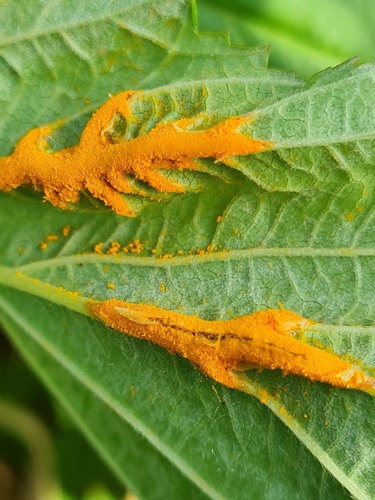
Triphragmium ulmariae is a Phragmidiaceae rust fungus that causes damaging meadowsweet rust gall on meadowsweet plants.
Triphragmium ulmariae (DC.) Link is a species of rust fungus belonging to the family Phragmidiaceae. This fungus causes meadowsweet rust gall, which forms as a chemically induced swelling that emerges from the lower surface of leaves of meadowsweet (Filipendula ulmaria). In its life cycle, the fungus grows within the petioles and midribs of meadowsweet (Filipendula ulmaria), a perennial plant in ...
View full details → 18
Phragmidium violaceum (Schultz) Brockm.
Phragmidium violaceum (Schultz) Brockm.
🍄 Fungi Phragmidiaceae
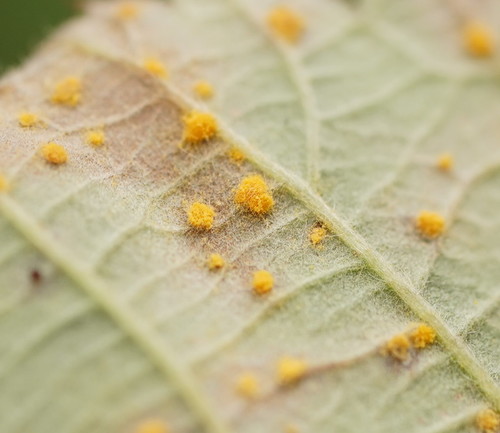
Phragmidium violaceum is a Rubus-infecting plant pathogen used for biological control of invasive blackberries.
Phragmidium violaceum (Schultz) Brockm. is a plant pathogen that is native to Europe, Africa, and the Middle East. It primarily infects plants belonging to the Rubus genus. It has been used as a biological control agent against invasive blackberry species in Chile, Australia, and New Zealand. In 2005, the pathogen was found growing on Himalayan blackberry plants in Oregon, United States. This acci...
View full details → 19
Phragmidium potentillae (Pers.) P.Karst.
Phragmidium potentillae (Pers.) P.Karst.
🍄 Fungi Phragmidiaceae

Frommeella tormentillae is a rust fungus in Phragmidiaceae that acts as a plant pathogen affecting strawberries.
Frommeella tormentillae, currently classified under the scientific name Phragmidium potentillae (Pers.) P.Karst., is a species of rust fungus belonging to the family Phragmidiaceae. It is a plant pathogen that infects strawberry plants.
View full details → 20
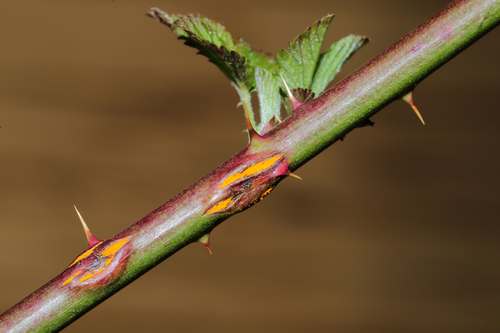
Kuehneola uredinis is a fungal plant pathogen that causes cane and leaf rust in certain Rubus and blackberry species.
Kuehneola uredinis (Link) Arthur is a fungal plant pathogen. It causes cane and leaf rust, and infects only Rubus cultivars, as well as wild and ornamental blackberry species.
View full details → 21
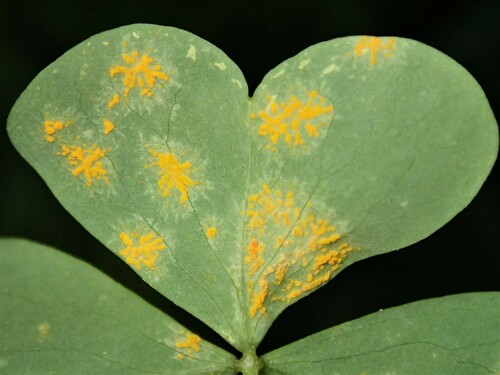
Puccinia oxalidis is a Puccinia fungus that causes rust on Oxalis plants, originally found in Mexico.
Puccinia oxalidis Dietel & Ellis is a species of fungus belonging to the genus Puccinia. This fungus causes rust disease in plants of the genus Oxalis, including the species Oxalis articulata. Signs of the disease appear as yellow dots on the undersides of infected leaves. The aecial life stage of Puccinia oxalidis can also be found growing on Berberis repens. The species was originally discovered...
View full details → 22
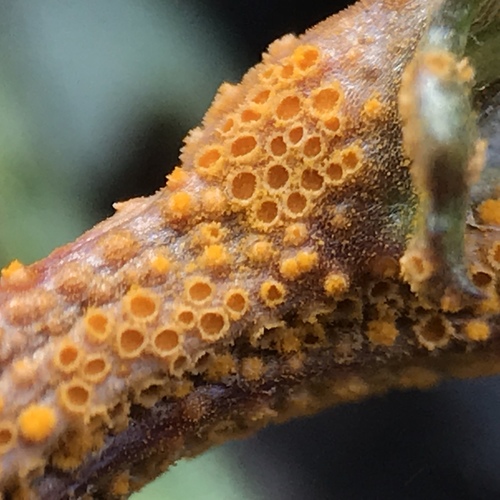
Puccinia lagenophorae is an Australia-origin rust fungus that infects certain Asteraceae plants and produces aecia and telia.
Puccinia lagenophorae Cooke is a species of rust fungus. It infects plants that belong to the family Asteraceae, with particularly common infections on Senecio squalidus and Senecio vulgaris. This fungus is native to Australia, and it was first documented in Europe in 1961. On its host plants, Puccinia lagenophorae produces aecia and telia.
View full details → 23
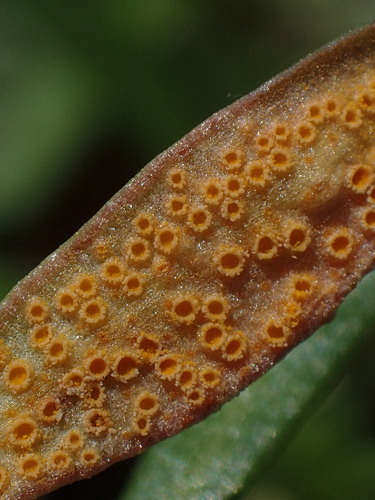
Puccinia mariae-wilsoniae is a North American rust fungus that infects portulacaceous hosts, with one named variety.
Puccinia mariae-wilsoniae Clinton is a species of rust fungus. This rust grows on all sides of its host plants, forming scattered clusters of reddish-brown sori on the plant surface. Its specialized reproductive structures called aecia are cup-shaped and have a noticeable peridium. The aeciospores (spores produced by aecia) are translucent, covered with tiny warts, and measure 18–27 μm by 14–20 μm...
View full details → 24
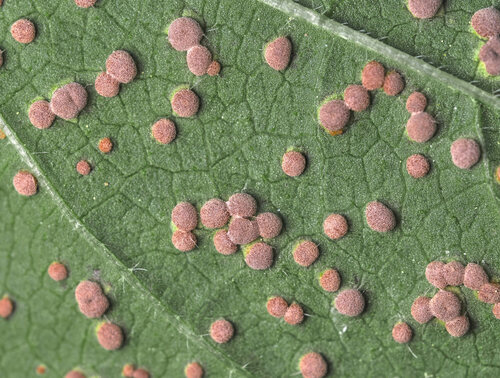
Puccinia malvacearum, or hollyhock/mallow rust, is an autoecious fungus that infects Malvaceae plants, with controls noted for the US.
Puccinia malvacearum Bertero ex Mont., commonly called hollyhock rust or mallow rust, is a fungal species belonging to the genus Puccinia. It is well-known for infecting plants that are members of the plant family Malvaceae. This organism is an autoecious pathogen, meaning it can complete its full life cycle using only a single host plant. The species was first discovered growing on the leaves of ...
View full details → 25
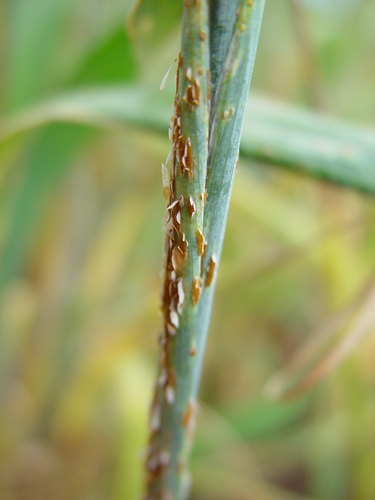
Puccinia graminis is a fungus that causes stem rust, an important disease of cereal crops with a complex life cycle.
Stem rust, also called cereal rust, black rust, red rust, or red dust, is a significant disease of cereal crops caused by the fungus Puccinia graminis Pers. Crop species affected by the disease include bread wheat, durum wheat, barley, and triticale. Stem rust has impacted cereal farming throughout human history. K. C. Mehta discovered that wheat stem rust recurs annually on the North Indian plain...
View full details → 26
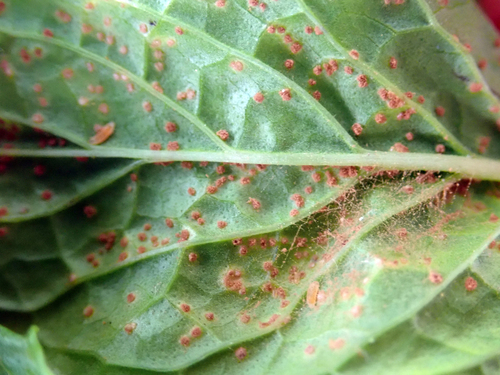
Puccinia menthae Pers. is a mint-rust-causing fungal plant pathogen originally found on Mentha aquatica leaves.
Puccinia menthae Pers. is a fungal plant pathogen that causes rust disease on mint plants. This species was originally discovered growing on the leaves of Mentha aquatica.
View full details → 27
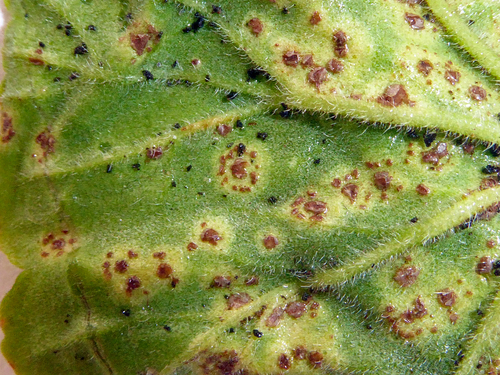
Puccinia pelargonii-zonalis is a pathogenic fungus that causes rust on Pelargonium geraniums, first found in South Africa.
Puccinia pelargonii-zonalis Doidge is a species of fungus that acts as a plant pathogen. It causes rust disease on Pelargonium geraniums. This species was first discovered growing on the leaves of Pelargonium zonale, located in KwaZulu-Natal, South Africa.
View full details → 28
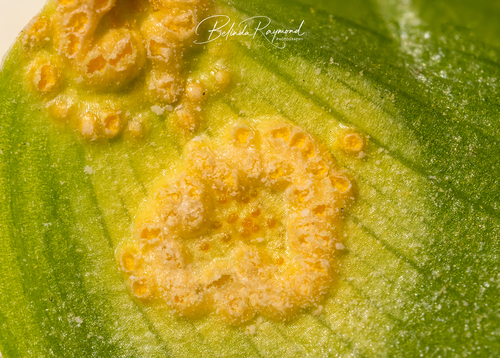
Puccinia myrsiphylli is an autoecious macrocyclic rust fungus that infects Asparagus asparagoides, found in South Africa, Australia, and New Zealand.
Puccinia myrsiphylli (Thüm.) G.Winter is a species of rust fungus, with defined spore characteristics: its uredospores are ellipsoid or sub-globose, pale yellow, measuring 30-40 x 26-30 μ; the epispore is hyaline, around 1.5 μ thick, closely and finely echinulate, with 4-5 scattered germ pores. Its teleutospores are oblong, cuneate or clavate, with a rounded, acuminate or truncate apex, usually at...
View full details → 29
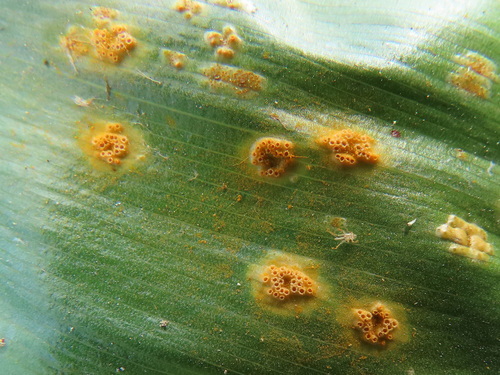
Puccinia sessilis is a common Eurasian plant pathogenic fungus that infects many plant species, including arum and ramsons.
Puccinia sessilis J.Schröt. is a species of fungus and plant pathogen, commonly known by the common names arum rust or ramsons rust. It commonly infects two plant species: Arum maculatum and Allium ursinum. Infection causes yellow to orange circular patches to form on leaves. On the underside of infected leaves, the fungus produces raised orange aecia, which are typically covered in spores. This s...
View full details → 30
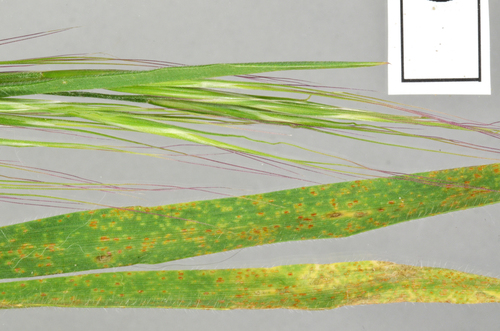
Puccinia recondita is a worldwide-occurring pathogenic fungus in the Pucciniaceae family, Pucciniales order.
Puccinia recondita Roberge ex Desm. is a species of fungus that acts as a plant pathogen. It is classified in the order Pucciniales and the family Pucciniaceae. This fungal species is found distributed across the world.
View full details →Frequently Asked Questions
What fungi are covered in this guide?
This guide features 30 fungi from the Fungi kingdom, with photos, descriptions, and taxonomy. Browse the complete collection of 88,000+ species on iNature.
Sources: GBIF, iNaturalist, Wikipedia · Disclaimer
Identify any species instantly — even offline
iNature uses on-device AI to identify plants, animals, fungi and more. No internet needed.
Download iNature — FreeStart Exploring Nature Today
Download iNature for free. 10 identifications on us. No account needed. No credit card required.
Download Free on App Store
