The Onagraceae (evening primrose family) includes plants that bloom at dusk to attract moths, the ornamental fuchsias beloved by hummingbirds, and the pioneer fireweed that colonizes burned landscapes. Many species have distinctive four-petalled flowers. This guide covers the most notable species in this charming plant family.
🌱 Plant Families
Evening Primrose Family (Onagraceae) — Species Guide
1
Camissonia campestris (Greene) P.H.Raven
Camissonia campestris (Greene) P.H.Raven
🌿 Plantae Onagraceae
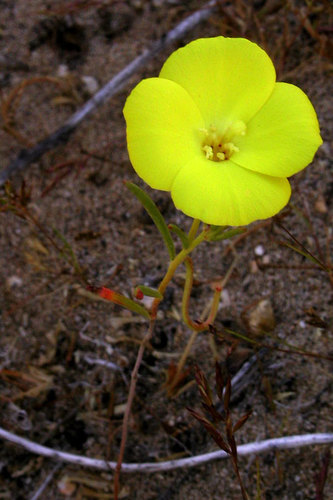
Camissonia campestris is an annual flowering Onagraceae plant native to the US Mojave Desert.
Camissonia campestris, commonly known as field primrose, Mojave sun cup, or Mojave suncup, is a flowering plant in the Onagraceae family. It is native to the Mojave Desert of the United States, where it grows primarily on open, sandy flats. It occurs across the western and central Mojave Desert at elevations ranging from sea level up to 2,000 meters. This is an annual plant that typically reaches ...
⚠️ Toxicity: Insufficient toxicity evidence; avoid direct contact and ingestion.
View full details →
2
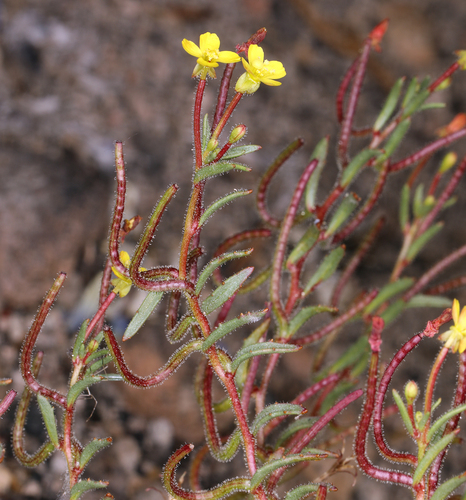
Camissonia contorta, the plains evening primrose, is a sandy soil endemic annual flowering plant ranging from California to British Columbia.
Camissonia contorta (Douglas) Kearney is a species of flowering plant in the Onagraceae family, commonly known as the plains evening primrose. This annual herb grows a slender, bending to curling stem that may be red or green, and is sometimes hairy. The stem can reach up to 30 centimeters long, growing either erect or spreading out. Its blue-green leaves are linear to very narrowly oval in shape,...
⚠️ Toxicity: Insufficient toxicity evidence; avoid direct contact and ingestion.
View full details →
3
Camissonia strigulosa (Fisch. & C.A.Mey.) P.H.Raven
Camissonia strigulosa (Fisch. & C.A.Mey.) P.H.Raven
🌿 Plantae Onagraceae
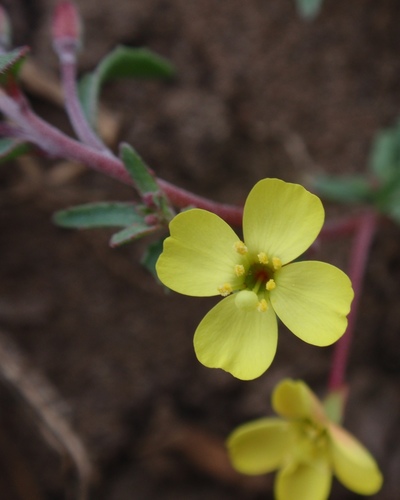
Camissonia strigulosa is an annual herb that grows in sand, with toothed leaves, yellow four-petaled flowers, and thin pod capsules holding tiny seeds.
Camissonia strigulosa is an annual herb. It produces a tough, slender, hairy stem that can grow upright or trail across sand. The stem reaches a maximum length of close to 50 centimeters. Small, thin linear leaves, colored green to red, grow along the stem; these leaves have tiny bumpy teeth along their edges. Its flowers have four yellow petals, each a few millimeters long, and the petals may bea...
⚠️ Toxicity: Insufficient toxicity evidence; avoid direct contact and ingestion.
View full details →
4
Camissoniopsis bistorta (Nutt. ex Torr. & A.Gray) W.L.Wagner & Hoch
Camissoniopsis bistorta (Nutt. ex Torr. & A.Gray) W.L.Wagner & Hoch
🌿 Plantae Onagraceae
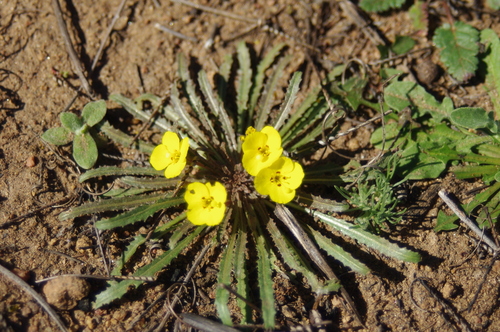
Camissoniopsis bistorta is an herbaceous flowering plant native to coastal southern California and northwestern Baja California.
Camissoniopsis bistorta is a herbaceous plant that grows as an annual or short-lived perennial. Young plants average approximately 2 to 3 cm (0.79 to 1.18 in) in size, and mature individuals reach a wide range of overall sizes. The entire plant is covered in either strigose or spreading hairs. It occasionally grows with a single simple stem, but more often produces several stems. These slender ste...
⚠️ Toxicity: Insufficient toxicity evidence; avoid direct contact and ingestion.
View full details →
5
Camissoniopsis cheiranthifolia (Hornem. ex Spreng.) W.L.Wagner & Hoch
Camissoniopsis cheiranthifolia (Hornem. ex Spreng.) W.L.Wagner & Hoch
🌿 Plantae Onagraceae
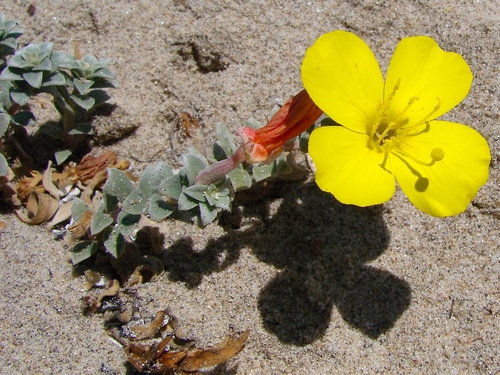
Camissoniopsis cheiranthifolia, the beach suncup, is a coastal sand-adapted plant with yellow morning-opening flowers.
Camissoniopsis cheiranthifolia, commonly known as beach suncup, grows prostrate along beach surfaces and forms mats over 1 meter across. It produces long stems from a central crown, lined with silvery grey-green leaves. Its prostrate growth habit and flexible swinging stems let this plant thrive well on the windy, shifting sands of coastal environments. Its four-petaled flowers open in the morning...
⚠️ Toxicity: Insufficient toxicity evidence; avoid direct contact and ingestion.
View full details →
6
Camissoniopsis micrantha (Hornem. ex Spreng.) W.L.Wagner & Hoch
Camissoniopsis micrantha (Hornem. ex Spreng.) W.L.Wagner & Hoch
🌿 Plantae Onagraceae
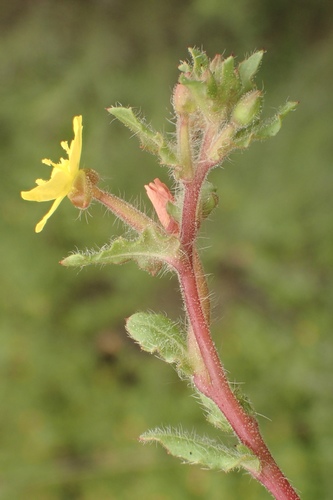
Camissoniopsis micrantha is an annual hairy herb found in southwestern US and northwestern Mexico in sandy open habitats.
Camissoniopsis micrantha is an annual herbaceous plant that grows a basal rosette of leaves. The entire plant is covered in dense, grayish, spreading hairs. Its stems can be either decumbent and branched, or erect and simple, and are typically less than 60 cm (24 inches) long. Its dark green leaves range from 1 to 12 cm (0.39 to 4.72 inches) in length; the largest leaves are the basal leaves that ...
⚠️ Toxicity: Insufficient toxicity evidence; avoid direct contact and ingestion.
View full details →
7
Camissoniopsis pallida (Abrams) W.L.Wagner & Hoch
Camissoniopsis pallida (Abrams) W.L.Wagner & Hoch
🌿 Plantae Onagraceae
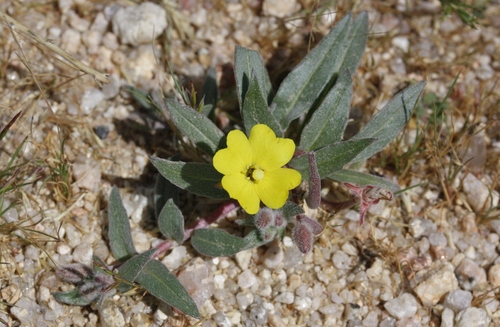
Camissoniopsis pallida, or pale primrose, is a low yellow-flowered annual Onagraceae native to the intersection of Arizona, California, and Nevada.
Camissoniopsis pallida (Abrams) W.L.Wagner & Hoch is a low-growing, yellow-flowered annual plant in the evening primrose family, Onagraceae. Its common names are pale primrose and pale yellow suncup. It is native to desert and scrub habitats in the intersection region of Arizona, California, and Nevada. This roughly hairy annual herb grows as a low patch on the ground, and sometimes produces an er...
⚠️ Toxicity: Insufficient toxicity evidence; avoid direct contact and ingestion.
View full details →
8
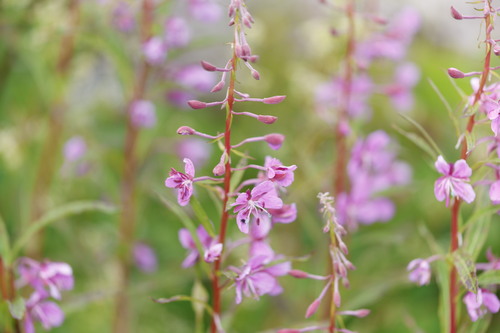
Chamaenerion angustifolium (fireweed) is a northern hemisphere pioneer herb with many uses, common on disturbed and burned land.
Chamaenerion angustifolium (L.) Scop. is a herbaceous perennial plant that is commonly called fireweed. It has reddish, usually simple, erect, smooth stems that grow 0.5–2 metres (1+1⁄2–6+1⁄2 feet) high, with scattered alternate leaves. Its leaves are spirally arranged, entire, narrowly lanceolate, and pinnately veined; secondary leaf veins anastomose, joining to form a continuous marginal vein ju...
⚠️ Toxicity: Insufficient toxicity evidence; avoid direct contact and ingestion.
View full details →
9
Chamaenerion dodonaei (Vill.) Schur ex Fuss.
Chamaenerion dodonaei (Vill.) Schur ex Fuss.
🌿 Plantae Onagraceae
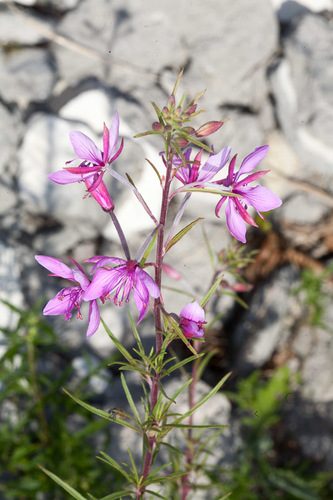
Chamaenerion dodonaei is a perennial herbaceous flowering willowherb native to parts of central and southern Europe.
Chamaenerion dodonaei (Vill.) Schur ex Fuss is a perennial herbaceous flowering plant that belongs to Onagraceae, the willowherb family. Within the Pannonian macroregion, this species is not found in the eastern portion, but occurs in the western portion. Its range also extends to the Dalmatian Coast. It grows in sandy and rocky locations, as well as on dry ruderal sites.
⚠️ Toxicity: Insufficient toxicity evidence; avoid direct contact and ingestion.
View full details →
10
Chamaenerion fleischeri (Hochst.) Fritsch
Chamaenerion fleischeri (Hochst.) Fritsch
🌿 Plantae Onagraceae
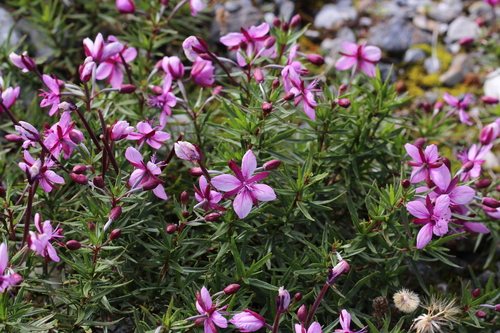
Chamaenerion fleischeri is a small scapose hemicryptophyte flowering plant endemic to the Alps, growing in alpine glacial and rocky habitats.
Chamaenerion fleischeri is a scapose hemicryptophyte. Its overwintering buds sit just below the soil surface, and its floral axis is more or less erect with only a few leaves. This plant grows to an average height of 10–40 centimetres (3.9–15.7 inches). It has an erect stem, and its leaves are usually glabrous and toothed. This species is quite similar to Chamaenerion dodonaei, but C. dodonaei gro...
⚠️ Toxicity: Insufficient toxicity evidence; avoid direct contact and ingestion.
View full details →
11
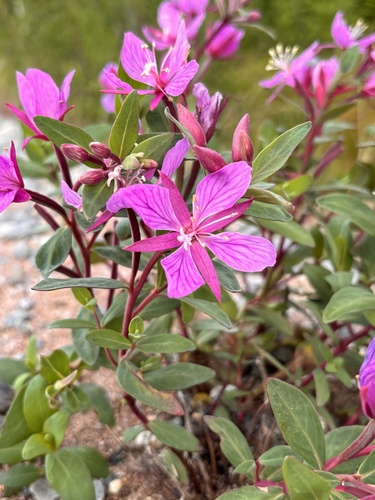
Chamaenerion latifolium is an edible circumboreal flowering plant, the national flower of Greenland.
Chamaenerion latifolium (previously classified as Epilobium latifolium, also referenced as Chamerion latifolium) is a species of flowering plant in the evening primrose family. Its English common names are dwarf fireweed and river beauty willowherb, and it is also known simply as River Beauty in the Canadian tundra. This species has a circumboreal distribution, found across all northern regions of...
⚠️ Toxicity: Insufficient toxicity evidence; avoid direct contact and ingestion.
View full details →
12
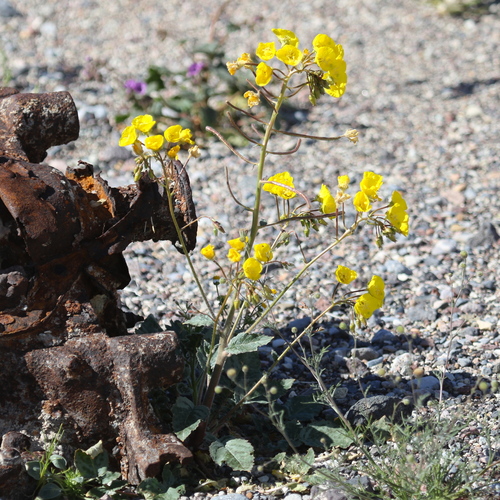
Chylismia brevipes, also called Mojave suncup, is a hairy yellow-flowered annual wildflower native to the American desert southwest.
Chylismia brevipes is a species of wildflower with the accepted scientific name Chylismia brevipes Small. It is native to the desert southwest of the United States, and has three common names: yellow cups, Mojave suncup, and golden suncup. This plant is a hairy annual wildflower that grows tall stems, often reaching over half a meter in height. Basal leaves surround the stems, and these leaves can...
⚠️ Toxicity: Insufficient toxicity evidence; avoid direct contact and ingestion.
View full details →
13
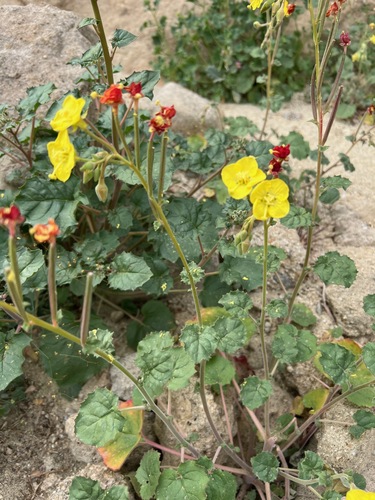
Chylismia cardiophylla (heartleaf suncup) is an evening primrose native to deserts of northwestern Mexico and the southwestern US.
Chylismia cardiophylla Small is a species of evening primrose, commonly called heartleaf suncup. It is native to the deserts of northwestern Mexico and the southwestern United States, where it grows in sandy and rocky habitats within desert scrub. This species is an annual or perennial herb that reaches a maximum height of around one meter, and can grow either as a single erect stem or a low, bush...
⚠️ Toxicity: Insufficient toxicity evidence; avoid direct contact and ingestion.
View full details →
14
Chylismia claviformis (Torr. & Frém.) A.Heller
Chylismia claviformis (Torr. & Frém.) A.Heller
🌿 Plantae Onagraceae
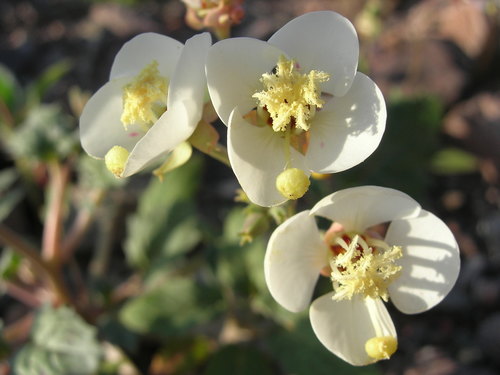
Chylismia claviformis is an annual flowering plant with distinct characteristics of its blooms and floral structures.
Chylismia claviformis is an annual plant that grows from a basal rosette of long oval leaves. It produces stems that often grow taller than half a meter. An inflorescence sits at the top of the stem, holding one to many primrose-like flowers. Each flower has four petals that can be white or yellow. The pistil can be quite long, with a bulbous stigma at its tip. The stamens are somewhat shorter tha...
⚠️ Toxicity: Insufficient toxicity evidence; avoid direct contact and ingestion.
View full details →
15
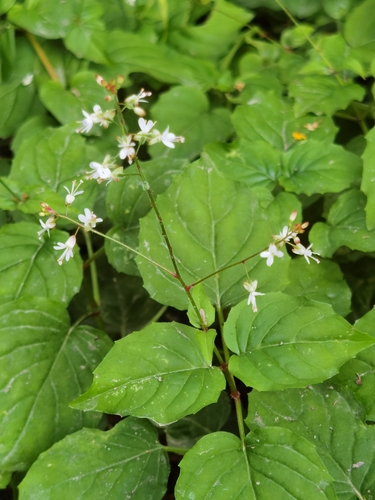
Circaea alpina L. is a small flowering plant native to North America and Eurasia that grows in moist upland forest habitats.
Circaea alpina L. has opposite, ovate leaves that measure 2–6 cm long and have coarse teeth along the edges. The petioles, which range from 1.5–4 cm (0.6–1.6 in) in length, feature a wing along their lower surface. Flowers and fruits are grouped close to the top of the fruiting raceme; each raceme produces 15 or fewer white or pink flowers, blooming from mid-May through early September. Every flow...
⚠️ Toxicity: Insufficient toxicity evidence; avoid direct contact and ingestion.
View full details →
16
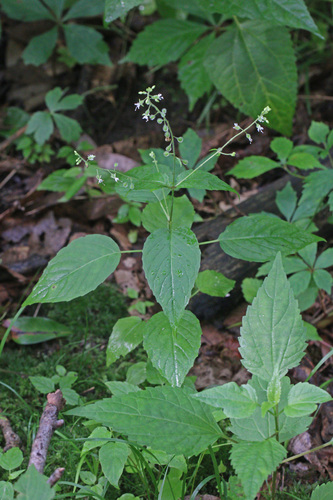
Circaea canadensis is a perennial herb found in eastern North American forests, once grouped with the similar species Circaea lutetiana.
Circaea canadensis (L.) Hill, commonly called eastern enchanter's nightshade, Canada enchanter's nightshade, and broad-leaved enchanter's nightshade, is a perennial herbaceous plant. It grows in forests in eastern North America. This species is very similar to its close relative Circaea lutetiana, and it was previously classified as part of the same species.
⚠️ Toxicity: Insufficient toxicity evidence; avoid direct contact and ingestion.
View full details →
17
Circaea lutetiana L. is a perennial herb native to Eurasia that grows in shaded moist woodland habitats.
Circaea lutetiana L. is a perennial herbaceous plant. It has slender green stems that bear opposite, simple leaves. It reaches 20 cm to 60 cm in height, and rarely grows as tall as 75 cm. Its white flowers bloom in summer. The base of each leaf is rounded or slightly notched, the leaf narrows gradually to a pointed tip, and edges are not strongly toothed but sinuate. Leaf stalks are equally hairy ...
⚠️ Toxicity: Insufficient toxicity evidence; avoid direct contact and ingestion.
View full details →
18
Clarkia amoena (Lehm.) A.Nelson & J.F.Macbr.
Clarkia amoena (Lehm.) A.Nelson & J.F.Macbr.
🌿 Plantae Onagraceae
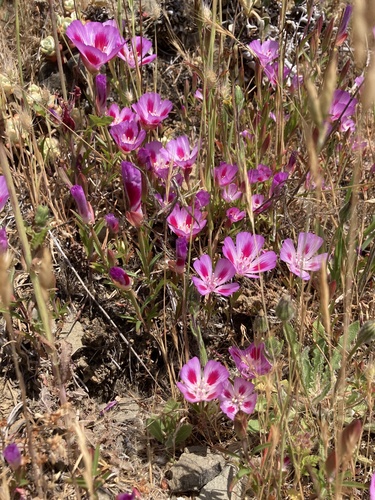
Clarkia amoena, or Farewell to spring, is an annual flowering plant commonly cultivated for gardens with many developed cultivars.
Clarkia amoena (Lehm.) A.Nelson & J.F.Macbr. is an annual plant that reaches up to 1 meter in height. It has slender, linear leaves that measure 2 to 7 centimeters long and 2 to 6 millimeters broad. Its flowers range in color from pink to pale purple, and each has four broad petals that are 1.5 to 6 centimeters long. Its fruit is a dry capsule that splits open when mature to release numerous seeds...
⚠️ Toxicity: Insufficient toxicity evidence; avoid direct contact and ingestion.
View full details →
19
Clarkia bottae (Spach) F.H.Lewis & M.E.Lewis
Clarkia bottae (Spach) F.H.Lewis & M.E.Lewis
🌿 Plantae Onagraceae
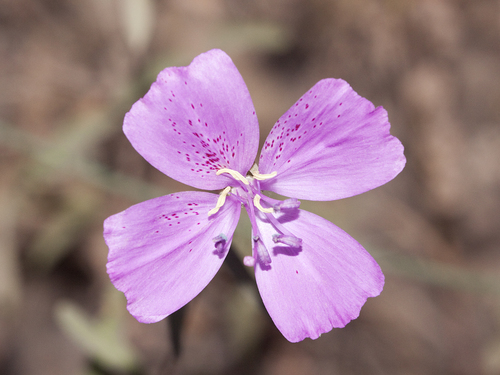
Clarkia bottae is a flowering plant endemic to southern California mountains, with one known cultivated cultivar Lilac Pixie.
Clarkia bottae grows spindly, waxy stems that can reach close to one meter in height, along with sparse, narrow leaves. Its flowers are bowl-shaped, with lavender or pinkish-purple petals that are often paler toward the base and speckled with red; each individual petal measures 1 to 3 centimeters long. The stigma extends out past the corolla, and is surrounded by shorter stamens. This species is e...
⚠️ Toxicity: Insufficient toxicity evidence; avoid direct contact and ingestion.
View full details →
20
Clarkia concinna (Fisch. & C.A.Mey.) Greene
Clarkia concinna (Fisch. & C.A.Mey.) Greene
🌿 Plantae Onagraceae
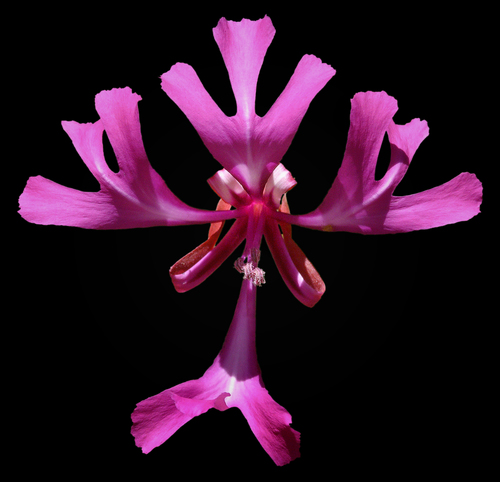
Clarkia concinna, common name red ribbons, is an annual wildflower endemic to northern California's low-elevation mountains.
Clarkia concinna, commonly called red ribbons, is a species of wildflower. It is endemic to California, growing in low-elevation mountains in the northern region of the state. It is an annual plant with erect herbaceous stems. Its distinctive flowers bear four looping red or dark pink sepals that resemble loops of silk ribbon. The longer pink petals have three lobes, which are typically streaked w...
⚠️ Toxicity: Insufficient toxicity evidence; avoid direct contact and ingestion.
View full details →
21
Clarkia cylindrica (Jeps.) F.H.Lewis & M.E.Lewis
Clarkia cylindrica (Jeps.) F.H.Lewis & M.E.Lewis
🌿 Plantae Onagraceae
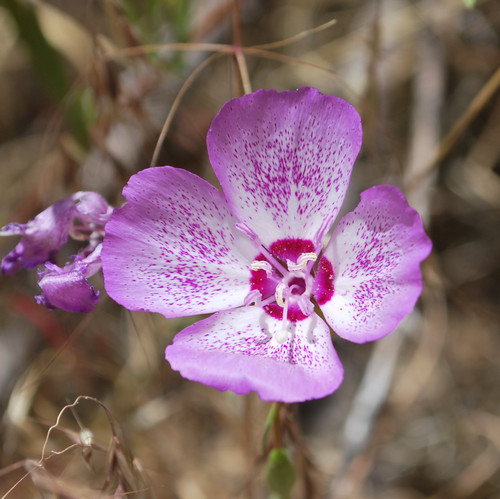
Clarkia cylindrica is an annual flowering herb, identifiable by its blended multi-colored petals and cylindrical fruit capsules.
Clarkia cylindrica is an annual herb that grows an erect stem reaching a maximum height of around 0.5 meters (1.6 feet). Its leaves are mostly linear in shape, and grow up to six centimeters long. The inflorescence bears several flowers: the blooms hang heavily while in bud, and become erect once they open. Each open flower forms a bowl shape with four fan-shaped petals up to approximately 3.5 cen...
⚠️ Toxicity: Insufficient toxicity evidence; avoid direct contact and ingestion.
View full details →
22
Clarkia delicata (Abrams) A.Nelson & J.F.Macbr.
Clarkia delicata (Abrams) A.Nelson & J.F.Macbr.
🌿 Plantae Onagraceae
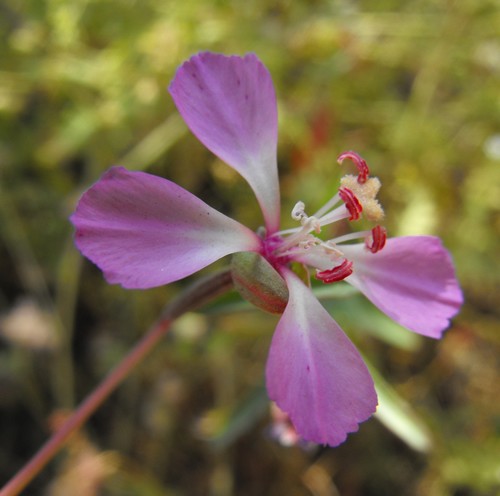
Clarkia delicata, the rare Campo or delicate clarkia, is an annual flowering herb native to southern California and northern Baja California.
Clarkia delicata (Abrams) A.Nelson & J.F.Macbr. is a rare species of flowering plant in the evening primrose family. It has two common names: Campo clarkia and delicate clarkia. This plant is native to northern Baja California and the adjacent area of San Diego County, California, where it grows in woodland and chaparral habitats of the Peninsular Ranges. It is an annual herb that grows an erect s...
⚠️ Toxicity: Insufficient toxicity evidence; avoid direct contact and ingestion.
View full details →
23
Clarkia epilobioides (Nutt.) A.Nelson & J.F.Macbr.
Clarkia epilobioides (Nutt.) A.Nelson & J.F.Macbr.
🌿 Plantae Onagraceae
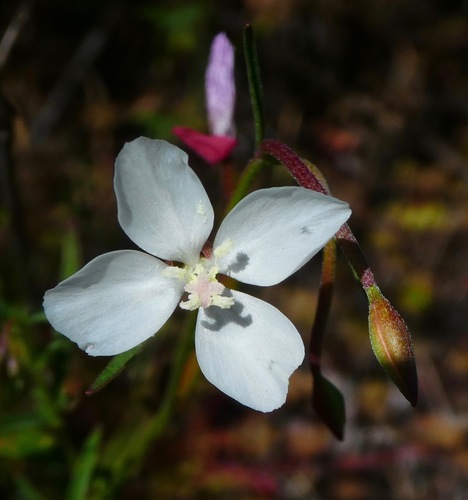
Clarkia epilobioides, or canyon clarkia, is an annual flowering plant native to western North America's shaded woodlands and chaparral.
Clarkia epilobioides (Nutt.) A.Nelson & J.F.Macbr. is a species of flowering plant in the evening primrose family, commonly called canyon clarkia. It is native to California, Arizona, and Baja California, where it grows in shaded woodland and chaparral habitat. This annual herb grows a slender, erect stem that sometimes reaches over half a meter in height. Its leaves range from narrowly to broadly...
⚠️ Toxicity: Insufficient toxicity evidence; avoid direct contact and ingestion.
View full details →
24
Clarkia gracilis (Piper) A.Nelson & J.F.Macbr.
Clarkia gracilis (Piper) A.Nelson & J.F.Macbr.
🌿 Plantae Onagraceae
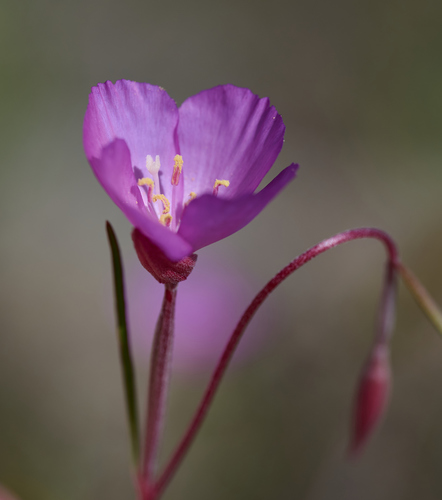
Slender clarkia (Clarkia gracilis) is a variable wildflower native to western US coastal and low elevation habitats, with four recognized subspecies.
Clarkia gracilis (Piper) A.Nelson & J.F.Macbr. is a species of wildflower with the common name slender clarkia. This species is native to the U.S. states of California, Oregon, and Washington, where it grows in coastal, foothill, valley, and low-elevation mountain habitats. The species shows variation across its recognized subspecies, but individuals generally grow an erect, slender stem that hold...
⚠️ Toxicity: Insufficient toxicity evidence; avoid direct contact and ingestion.
View full details →
25
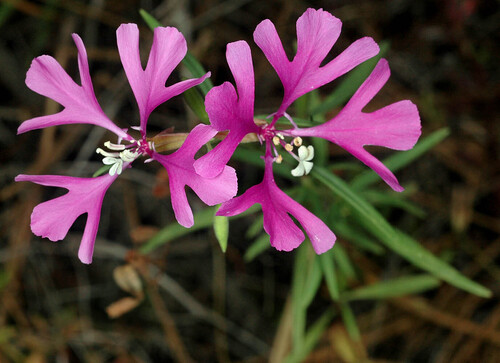
Clarkia pulchella Pursh is an herbaceous perennial type species of Clarkia native to the Pacific Northwest of North America.
Clarkia pulchella Pursh is an herbaceous perennial plant, and it is the type species of the genus Clarkia. This plant grows to a height of 10 to 50 cm (3+7⁄8 to 19+5⁄8 inches), it has an erect growth form, may be branched or unbranched, and its surface is covered with short hairs. Its leaves grow alternately along the stem, are shaped like lances or spoons, are about 2 to 7 cm (3⁄4 to 2+3⁄4 inches...
⚠️ Toxicity: Insufficient toxicity evidence; avoid direct contact and ingestion.
View full details →
26
Clarkia purpurea (Curtis) A.Nelson & J.F.Macbr.
Clarkia purpurea (Curtis) A.Nelson & J.F.Macbr.
🌿 Plantae Onagraceae
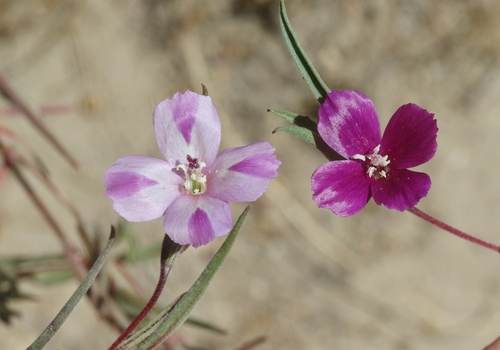
Clarkia purpurea is a flowering plant with colored four-petaled blooms, used by California Indigenous peoples for seed food.
Clarkia purpurea (Curtis) A.Nelson & J.F.Macbr. has a thin reddish stem that can reach nearly 1 meter (3 feet) in height, and bears a small number of lance-shaped leaves. Its bowl-shaped flowers have four petals, which are typically one to two centimeters long. The petals come in shades of pink, purple, or deep wine red, and often have a pink or red streak or spot in the center. The fruit of this ...
⚠️ Toxicity: Insufficient toxicity evidence; avoid direct contact and ingestion.
View full details →
27
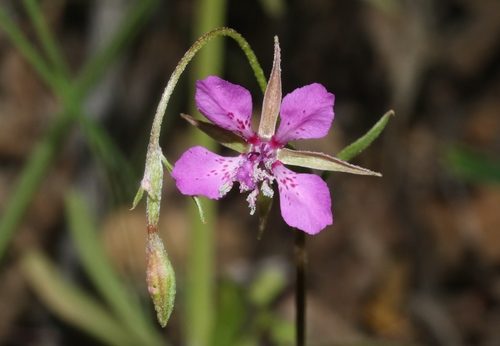
Clarkia rhomboidea, or diamond/forest clarkia, is a pink-flowered native wildflower of western North American forests.
Clarkia rhomboidea Douglas is a wildflower species with the common names diamond clarkia and forest clarkia. It is native to western North America, where it commonly grows in a variety of forest and woodland habitats. This species of clarkia produces a spindly stem that does not grow over one meter in height, and it bears occasional small leaves. Its flowers have four petals that range in color fr...
⚠️ Toxicity: Insufficient toxicity evidence; avoid direct contact and ingestion.
View full details →
28
Clarkia rubicunda (Lindl.) F.H.Lewis & M.E.Lewis
Clarkia rubicunda (Lindl.) F.H.Lewis & M.E.Lewis
🌿 Plantae Onagraceae
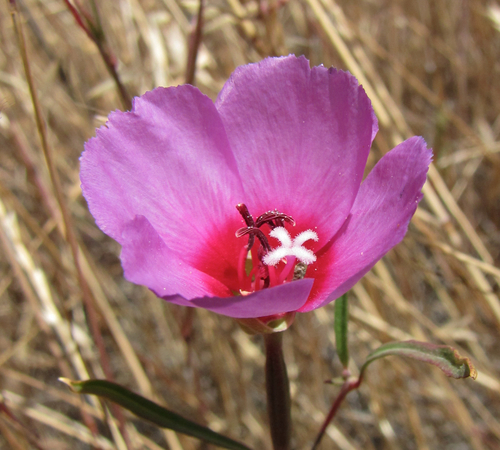
Clarkia rubicunda, or Ruby Chalice Clarkia, is an endemic California flowering plant that blooms pink to purplish flowers in June and July.
Clarkia rubicunda is a flowering plant that is endemic to California, where it occurs mostly in the Central Coast region of the state. It has two common names: Ruby Chalice Clarkia and Farewell to Spring. This species produces attractive poppy-like flowers, with wide, cup-shaped corollas made of four pink or purplish petals. The flower's corolla sometimes has a bright red center. As one of its com...
⚠️ Toxicity: Insufficient toxicity evidence; avoid direct contact and ingestion.
View full details →
29
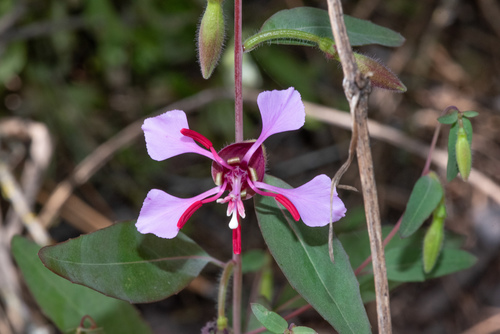
Clarkia unguiculata Lindl. is an endemic California wildflower cultivated in gardens, with edible seeds.
Clarkia unguiculata Lindl. has a spindly, hairless, waxy stem with a red tint, and grows up to 3 ft (0.9 m) tall, with only a small number of leaves along the stem. Leaves are arranged oppositely at the base of the stem, and become alternately arranged further up the stem. Its showy flowers grow in a raceme, where each flower attaches to the main stalk via a short stem extension called a pedicel. ...
⚠️ Toxicity: Insufficient toxicity evidence; avoid direct contact and ingestion.
View full details →
30
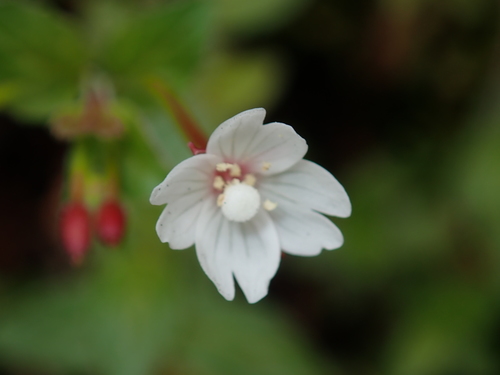
Only Epilobium amurense subsp. amurense occurs in the Pan - Himalaya region, while subsp. cephalostigma doesn't. Chen et al. (1992) said its “holotype” is in LE, but duplicate number is unknown and type status can't be determined per Art. 9.1.
Note: Only Epilobium amurense subsp. amurense is found in the Pan - Himalaya region. The other subspecies, E. amurense Hausskn. subsp. cephalostigma (Haussknecht 1879: 57) Chen, Hoch & Raven (1992: 127), does not occur in this area. Chen et al. (1992) stated that the “holotype” of E. amurense is stored in LE. However, the number of duplicates is unknown. According to Art. 9.1, the type status of E...
View full details →Frequently Asked Questions
How many species are in the Onagraceae family?
This guide features 30 representative species from the Onagraceae family. The full family contains many more species worldwide — explore them all on iNature.
How to identify Onagraceae species?
Onagraceae species share common features in their flowers, leaves, and growth patterns. This guide provides photos and descriptions for 30 species. For instant field identification, use the iNature app.
Sources: GBIF, iNaturalist, Wikipedia · Disclaimer
Identify any species instantly — even offline
iNature uses on-device AI to identify plants, animals, fungi and more. No internet needed.
Download iNature — FreeStart Exploring Nature Today
Download iNature for free. 10 identifications on us. No account needed. No credit card required.
Download Free on App Store
