The Lycaenidae, commonly called blues, coppers, and hairstreaks, are a family of small but brilliantly colored butterflies found worldwide. Many species have fascinating mutualistic relationships with ants, whose larvae being tended in ant nests. This guide covers the most frequently encountered lycaenid butterflies.
🦋 Insect Guide
Blue Butterflies (Lycaenidae) — Identification & Photos
1
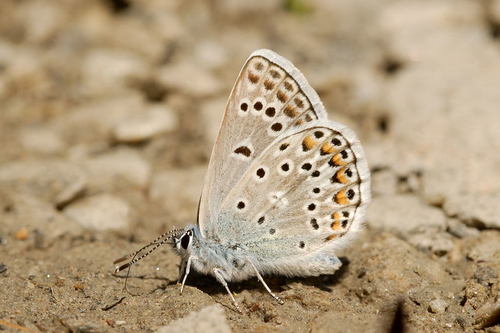
Plebicula escheri is a butterfly species from Southern Europe and the Alps, distinct from similar species by size and wing markings.
This species, originally described as Lycaena escheri Hübner (referenced as L. escheri Hbn. in Seitz, matching plate 81a and 81b), is now known as Plebicula escheri (Hübner). Males and females are similar above to Plebicula icarus, but are much larger. Their underside has more prominent spotting and a greater number of ocelli, but the forewing underside always lacks basal ocelli. The underside gro...
View full details → 2
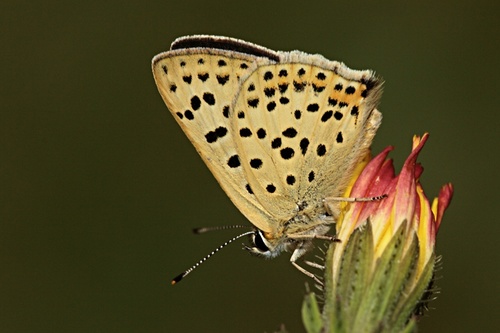
This is a detailed description of the butterfly Loweia tityrus, its forms, distribution, and life cycle.
This description, originally sourced from Seitz, covers the butterfly currently known as Loweia tityrus (Poda, 1761), originally referenced under the name C. dorilis Hufn. with synonyms circe Schiff., garbas F., phocas Rott., dorylas Kirby. Males are black-brown on the upperside, with a striking metallic green gloss when alive. They have black spots that align with spots on the underside, and a ve...
View full details → 3
Castalius melaena is a butterfly species of uncertain taxonomic status whose larvae feed on Ziziphus plants.
This species has the scientific name Castalius melaena (Trimen, 1887). Males have a wingspan of 19–24 mm, while females have a wingspan of 21–25 mm. Adult Castalius melaena fly year-round, and are most commonly encountered between October and March. The taxonomic status of this species remains uncertain, because significant variations have been observed across its individual specimens. The larvae ...
View full details → 4
Tuxentius calice, the white pie, is a Lycaenidae butterfly found in southern equatorial Africa with larvae feeding on Ziziphus plants.
This butterfly species was originally published under the scientific name Castalius calice (Hopffer, 1855), and is currently classified as Tuxentius calice, commonly known as the white pie. It belongs to the butterfly family Lycaenidae. Its distribution is limited to regions of Africa that lie south of the equator. Males of this species have a wingspan ranging from 21 to 24 mm, while females have ...
View full details → 5
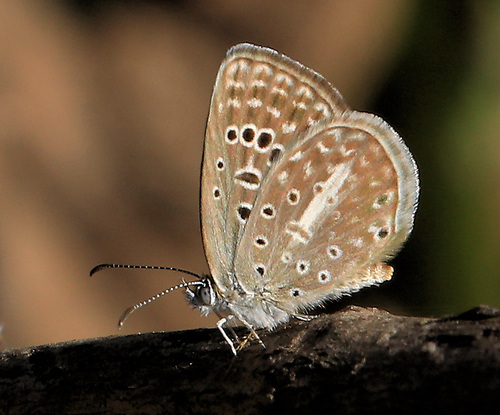
Actizera lucida, the rayed blue, is an African Lycaenidae butterfly with larvae that feed on specific plants.
Actizera lucida, commonly known as the rayed blue, is a butterfly species that belongs to the family Lycaenidae. Its distribution range extends from eastern and southern Africa to Kenya, and it is also found on Madagascar. Within South Africa, it is widespread, occurring from West Cape through to Orange Free State, KwaZulu-Natal, Gauteng, Mpumalanga, Limpopo Province, and North West Province. Male...
View full details → 6
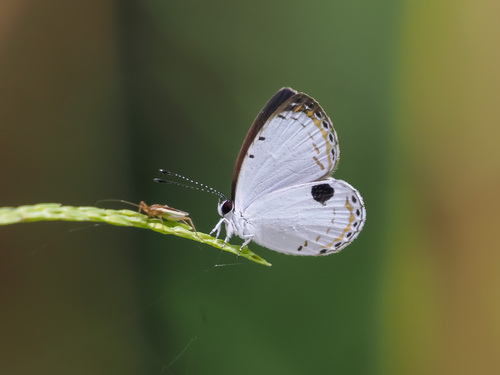
Pithecops corvus, the forest Quaker, is a Lycaenidae butterfly found in the Indomalayan realm, whose larvae feed on multiple plant genera.
Pithecops corvus, commonly called the forest Quaker, is a species of butterfly that belongs to the Lycaenidae family. This species was first described by Hans Fruhstorfer in 1919. Its geographic range lies within the Indomalayan realm. The caterpillar larvae of Pithecops corvus feed on plant species from the genera Desmodium, Gardenia and Glycosmis. This includes the specific Desmodium species Des...
View full details → 7
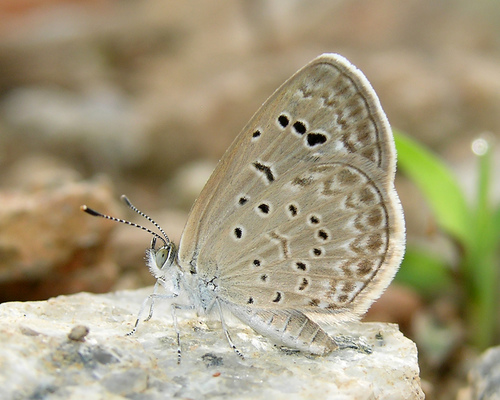
Zizeeria karsandra is a species first described in 1865, with a documented list of recorded food plants.
This species, Zizeeria karsandra, was originally described by Frederic Moore in 1865. Moore's original description reads: "Upperside purple-brown. Underside greyish brown, exterior margins defined by a brown line: fore wing with a spot within discoidal cell, a discocellular streak, a spot above it, and a transverse discal series of six spots black, each encircled with white; a marginal and submarg...
View full details → 8
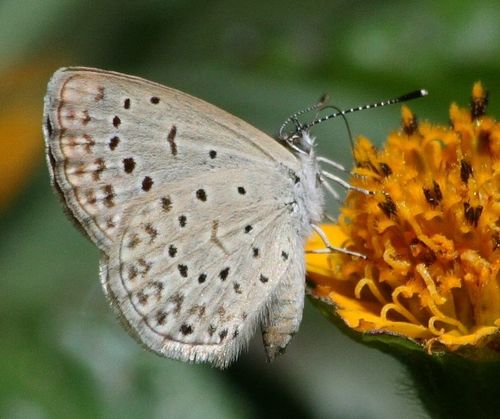
Zizeeria knysna, the dark grass blue, is a Lycaenidae blue butterfly found in Africa, Cyprus and the Iberian Peninsula.
Zizeeria knysna (Trimen, 1862), commonly known as the dark grass blue or African grass blue, is a species of blue butterfly belonging to the family Lycaenidae. This species is found in Africa, Cyprus, and the Iberian Peninsula. It is sometimes mistakenly referred to by the scientific name Zizeeria lysimon (Hübner). This species name is invalid, because it is preoccupied by Papilio lisimon Stoll, [...
View full details → 9
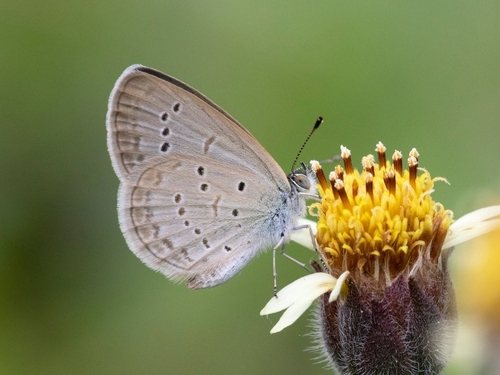
Zizina otis, the lesser grass blue, is a Lycaenidae blue butterfly first described in 1787, found across south and southeast Asia.
Zizina otis, commonly known as the lesser grass blue, is a species of blue butterfly that belongs to the Lycaenidae family. This species is found across south and southeast Asia. It was first officially described by Johan Christian Fabricius in 1787. The lesser grass blue is frequently misidentified as Zizina labradus, the common grass blue. In terms of distribution, Zizina otis occurs in south As...
View full details → 10
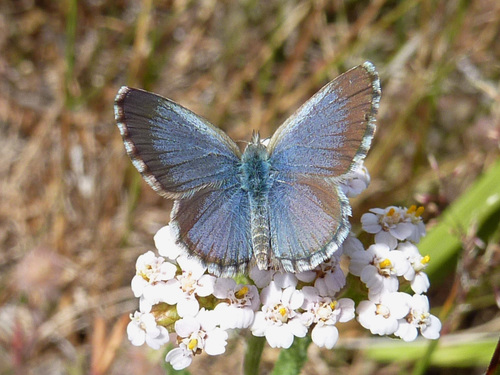
Zizina oxleyi is a subspecies of the lesser grass blue butterfly that occurs only in southern New Zealand's South Island.
Scientific name: Zizina oxleyi. Zizina otis, the lesser grass blue, is a species of blue butterfly in the Lycaenidae family, found in south and southeast Asia. This species was first described by Johan Christian Fabricius in 1787. The lesser grass blue is often misidentified as Zizina labradus, the common grass blue. Zizina otis occurs in south Asia. It was reported from the Hawaiian island of Oah...
View full details → 11

Pseudozizeeria maha, the pale grass blue, is a small South Asian blue butterfly that feeds on specific host plant families as larvae.
Pseudozizeeria maha, commonly known as the pale grass blue, is a small butterfly in the lycaenids (blues) butterfly family. It is found in South Asia, and was first officially described by Vincenz Kollar in 1848. Female pale grass blues lay their eggs directly on host food plants. After hatching, the larvae of this butterfly feed on these host plants. Known host plants belong to three plant famili...
View full details → 12
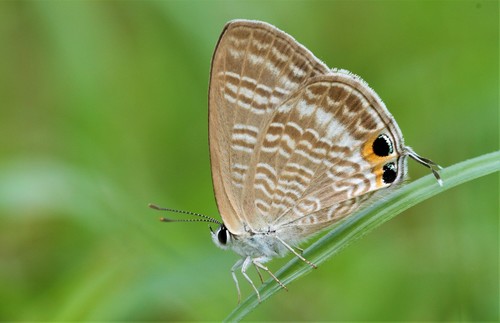
Lampides boeticus is a large, sexually dimorphic butterfly found across multiple continents, with larvae feeding on Fabaceae plants.
Lampides boeticus (Linnaeus, 1767) is a small butterfly species, though it is unusually large for its family. Males have a wingspan of 24–32 mm, while females have a wingspan of 24–34 mm. This species exhibits clear sexual dimorphism in the upperside of the wings: males are mainly violet-blue with brown edges, while females only have a small amount of blue colour in the centre of the wings. Both s...
View full details → 13
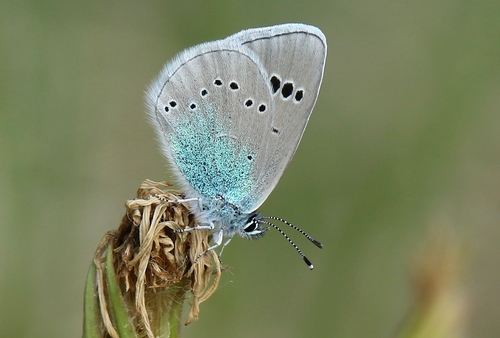
Glaucopsyche alexis is a blue butterfly found across Eurasia and North Africa, with multiple described color and pattern forms.
This entry is for Glaucopsyche alexis (Poda, 1761), cited as L. cyllarus Rott. (= damoetas Schiff.) from Seitz’s description. Males have light cyaneous blue upper wings with a violet sheen and a narrow black border; females are darker blue, with a black border that gradually fades and covers nearly the entire outer half of the wings. The underside is silver-grey in males and ashy grey in females. ...
View full details → 14
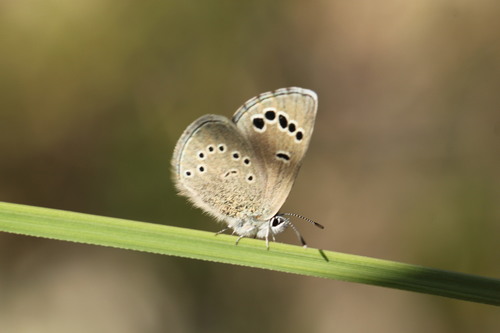
Glaucopsyche paphos is a small, Cyprus-endemic blue butterfly sometimes treated as a subspecies of Glaucopsyche melanops.
Glaucopsyche paphos (Chapman, 1920) is a small butterfly in the blues family, found in the Palearctic region. This species is endemic to Cyprus. It is sometimes classified as a subspecies of Glaucopsyche melanops.
View full details → 15
Glaucopsyche melanops (Boisduval, 1829)
Glaucopsyche melanops (Boisduval, 1829)
🦋 Animalia Lycaenidae
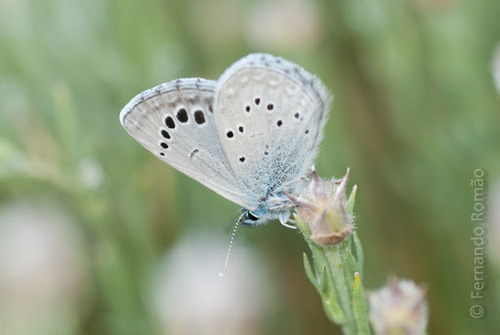
Glaucopsyche melanops is a small butterfly found in Southwest Europe and North Africa, with multiple described forms and aberrations.
This species, known scientifically as Glaucopsyche melanops (Boisduval, 1829), is also referenced as L. melanops Bdv. (= saportae Hbn.) in Seitz's description. The upper side of its wings is similar to the smallest varieties of Glaucopsyche cyllarus. However, the ocelli on the underside of its forewing are enlarged, usually much more so than shown in the referenced figure. The row of ocelli is str...
View full details → 16
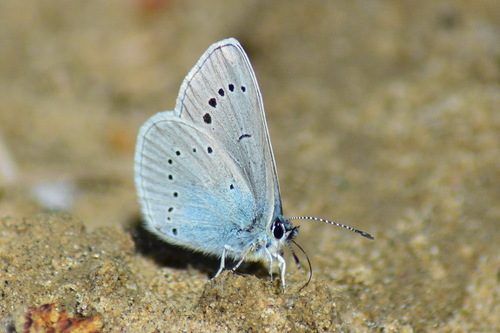
Glaucopsyche lycormas is a Lycaenidae butterfly found in multiple areas of the East Palearctic.
Glaucopsyche lycormas, scientifically described by Butler in 1866, is a butterfly species belonging to the family Lycaenidae. This species occurs in the East Palearctic realm, with recorded distribution across Siberia, Mongolia, China, Korea, and Japan.
View full details → 17

Glaucopsyche piasus is a butterfly species native to North America that has one generation per year and feeds on lupines and milkvetches as larvae.
Glaucopsyche piasus, commonly called the silvery blue, has checkered wing fringes. On the upper wing surface, males are violet blue with a wide dark border, while females have a duller coloration. The underside of the wings is gray, marked with many small black spots. On the hindwing, there is a post-median band of white arrowhead-shaped markings that all point inwards. This species has a wingspan...
View full details → 18
Glaucopsyche lygdamus (Doubleday, 1842)
Glaucopsyche lygdamus (Doubleday, 1842)
🦋 Animalia Lycaenidae
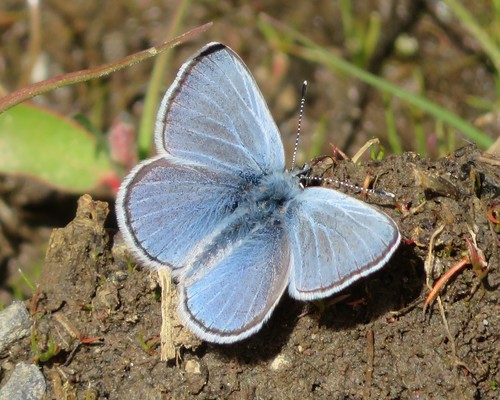
Glaucopsyche lygdamus is a North American butterfly with blue to grayish-blue wings that feeds on Lupinus plants.
Glaucopsyche lygdamus (Doubleday, 1842) has species-specific appearance traits. On the upper side of its wings, males are light blue, while females are dull grayish blue. The underside of its wings is gray, marked with a single row of round spots that vary in size depending on the region where the individual is found. This species has a wingspan ranging from 18 to 28 mm. It can be found across muc...
View full details → 19
Philotes sonorensis (C.Felder & R.Felder, 1865)
Philotes sonorensis (C.Felder & R.Felder, 1865)
🦋 Animalia Lycaenidae
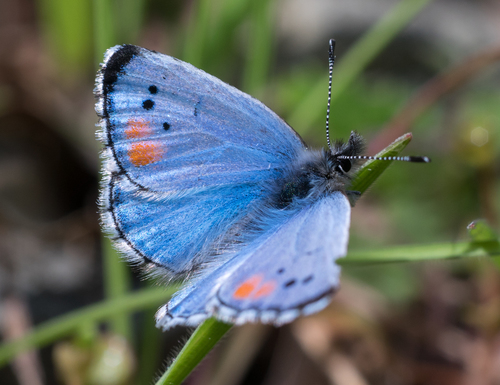
Philotes sonorensis, the only species in the monotypic genus Philotes, is a Lycaenidae butterfly found in California and Baja California.
Philotes is a genus of butterflies in the family Lycaenidae. This is a monotypic genus, meaning it contains only one species: Philotes sonorensis, commonly known as the Sonoran blue or stonecrop blue. This species is found in North America, specifically in California and Baja California. Its natural habitat includes rocky washes, rocky outcrops, and rocky cliffs in desert regions. The wingspan of ...
View full details → 20
Euphilotes enoptes ancilla (Barnes & McDunnough, 1918)
Euphilotes enoptes ancilla (Barnes & McDunnough, 1918)
🦋 Animalia Lycaenidae
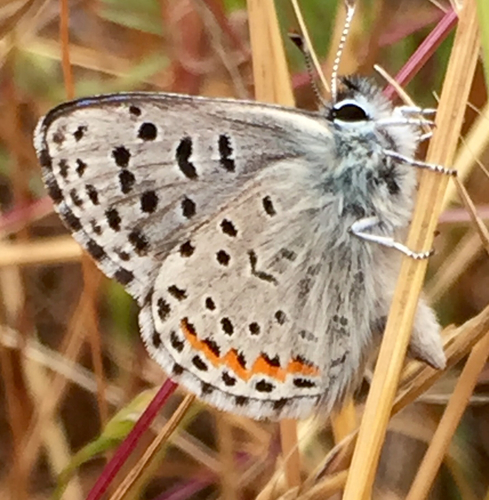
The dotted blue, Euphilotes enoptes, is a North American lycaenid blue butterfly with MONA Hodges number 4367.
Euphilotes enoptes, commonly known as the dotted blue, is a species of blue butterfly that belongs to the Polyommatinae subfamily of the Lycaenidae butterfly family. This species is found in North America. Its assigned MONA (Hodges) number is 4367. The subspecies covered here is Euphilotes enoptes ancilla, first described by Barnes & McDunnough in 1918.
View full details → 21
The dotted blue, Euphilotes enoptes, is a Polyommatinae blue butterfly found in North America with Hodges number 4367.
Euphilotes enoptes (Boisduval, 1852), commonly known as the dotted blue, is a species of blue butterfly belonging to the subfamily Polyommatinae and the family Lycaenidae. This species is native to North America, and its MONA (Hodges) reference number is 4367.
View full details → 22
Philotes pallescens Tilden & Downey, 1955
Philotes pallescens Tilden & Downey, 1955
🦋 Animalia Lycaenidae
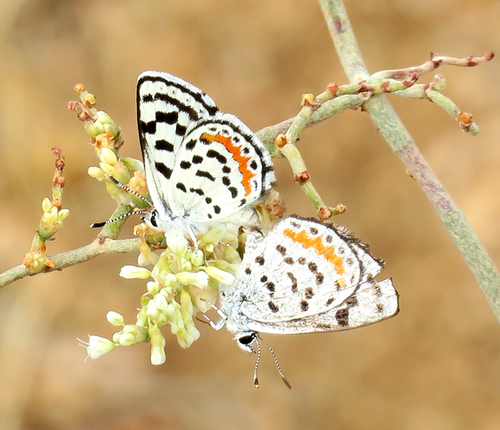
Euphilotes pallescens, the pale blue butterfly, is a Lycaenidae species found in the southwestern United States.
Euphilotes pallescens, commonly known as the pale blue, pallid blue, or pallid dotted blue, is a butterfly species belonging to the family Lycaenidae. This species is found in the United States, specifically in southeastern California, Nevada, southern Utah, and northern Arizona. Its wingspan measures between 16 and 21 mm. Adult butterflies have one generation per year and are active from July to ...
View full details → 23
Euphilotes enoptes columbiae (Mattoni, 1954)
Euphilotes enoptes columbiae (Mattoni, 1954)
🦋 Animalia Lycaenidae
The dotted blue, Euphilotes enoptes, is a Polyommatinae blue butterfly found in North America with Hodges number 4367.
Euphilotes enoptes, commonly called the dotted blue, is a species of blue butterfly belonging to the Polyommatinae subfamily of the Lycaenidae butterfly family. This butterfly species is native to North America. The MONA, also known as Hodges, number for Euphilotes enoptes is 4367. The subspecies addressed here is Euphilotes enoptes columbiae, originally described by Mattoni in 1954.
View full details → 24
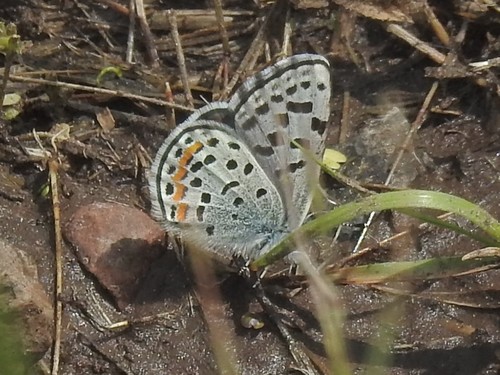
Euphilotes battoides, the square-spotted blue, is a Lycaenidae butterfly found in western North America that feeds on Eriogonum nectar.
Euphilotes battoides, commonly known as the square-spotted blue or buckwheat blue, is a species of butterfly in the family Lycaenidae. This species is distributed across western North America, ranging from California south to Baja California Norte, and extending east to southern Colorado and New Mexico. There are unconfirmed reports that it may also occur in Oregon and Washington, and further rese...
View full details → 25
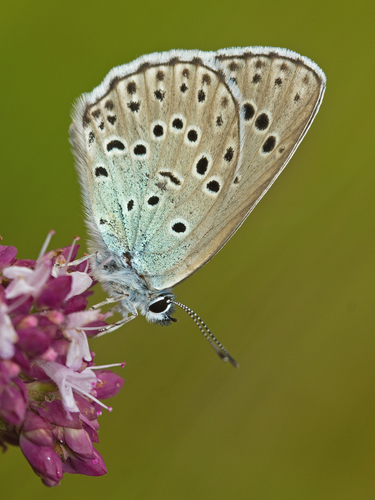
Maculinea arion, the large blue butterfly, is a large Lycaenid butterfly with specific habitat requirements across the Palearctic.
Maculinea arion, commonly known as the large blue butterfly, has caterpillars that grow to around half an inch (13 millimetres) in length. Caterpillars spend up to 9 months before undergoing metamorphosis into a chrysalis to become an adult butterfly. Large blue butterflies are among the largest members of the gossamer-winged butterfly family Lycaenidae, reaching a wingspan of up to 2 inches (51 m...
View full details → 26
Maculinea nausithous (Bergstrasser, 1779)
Maculinea nausithous (Bergstrasser, 1779)
🦋 Animalia Lycaenidae
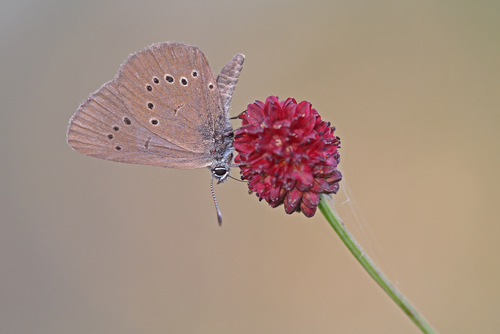
Maculinea nausithous is a butterfly species found across Central Asia with distinct wing markings that lives in damp meadows.
This description of Maculinea nausithous (Bergstrasser, 1779), also referenced as L. arcas Rott. (= erebus Knoch, 83 e) from Seitz, notes that males are similar to Maculinea euphemus, while females have entirely black-brown upper wing surfaces. The species is most easily distinguished by its coffee-brown underside, which bears only one row of ocelli. Several aberrations are recorded: ab. minor Fre...
View full details → 27
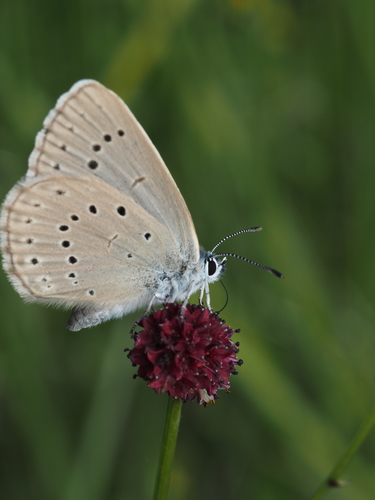
Phengaris teleius is a butterfly found across Europe (except England) and adjacent Asia, with varied forms and larvae feeding on Sanguisorba.
This species is described from Seitz as L. euphemus Hbn. (= diomedes Rott.) (83 a). Males have almost entirely blue uppersides that are not shining, with black margins, a black discocellular spot on the forewing, and commonly some small black spots on the disc. Females are much blacker, often slightly paler on the disc, and this lighter area has rows of black spots. The underside has very many oce...
View full details → 28
Maculinea alcon (Denis & Schiffermüller), 1776
Maculinea alcon (Denis & Schiffermüller), 1776
🦋 Animalia Lycaenidae
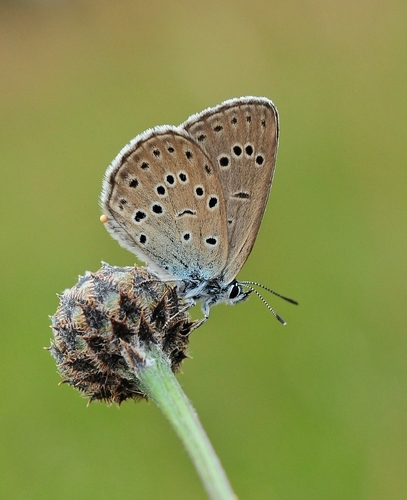
Maculinea alcon is a butterfly species found across Central Europe and North Asia that feeds only on gentian plants as a caterpillar.
This description of Maculinea alcon, originally published as L. alcon Schiff. by Seitz, notes that the species is large. Males have deep blue upper wings that lack a brilliant gloss, while females are black-brown, with dark blue dusting in the basal wing area. The dark violet-grey underside has numerous ocelli. M. alcon is easily distinguished from related species including coeligena, euphemus, ar...
View full details → 29
Pseudophilotes baton (Bergstrasser, 1779)
Pseudophilotes baton (Bergstrasser, 1779)
🦋 Animalia Lycaenidae
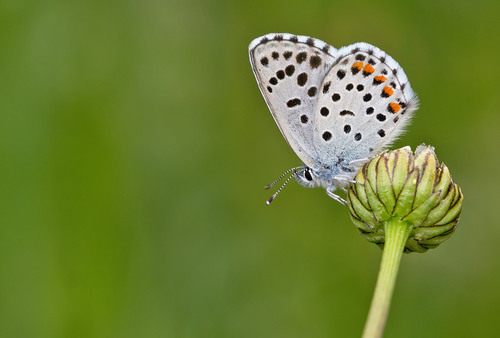
Pseudophilotes baton is a small blue butterfly found from Europe to Central Asia, with related taxa described and known larval hosts.
This is the original description of *Pseudophilotes baton*, published in Seitz. Under the synonym L. baton Bgstr. (also called amphion Esp., hylas Schiff.), the species is described as follows. The upperside is blackish; males have more or less blue dusting, the forewing has a distinct discocellular spot, and the fringes are spotted. The underside has numerous ocelli on a leaden grey ground; ocell...
View full details → 30
Pseudophilotes baton panoptes is a small blue butterfly taxon found across Eurasia and North Africa with described forms and life history details.
This entry, originally published in Seitz, describes the taxon originally named L. baton Bgstr. (synonyms: amphion Esp., hylas Schiff.) (plate 79 d). The upperside of the wings is blackish; males have more or less blue dusting, the forewing has a distinct discocellular spot, and the fringes are spotted. On the underside, there are numerous ocelli on a leaden grey background; the ocelli are larger ...
View full details →Frequently Asked Questions
How many species are in the Lycaenidae family?
This guide features 30 representative species from the Lycaenidae family. The full family contains many more species worldwide — explore them all on iNature.
How to identify Lycaenidae species?
Lycaenidae species share common features in their flowers, leaves, and growth patterns. This guide provides photos and descriptions for 30 species. For instant field identification, use the iNature app.
Sources: GBIF, iNaturalist, Wikipedia · Disclaimer
Identify any species instantly — even offline
iNature uses on-device AI to identify plants, animals, fungi and more. No internet needed.
Download iNature — FreeStart Exploring Nature Today
Download iNature for free. 10 identifications on us. No account needed. No credit card required.
Download Free on App Store
