The Amaryllidaceae (amaryllis family) produces some of spring's most beloved flowers — daffodils, snowdrops, and amaryllis — along with the entire allium group including onions, garlic, and chives. These bulbous plants are found worldwide and many contain defensive alkaloids. This guide covers the most notable species from gardens to wild habitats.
🌱 Plant Families
Amaryllis Family (Amaryllidaceae) — Species & Photos
1
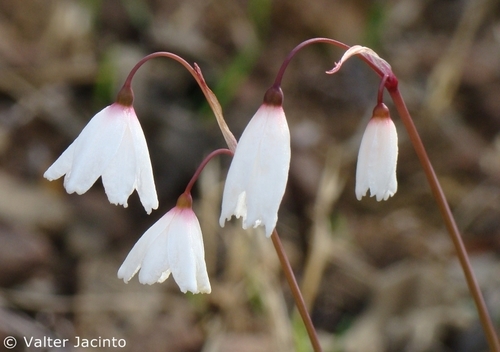
Acis autumnalis is a small Mediterranean flowering bulb widely grown as an ornamental plant.
Acis autumnalis (L.) Sweet grows to a height of about 10–15 cm (4–6 in). Its leaves are narrow, often appear to form tufts, and typically only emerge after the plant has flowered. This species flowers from late summer to autumn, producing one to four flowers per stalk, with each flower held on a long, thin pedicel. Its white tepals measure 9–14 mm long, and are pinkish at the base; less commonly, ...
⚠️ Toxicity: Insufficient toxicity evidence; avoid direct contact and ingestion.
View full details →
2
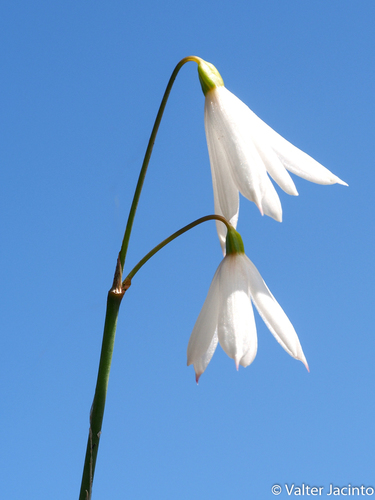
Acis trichophylla is a bulbous perennial ornamental plant native to parts of the Iberian Peninsula and Morocco.
Acis trichophylla is a bulbous perennial plant, which grows up to 30 centimetres (12 inches) tall, though it is usually shorter. Each bulb typically produces three very narrow leaves, which emerge before the flowers. Each leaf grows up to 18 centimetres (7.1 inches) long, and is at most 1 millimetre wide. Flowering occurs in late winter or early spring. The flowers are white, sometimes with pink t...
⚠️ Toxicity: Insufficient toxicity evidence; avoid direct contact and ingestion.
View full details →
3
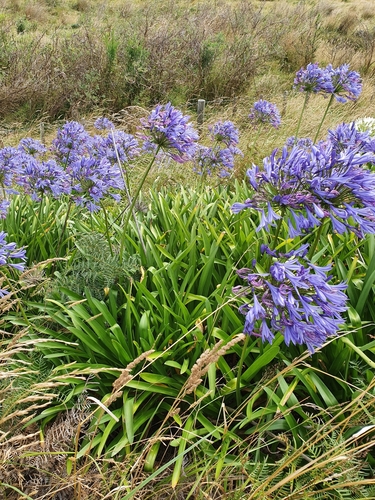
Agapanthus praecox Willd. is a long-lived perennial lily with detailed cultivation guidance outlined here.
Agapanthus praecox Willd. is a variable perennial species that can live up to 75 years, and produces open-faced flowers. It has evergreen leaves measuring 2 cm wide and 50 cm long. Its inflorescence forms an umbel, and its flowers come in blue, purple, or white. Flowers bloom from late spring to summer, after which they develop into capsules filled with black seeds. The plant’s flowering stem grow...
⚠️ Toxicity: Insufficient toxicity evidence; avoid direct contact and ingestion.
View full details →
4
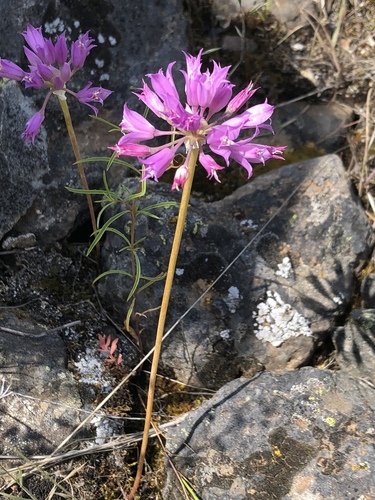
Allium acuminatum Hook. is an edible onion relative native to western North America, eaten by First Peoples of southern British Columbia.
Allium acuminatum Hook. produces spherical bulbs that are less than 2 cm across and smell like onions. Its scape reaches up to 40 cm in height, and bears an umbel containing up to 40 flowers. The flowers range in color from pink to purple, and have yellow anthers. This plant grows two or three grooved leaves, which typically wither before the plant blooms. Its native habitats are open, rocky slope...
⚠️ Toxicity: Insufficient toxicity evidence; avoid direct contact and ingestion.
View full details →
5
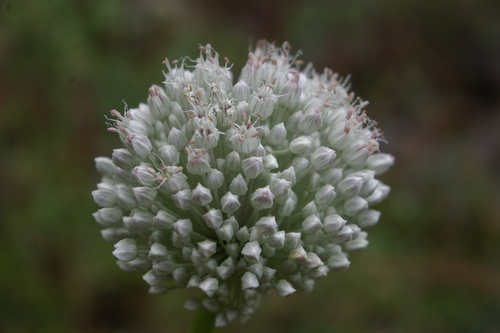
Allium ampeloprasum L. is an allium species that is the source of many common cultivated vegetables including leek and elephant garlic.
Allium ampeloprasum L. is a species of allium with the following characteristics. In wild populations, individuals produce bulbs up to 3 centimetres (1+1⁄4 inches) across. Scapes are round in cross-section, reaching up to 180 cm (71 in) tall, and each bears an umbel that can hold as many as 500 flowers. Flowers are urn-shaped, up to 6 millimetres (1⁄4 inch) across. Tepals may be white, pink, or re...
⚠️ Toxicity: Insufficient toxicity evidence; avoid direct contact and ingestion.
View full details →
6
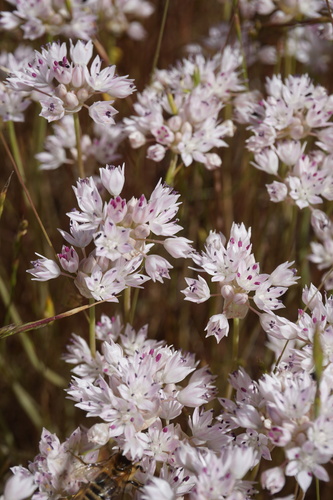
Allium amplectens Torr. is a herbaceous perennial onion with a known cultivar 'Graceful', growing to 50 cm tall and broad.
Allium amplectens Torr. is a herbaceous perennial that grows from a pinkish-brown bulb. It reaches up to 50 cm (20 in) in both height and width. It produces a bare green stem, which is topped by an inflorescence wrapped in bright pink or magenta bracts. When these bracts open, they reveal between 10 and 50 shiny white or pale pink flowers; each flower is less than one centimeter wide. Its six stou...
⚠️ Toxicity: Insufficient toxicity evidence; avoid direct contact and ingestion.
View full details →
7
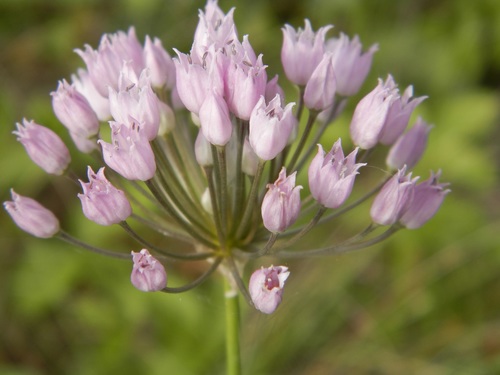
Allium angulosum (mouse garlic) is an edible perennial cultivated as ornamental and kitchen herb, native to central Europe and northern Asia.
Allium angulosum, commonly known as mouse garlic, is a species of garlic that is native to a broad area of central Europe and northern Asia, ranging from France and Italy east to Siberia and Kazakhstan. It is a perennial herb that grows up to 50 centimeters in height. Its bulbs are narrow and elongated, measuring approximately 5 millimeters in diameter. This plant produces a hemispherical umbel ma...
⚠️ Toxicity: Toxicity risk detected (mainly via ingestion); avoid direct contact and ingestion.
View full details →
8
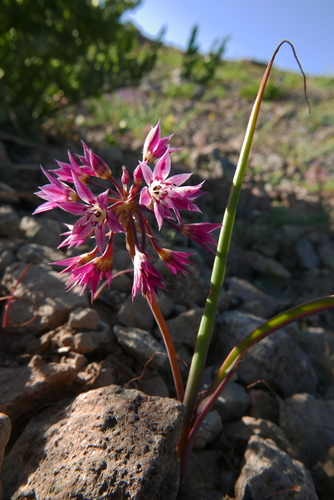
Allium campanulatum, or dusky onion, is a flowering onion species that blooms between May and August.
Allium campanulatum, commonly called dusky onion, grows from a gray-brown bulb 1 to 2 centimeters wide. This bulb may produce tiny rhizomes that grow small daughter bulblets. It has a stout stem, and usually bears two long, thin leaves that wither before its flowers bloom. An inflorescence holding 10 to 50 flowers forms at the top of the stem. Each individual flower measures 0.5 to 1 centimeter wi...
⚠️ Toxicity: Insufficient toxicity evidence; avoid direct contact and ingestion.
View full details →
9
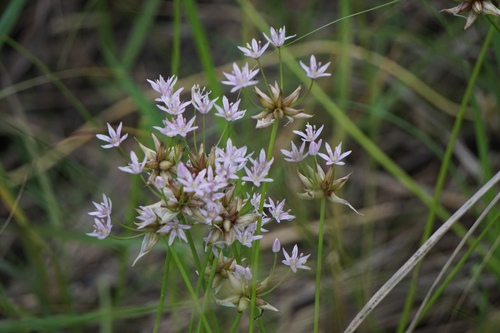
Allium canadense L., or Canada onion, is an edible onion relative with traditional culinary and medicinal uses, and some known safety risks.
Allium canadense L., commonly called Canada onion, produces an edible bulb covered in a dense layer of brown fibrous skin. The whole plant has a strong onion odor and flavor. A similar species, crow garlic (Allium vineale), has a strong garlic taste instead. Narrow, grass-like leaves grow from the base of the stem, which is topped by a dome-shaped cluster of star-shaped pink or white flowers. Thes...
⚠️ Toxicity: Insufficient toxicity evidence; avoid direct contact and ingestion.
View full details →
10
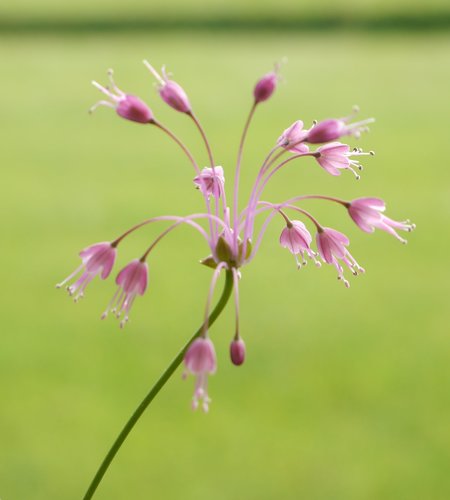
Allium carinatum L. is a flowering bulbous plant native to Europe and the Mediterranean, with cultivars awarded the RHS Award of Garden Merit.
Allium carinatum L. produces a single small bulb that is rarely more than 15 mm long, flat leaves, and an umbel of purple to reddish-purple flowers that grows up to 60 cm tall. Its flowers grow on long pedicels and are often nodding, meaning they hang downwards. This species is considered native to the Mediterranean Region, ranging from Spain to Turkey, and extends north to Sweden and the Baltic R...
⚠️ Toxicity: Insufficient toxicity evidence; avoid direct contact and ingestion.
View full details →
11
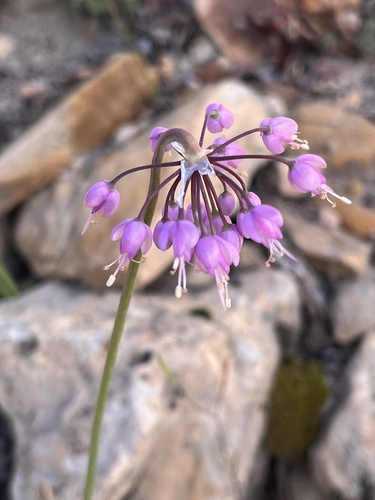
Allium cernuum Roth is a nodding-flowered edible perennial onion native to much of North America, grown ornamentally in gardens.
Allium cernuum Roth is a herbaceous perennial plant that grows from an unsheathed, elongated conical bulb. This bulb tapers gradually and directly into several keeled, thin and flat, grass-like leaves that are 2–4 millimetres (3⁄32–5⁄32 inch) wide. Each mature bulb produces a single flowering stem, which ends in a downward-nodding umbel of white or rose, bell-shaped (campanulate) flowers that bloo...
⚠️ Toxicity: Insufficient toxicity evidence; avoid direct contact and ingestion.
View full details →
12
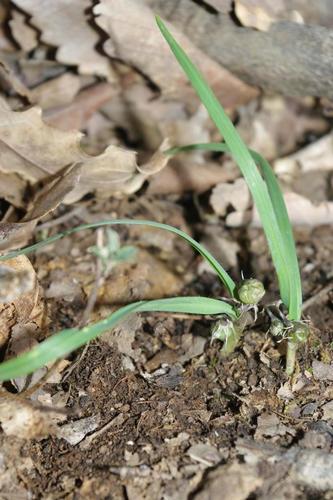
The species name Allium coloratum may refer to Allium coloratum Dulac (equivalent to Allium schoenoprasum L.) or Allium coloratum Spreng. (equivalent to Allium carinatum subsp. pulchellum).
The species name Allium coloratum can refer to two different things. Allium coloratum Dulac (nom. illeg.) is equivalent to Allium schoenoprasum L. Allium coloratum Spreng. is equivalent to Allium carinatum subsp. pulchellum (G.Don) Bonnier & Layens.
View full details → 13
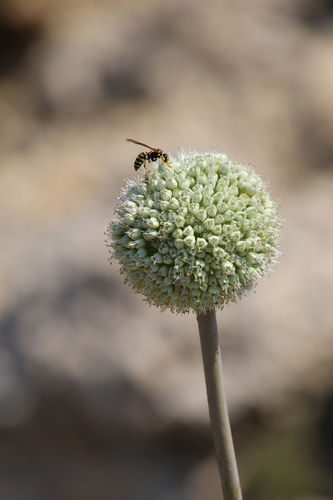
Allium commutatum is a Mediterranean amaryllis family onion species native from Corsica and Algeria to Turkey, introduced to northern Argentina.
Allium commutatum is a species of Mediterranean onion belonging to the amaryllis family. Its native range stretches from Corsica and Algeria to Turkey, and it has additionally been introduced to northern Argentina. This species typically grows on rocky slopes that overlook the Mediterranean Sea. Its bulbs are salt-resistant and buoyant, so they are very often dispersed by storms. The leaves of All...
⚠️ Toxicity: Insufficient toxicity evidence; avoid direct contact and ingestion.
View full details →
14
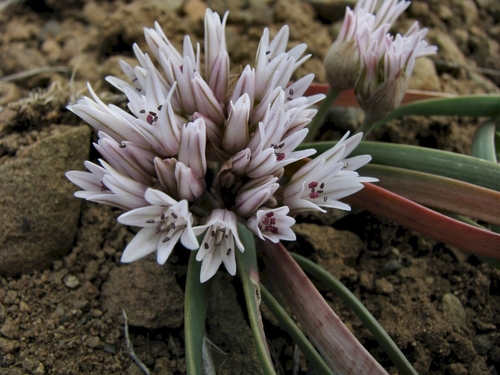
Allium crenulatum, the Olympic onion, is a bulbous plant native to the Pacific Northwest of North America that grows in mountain habitats.
Allium crenulatum, commonly known as the Olympic onion, is a plant species native to Oregon, Washington, and British Columbia. It grows in the Cascades, the Coast Ranges, the Olympic Mountains, the Wenatchee Mountains, and the mountains on Vancouver Island. There is a single unconfirmed report of this species occurring in Alabama. This onion grows on talus slopes and in alpine tundra, at elevation...
⚠️ Toxicity: Insufficient toxicity evidence; avoid direct contact and ingestion.
View full details →
15
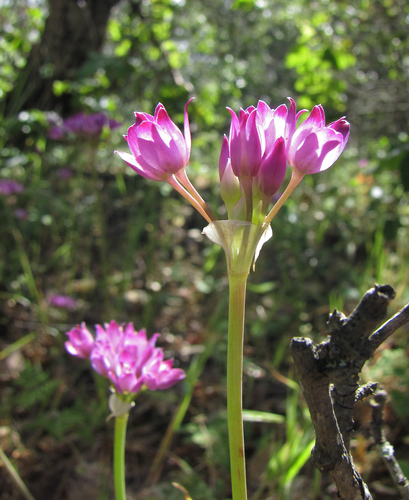
Allium dichlamydeum is a bulb-forming allium with green stems, long leaves, and bright magenta to fuchsia flowers.
Allium dichlamydeum grows from a brown or gray bulb that is 1.0 to 1.5 centimeters wide. This plant produces a stout, leafless green stem, which is surrounded by 3 to 6 long onion-like leaves. At the top of the thick stem sits an inflorescence holding 5 to 30 individual flowers. Each flower measures about one centimeter across, and has six oval tepals with dull points, that range in color from bri...
⚠️ Toxicity: Insufficient toxicity evidence; avoid direct contact and ingestion.
View full details →
16
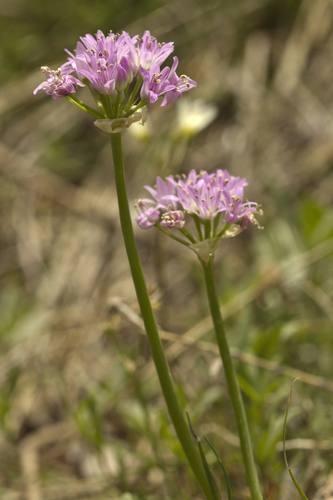
Allium drummondii, or Drummond's onion, is a North American perennial onion native to the southern Great Plains with edible bulbs that require long cooking.
Allium drummondii Regel, commonly called Drummond's onion, wild garlic, and prairie onion, is a North American onion species native to the southern Great Plains of North America. Its recorded distribution includes South Dakota, Kansas, Nebraska, Colorado, Oklahoma, Arkansas, Texas, New Mexico, and northeastern Mexico. This is a perennial plant that grows from bulbs. Its flowers bloom in April and ...
⚠️ Toxicity: Insufficient toxicity evidence; avoid direct contact and ingestion.
View full details →
17
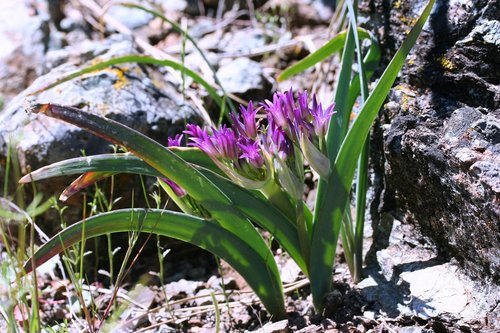
Allium falcifolium (scytheleaf onion) is a North American wild onion native to northern California and southern Oregon.
Allium falcifolium Hook. & Arn., commonly called scytheleaf onion or coast flatstem onion, is a North American wild onion species. It is native to northern California and southern Oregon, where it grows in heavy, rocky soils, particularly serpentine soils. This plant grows from a reddish-brown bulb that is 1 to 2 centimeters wide. Its reddish or yellowish-green stem is flattened, being thick at th...
⚠️ Toxicity: Insufficient toxicity evidence; avoid direct contact and ingestion.
View full details →
18
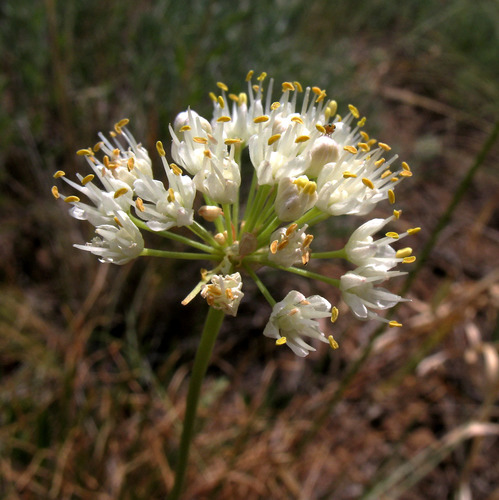
Allium flavescens Besser is a Eurasian wild onion species native to several regions from Europe to Central Asia.
Allium flavescens Besser, commonly known as Allium flavescens, is a Eurasian species of wild onion. Its native range covers Bulgaria, Romania, Ukraine, European Russia, Western Siberia, Altay Krai, and Kazakhstan.
⚠️ Toxicity: Insufficient toxicity evidence; avoid direct contact and ingestion.
View full details →
19
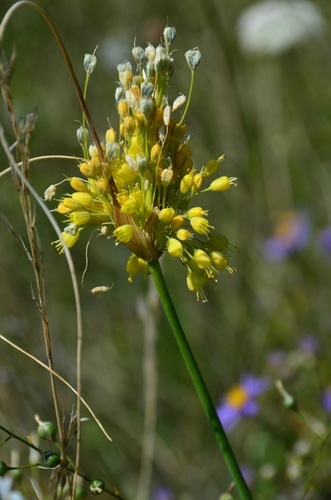
Allium flavum L. is a yellow-flowered ornamental allium that has gained the RHS Award of Garden Merit for UK cultivation.
Allium flavum L. produces a single bulb and a scape that can grow up to 40 centimeters tall. Its umbel holds bright yellow, bell-shaped flowers that have a pleasant scent. The Latin species epithet flavum means "yellow", a reference to the color of this plant's flowers. It flowers between June and July, and is hardy in USDA zones 4 through 8. When cultivated in the United Kingdom, Allium flavum ha...
⚠️ Toxicity: Insufficient toxicity evidence; avoid direct contact and ingestion.
View full details →
20
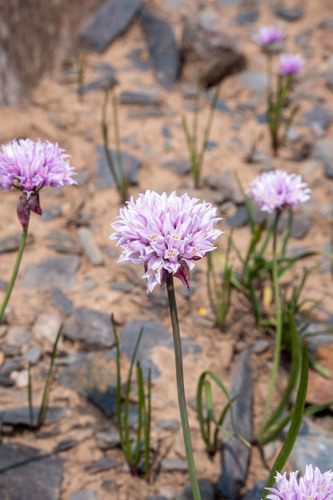
Allium geyeri is an onion species with three varieties, bulbs up to 25 mm, and pollinated by multiple bumble bee species.
Allium geyeri S.Watson, a species of onion, is divided into three accepted varieties: Allium geyeri var. chatterleyi S.L.Welsh, which is found only in the Abajo Mountains of Utah; and Allium geyeri var. geyeri and Allium geyeri var. tenerum M.E.Jones, which both occur across most of the species' full range. Allium geyeri grows narrowly elongate bulbs that reach up to 25 millimeters in length. Its ...
⚠️ Toxicity: Insufficient toxicity evidence; avoid direct contact and ingestion.
View full details →
21
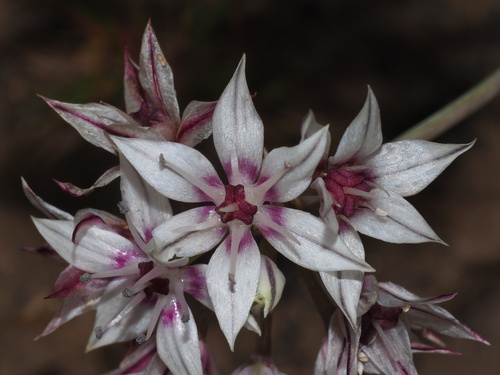
Allium haematochiton is an allium with red bulbs, green stems, curling withering leaves, and white to pink flowers with dark midveins.
Allium haematochiton produces a small rhizome that is connected to clusters of bright red bulbs. Several leafless green stems grow from these bulbs, and a small number of withering, curling leaves are present on each stem. An inflorescence holding multiple flowers sits at the top of each stem, with each flower attached by a short pedicel. Each flower is just under one centimeter wide, and its colo...
⚠️ Toxicity: Insufficient toxicity evidence; avoid direct contact and ingestion.
View full details →
22
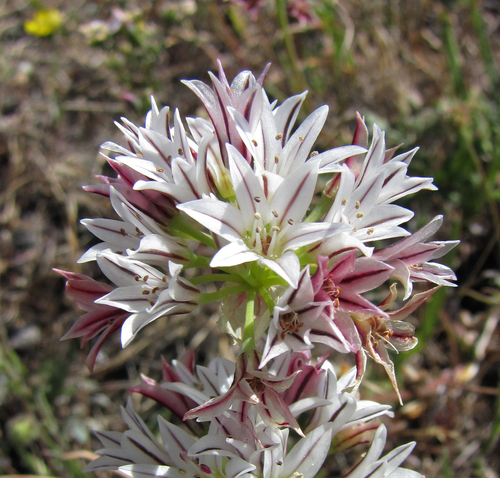
Allium lacunosum (pitted onion) is a wild onion with four varieties, three of which are uncommon, native to California, USA.
Allium lacunosum, commonly known as the pitted onion, grows from a yellowish-brown bulb with a thick coat that measures 1 to 2 centimeters long. The stem can reach a maximum height of about 35 centimeters, or 14 inches. This species typically produces two leaves, which may be the same length as the stem or longer. The inflorescence holds up to 45 flowers; the flowers have dark veins, range in colo...
⚠️ Toxicity: Insufficient toxicity evidence; avoid direct contact and ingestion.
View full details →
23
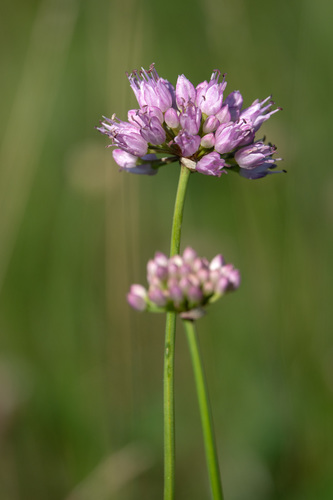
Allium lusitanicum is a bulb-forming perennial onion species widespread across most of European mountainous regions.
Allium lusitanicum Lam. is a plant species that is widespread across much of Europe, and occurs mostly in mountainous regions. It has been recorded from every European country stretching from Portugal to Ukraine, with the exceptions of Iceland, Ireland, the United Kingdom, Netherlands, Belgium, Luxembourg, Denmark, Finland, Albania and Greece. Allium lusitanicum is a bulb-forming perennial plant. ...
⚠️ Toxicity: Insufficient toxicity evidence; avoid direct contact and ingestion.
View full details →
24
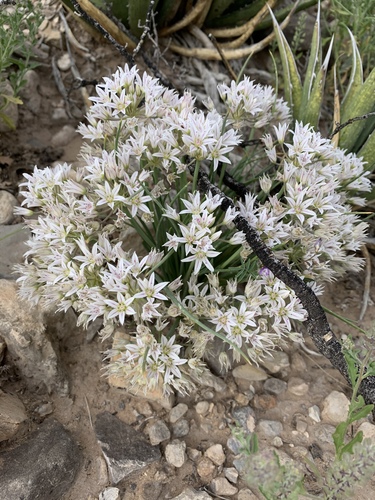
Allium macropetalum, the desert onion, is a wild onion native to southwestern US and northwestern Mexico deserts.
Allium macropetalum Rydb., commonly called the desert onion, is a species of wild onion. It is native to desert regions of the southwestern United States and northwestern Mexico. It has been recorded growing on desert plains and hills in Sonora, Arizona, Utah, Colorado, New Mexico, and Texas, at elevations reaching up to 2500 m. This species produces egg-shaped bulbs that grow up to 2.5 cm in leng...
⚠️ Toxicity: Insufficient toxicity evidence; avoid direct contact and ingestion.
View full details →
25
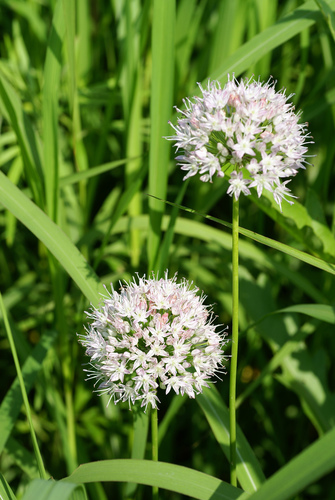
Allium macrostemon is an East Asian wild onion species recorded as an edible herb in Huangdi Neijing.
Allium macrostemon Bunge has multiple common names, including Japanese wild onion, spring onion, green onion, Chinese garlic, Japanese garlic, and long-stamen onion. It is also known by the Chinese common name 野蒜 and the Japanese common name ノビル. It is a species of wild onion that is widespread across much of East Asia. Its confirmed distribution covers many parts of China, Japan (including the Ry...
⚠️ Toxicity: Insufficient toxicity evidence; avoid direct contact and ingestion.
View full details →
26
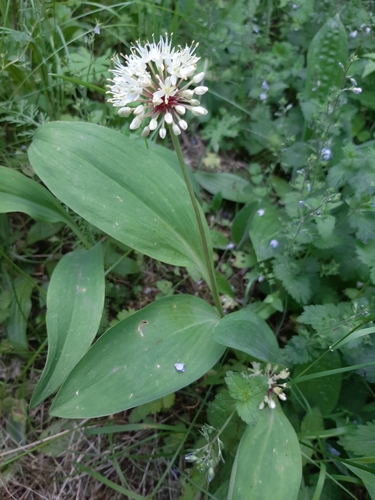
Allium microdictyon is an Amaryllidaceae flowering plant native to northeast Asia, eaten as mountain garlic by Koreans.
Allium microdictyon Prokh. is a flowering plant species that belongs to the Amaryllidaceae family. Its native range covers eastern Siberia, Mongolia, Inner Mongolia, Manchuria, Korea, and the southern parts of the Russian Far East. This species is very similar to Allium ochotense. Both Allium microdictyon and Allium ochotense are called 'mountain garlic' by Koreans, who use the leaves of these pla...
⚠️ Toxicity: Insufficient toxicity evidence; avoid direct contact and ingestion.
View full details →
27
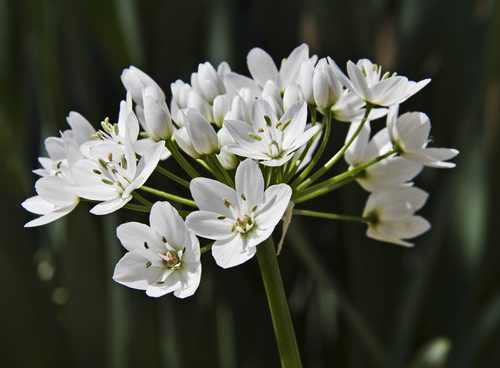
Allium neapolitanum Cirillo is a white-flowered ornamental onion native to the Mediterranean, invasive in parts of the U.S.
Allium neapolitanum Cirillo produces round bulbs that grow up to 2 cm (3⁄4 inch) across. Its scape reaches up to 25 cm (10 inches) tall, is round in cross-section, and sometimes develops wings toward its base. The inflorescence forms an umbel holding up to 25 white flowers with yellow anthers. This species appears to have beta-adrenergic antagonist properties. Its native range spans the Mediterran...
⚠️ Toxicity: Insufficient toxicity evidence; avoid direct contact and ingestion.
View full details →
28
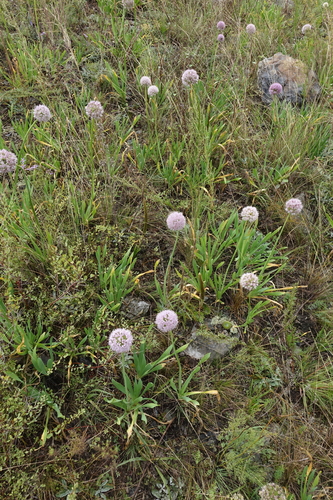
Allium nutans, or Siberian/blue chives, is an onion species native to central and north Asia and eastern Europe that grows in damp places.
Allium nutans, commonly known in English as Siberian chives or blue chives, is a species of onion. It is native to European Russia, Kazakhstan, Mongolia, Tibet, Xinjiang, and Asiatic Russia, specifically the regions of Altay Krai, Krasnoyarsk, Tuva, Western Siberia, and Amur Oblast. It grows in wet meadows and other damp locations. This species produces one or two bulbs, reaching 1.5 to 2.0 cm (5⁄...
⚠️ Toxicity: Insufficient toxicity evidence; avoid direct contact and ingestion.
View full details →
29
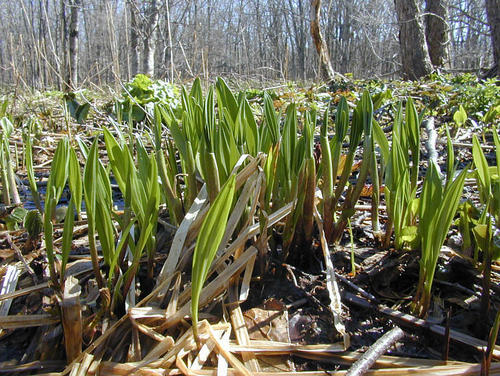
Allium ochotense Prokh. is a strong garlic-scented wild onion distributed across Northeast Asia, with limited cultivation in Japan.
Allium ochotense Prokh. grows 20–30 cm (8–12 in) tall, has a strong garlic-like odor considered more intense than that of true garlic, linked to allicin content. Its bulbs are surrounded by a grayish-brown, netlike coating. It produces 1–3 glabrous, broadly elliptic leaves, and its whitish-green perianth forms the plant's flowers. This is a slow-growing species. It can reproduce by seed, and like ...
⚠️ Toxicity: Insufficient toxicity evidence; avoid direct contact and ingestion.
View full details →
30
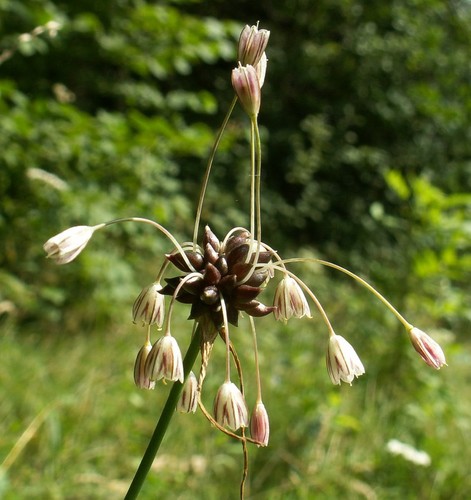
Allium oleraceum L. is a bulbous flowering plant widespread in Europe, with limited naturalization in North America and declining coastal populations.
Allium oleraceum L. grows to a height of approximately 12 inches (30 cm). Its underground bulb reaches up to 0.8 inches (2 cm) in diameter. The main stem is usually rounded, though it is occasionally flattened, and it bears two to four leaves plus a terminal inflorescence. This inflorescence is made up of several small, stalked, pinkish-brown flowers, and sometimes also contains a few bulblets. Th...
⚠️ Toxicity: Insufficient toxicity evidence; avoid direct contact and ingestion.
View full details →
Frequently Asked Questions
How many species are in the Amaryllidaceae family?
This guide features 30 representative species from the Amaryllidaceae family. The full family contains many more species worldwide — explore them all on iNature.
How to identify Amaryllidaceae species?
Amaryllidaceae species share common features in their flowers, leaves, and growth patterns. This guide provides photos and descriptions for 30 species. For instant field identification, use the iNature app.
Sources: GBIF, iNaturalist, Wikipedia · Disclaimer
Identify any species instantly — even offline
iNature uses on-device AI to identify plants, animals, fungi and more. No internet needed.
Download iNature — FreeStart Exploring Nature Today
Download iNature for free. 10 identifications on us. No account needed. No credit card required.
Download Free on App Store
